
إدارة فقرات نص PowerPoint في بايثون
نظرة عامة
Aspose.Slides for Python عبر .NET تمثّل النص كهرمية تتكوّن من إطارات النص، الفقرات، والأجزاء:
- TextFrame يمثل حاوية النص داخل الشكل ويوفر إمكانية الوصول إلى مجموعة الفقرات الخاصة به.
- Paragraph يمثل فقرة واحدة داخل إطار النص ويوفر إمكانية الوصول إلى أجزائه وتنسيق مستوى الفقرة.
- Portion يمثل مجموعة نصية داخل الفقرة. يمكن لكل جزء أن يحتوي على نصه الخاص وتنسيق مستوى الحرف.
وبالتالي يمكن للفقرة أن تحتوي على نص بخطوط، ألوان، أحجام، وتنسيقات أخرى مختلفة باستخدام أجزاء متعددة.
إنشاء وتنسيق الفقرات
إنشاء فقرات مع عدة أجزاء
الخطوات التالية تنشئ إطار نص يحتوي على ثلاث فقرات، كل فقرة تحتوي على ثلاثة أجزاء:
- إنشاء مثيل من الفئة Presentation.
- الوصول إلى الشريحة المعنية عبر الفهرس الخاص بها.
- إضافة AutoShape مستطيلة إلى الشريحة.
- الوصول إلى TextFrame الخاص بالشكل.
- استخدام الفقرة الافتراضية وإضافة كائنين إضافيين من نوع Paragraph إلى إطار النص.
- إضافة عدد كافٍ من كائنات Portion لكل فقرة لتحتوي على ثلاثة أجزاء. الفقرة الافتراضية تحتوي بالفعل على جزء فارغ واحد.
- تعيين النص لكل جزء.
- تطبيق تنسيق مستوى الحرف عبر Portion.portion_format.
- حفظ العرض التقديمي المعدّل.
import aspose.pydrawing as draw
import aspose.slides as slides

with slides.Presentation() as presentation:
    slide = presentation.slides[0]
    shape = slide.shapes.add_auto_shape(slides.ShapeType.RECTANGLE, 50, 150, 300, 150)
    text_frame = shape.text_frame

    first_paragraph = text_frame.paragraphs[0]
    first_paragraph.portions.add(slides.Portion())
    first_paragraph.portions.add(slides.Portion())

    second_paragraph = slides.Paragraph()
    second_paragraph.portions.add(slides.Portion())
    second_paragraph.portions.add(slides.Portion())
    second_paragraph.portions.add(slides.Portion())
    text_frame.paragraphs.add(second_paragraph)

    third_paragraph = slides.Paragraph()
    third_paragraph.portions.add(slides.Portion())
    third_paragraph.portions.add(slides.Portion())
    third_paragraph.portions.add(slides.Portion())
    text_frame.paragraphs.add(third_paragraph)

    for paragraph_index in range(text_frame.paragraphs.count):
        paragraph = text_frame.paragraphs[paragraph_index]
        for portion_index in range(paragraph.portions.count):
            portion = paragraph.portions[portion_index]
            portion.text = f"Portion {paragraph_index + 1}.{portion_index + 1}"

            if portion_index == 0:
                portion.portion_format.fill_format.fill_type = slides.FillType.SOLID
                portion.portion_format.fill_format.solid_fill_color.color = draw.Color.red
                portion.portion_format.font_bold = slides.NullableBool.TRUE
                portion.portion_format.font_height = 15
            elif portion_index == 1:
                portion.portion_format.fill_format.fill_type = slides.FillType.SOLID
                portion.portion_format.fill_format.solid_fill_color.color = draw.Color.blue
                portion.portion_format.font_italic = slides.NullableBool.TRUE
                portion.portion_format.font_height = 18

    presentation.save("paragraphs_with_portions.pptx", slides.export.SaveFormat.PPTX)
إنشاء قوائم نقطية ومرتبة
إنشاء قائمة نقطية أو مرتبة
تجعل القوائم النقطية والمرتبة العناصر المرتبطة أسهل في القراءة. في Aspose.Slides، يتم تعريف إعدادات القائمة عبر BulletFormat.
- إنشاء مثيل من الفئة Presentation.
- الوصول إلى الشريحة المعنية عبر الفهرس الخاص بها.
- إضافة AutoShape إلى الشريحة المختارة.
- الوصول إلى TextFrame الخاص بالشكل.
- إزالة الفقرة الافتراضية من إطار النص.
- إنشاء Paragraph لرمز نقطة.
- تعيين BulletFormat.type إلى BulletType.SYMBOL وتحديد حرف النقطة.
- تعيين نص الفقرة، والمسافة البادئة، ولون النقطة، وارتفاع النقطة.
- إضافة الفقرة إلى إطار النص.
- إنشاء فقرة ثانية وتعيين BulletFormat.type إلى BulletType.NUMBERED.
- تهيئة نمط النقطة المرتبة وإضافة الفقرة إلى إطار النص.
- حفظ العرض التقديمي.
import aspose.pydrawing as draw
import aspose.slides as slides

with slides.Presentation() as presentation:
    slide = presentation.slides[0]
    shape = slide.shapes.add_auto_shape(slides.ShapeType.RECTANGLE, 200, 200, 400, 200)
    text_frame = shape.text_frame
    text_frame.paragraphs.clear()

    symbol_paragraph = slides.Paragraph()
    symbol_paragraph.text = "Welcome to Aspose.Slides"
    symbol_paragraph.paragraph_format.bullet.type = slides.BulletType.SYMBOL
    symbol_paragraph.paragraph_format.bullet.char = chr(0x2022)
    symbol_paragraph.paragraph_format.indent = 25
    symbol_paragraph.paragraph_format.bullet.color.color_type = slides.ColorType.RGB
    symbol_paragraph.paragraph_format.bullet.color.color = draw.Color.black
    symbol_paragraph.paragraph_format.bullet.is_bullet_hard_color = slides.NullableBool.TRUE
    symbol_paragraph.paragraph_format.bullet.height = 100
    text_frame.paragraphs.add(symbol_paragraph)

    numbered_paragraph = slides.Paragraph()
    numbered_paragraph.text = "This is a numbered item"
    numbered_paragraph.paragraph_format.bullet.type = slides.BulletType.NUMBERED
    numbered_paragraph.paragraph_format.bullet.numbered_bullet_style = slides.NumberedBulletStyle.BULLET_CIRCLE_NUM_WD_BLACK_PLAIN
    numbered_paragraph.paragraph_format.indent = 25
    numbered_paragraph.paragraph_format.bullet.color.color_type = slides.ColorType.RGB
    numbered_paragraph.paragraph_format.bullet.color.color = draw.Color.black
    numbered_paragraph.paragraph_format.bullet.is_bullet_hard_color = slides.NullableBool.TRUE
    numbered_paragraph.paragraph_format.bullet.height = 100
    text_frame.paragraphs.add(numbered_paragraph)

    presentation.save("bulleted_and_numbered_list.pptx", slides.export.SaveFormat.PPTX)
استخدام نقاط صورة
استخدام نقاط صورة يتيح لك استبدال الرمز أو الرقم بصورة مخصصة.
- إنشاء مثيل من الفئة Presentation.
- الوصول إلى الشريحة المعنية عبر الفهرس الخاص بها.
- إضافة AutoShape والوصول إلى TextFrame الخاص به.
- إزالة الفقرة الافتراضية من إطار النص.
- تحميل صورة النقطة وإضافتها إلى مجموعة الصور في العرض التقديمي ككائن PPImage.
- إنشاء Paragraph وتعيين نصه.
- تعيين BulletFormat.type إلى BulletType.PICTURE.
- تعيين الصورة عبر BulletFormat.picture وتحديد ارتفاع النقطة.
- إضافة الفقرة إلى إطار النص.
- حفظ العرض التقديمي المعدّل.
import aspose.slides as slides

with slides.Presentation() as presentation:
    slide = presentation.slides[0]

    with slides.Images.from_file("bullets.png") as bullet_image:
        presentation_image = presentation.images.add_image(bullet_image)

    shape = slide.shapes.add_auto_shape(slides.ShapeType.RECTANGLE, 200, 200, 400, 200)
    text_frame = shape.text_frame
    text_frame.paragraphs.clear()

    paragraph = slides.Paragraph()
    paragraph.text = "Welcome to Aspose.Slides"
    paragraph.paragraph_format.bullet.type = slides.BulletType.PICTURE
    paragraph.paragraph_format.bullet.picture.image = presentation_image
    paragraph.paragraph_format.bullet.height = 100
    text_frame.paragraphs.add(paragraph)

    presentation.save("picture_bullet.pptx", slides.export.SaveFormat.PPTX)
    presentation.save("picture_bullet.ppt", slides.export.SaveFormat.PPT)
إنشاء قائمة متعددة المستويات
قم بتعيين ParagraphFormat.depth لوضع الفقرات في مستويات مختلفة من القائمة. المستوى الأعلى له عمق يساوي 0.
- إنشاء Presentation والوصول إلى شريحة.
- إضافة AutoShape ومحو الفقرة الافتراضية من إطار النص الخاص به.
- إنشاء أربع فقرات وتكوين رموز النقاط الخاصة بها.
- تعيين قيم ParagraphFormat.depth الخاصة بها إلى
0،1،2، و3. - إضافة الفقرات إلى إطار النص وحفظ العرض التقديمي.
import aspose.pydrawing as draw
import aspose.slides as slides

with slides.Presentation() as presentation:
    slide = presentation.slides[0]
    shape = slide.shapes.add_auto_shape(slides.ShapeType.RECTANGLE, 200, 200, 400, 200)
    text_frame = shape.text_frame
    text_frame.paragraphs.clear()

    first_paragraph = slides.Paragraph()
    first_paragraph.text = "Content"
    first_paragraph.paragraph_format.bullet.type = slides.BulletType.SYMBOL
    first_paragraph.paragraph_format.bullet.char = chr(0x2022)
    first_paragraph.paragraph_format.default_portion_format.fill_format.fill_type = slides.FillType.SOLID
    first_paragraph.paragraph_format.default_portion_format.fill_format.solid_fill_color.color = draw.Color.black
    first_paragraph.paragraph_format.depth = 0

    second_paragraph = slides.Paragraph()
    second_paragraph.text = "Second level"
    second_paragraph.paragraph_format.bullet.type = slides.BulletType.SYMBOL
    second_paragraph.paragraph_format.bullet.char = "-"
    second_paragraph.paragraph_format.default_portion_format.fill_format.fill_type = slides.FillType.SOLID
    second_paragraph.paragraph_format.default_portion_format.fill_format.solid_fill_color.color = draw.Color.black
    second_paragraph.paragraph_format.depth = 1

    third_paragraph = slides.Paragraph()
    third_paragraph.text = "Third level"
    third_paragraph.paragraph_format.bullet.type = slides.BulletType.SYMBOL
    third_paragraph.paragraph_format.bullet.char = chr(0x2022)
    third_paragraph.paragraph_format.default_portion_format.fill_format.fill_type = slides.FillType.SOLID
    third_paragraph.paragraph_format.default_portion_format.fill_format.solid_fill_color.color = draw.Color.black
    third_paragraph.paragraph_format.depth = 2

    fourth_paragraph = slides.Paragraph()
    fourth_paragraph.text = "Fourth level"
    fourth_paragraph.paragraph_format.bullet.type = slides.BulletType.SYMBOL
    fourth_paragraph.paragraph_format.bullet.char = "-"
    fourth_paragraph.paragraph_format.default_portion_format.fill_format.fill_type = slides.FillType.SOLID
    fourth_paragraph.paragraph_format.default_portion_format.fill_format.solid_fill_color.color = draw.Color.black
    fourth_paragraph.paragraph_format.depth = 3

    text_frame.paragraphs.add(first_paragraph)
    text_frame.paragraphs.add(second_paragraph)
    text_frame.paragraphs.add(third_paragraph)
    text_frame.paragraphs.add(fourth_paragraph)

    presentation.save("multilevel_list.pptx", slides.export.SaveFormat.PPTX)
بدء عناصر القائمة المرتبة بقيم مخصصة
استخدم BulletFormat.numbered_bullet_start_with لتعيين الرقم الأولي المعروض لفقرة مرتبة.
- إنشاء Presentation وإضافة AutoShape إلى شريحة.
- مسح الفقرة الافتراضية من إطار النص الخاص بالشكل.
- إنشاء ثلاث فقرات مرتبة.
- تعيين BulletFormat.numbered_bullet_start_with إلى
2،3، و7للفقرات المعنية. - إضافة الفقرات إلى إطار النص وحفظ العرض التقديمي.
import aspose.slides as slides

with slides.Presentation() as presentation:
    slide = presentation.slides[0]
    shape = slide.shapes.add_auto_shape(slides.ShapeType.RECTANGLE, 200, 200, 400, 200)
    text_frame = shape.text_frame
    text_frame.paragraphs.clear()

    first_paragraph = slides.Paragraph()
    first_paragraph.text = "Start at 2"
    first_paragraph.paragraph_format.bullet.type = slides.BulletType.NUMBERED
    first_paragraph.paragraph_format.bullet.numbered_bullet_start_with = 2
    text_frame.paragraphs.add(first_paragraph)

    second_paragraph = slides.Paragraph()
    second_paragraph.text = "Start at 3"
    second_paragraph.paragraph_format.bullet.type = slides.BulletType.NUMBERED
    second_paragraph.paragraph_format.bullet.numbered_bullet_start_with = 3
    text_frame.paragraphs.add(second_paragraph)

    third_paragraph = slides.Paragraph()
    third_paragraph.text = "Start at 7"
    third_paragraph.paragraph_format.bullet.type = slides.BulletType.NUMBERED
    third_paragraph.paragraph_format.bullet.numbered_bullet_start_with = 7
    text_frame.paragraphs.add(third_paragraph)

    presentation.save("custom_numbered_list.pptx", slides.export.SaveFormat.PPTX)
التحكم في تنسيق الفقرة وخصائص النهاية
تعيين مسافة بادئة للسطر الأول
استخدم خاصية ParagraphFormat.indent للتحكم في المسافة البادئة للسطر الأول في الفقرة. هذه الخاصية تحرك السطر الأول فقط بالنسبة إلى الهامش الأيسر للفقرة. القيمة الموجبة تُحرك السطر الأول إلى اليمين، بينما تبقى الأسطر الأخرى محاذية مع جسم الفقرة.
استخدم ParagraphFormat.margin_left عندما تحتاج إلى نقل الفقرة بأكملها. استخدم ParagraphFormat.indent عندما تحتاج إلى نقل السطر الأول فقط.
المثال أدناه ينشئ عدة فقرات ويطبق قيم مختلفة لـ ParagraphFormat.indent لتوضيح كيفية تأثير المسافة البادئة للسطر الأول على تنسيق الفقرة.
- إنشاء مثيل من الفئة Presentation.
- الوصول إلى الشريحة المستهدفة.
- إضافة AutoShape مستطيلة إلى الشريحة.
- الوصول إلى TextFrame الخاص بالشكل وإزالة الفقرة الافتراضية.
- إنشاء عدة فقرات وتعيين قيم مختلفة لـ ParagraphFormat.indent لكل منها.
- إضافة الفقرات إلى إطار النص.
- حفظ العرض التقديمي المعدّل.
import aspose.pydrawing as draw
import aspose.slides as slides

with slides.Presentation() as presentation:
    slide = presentation.slides[0]
    shape = slide.shapes.add_auto_shape(slides.ShapeType.RECTANGLE, 50, 50, 420, 220)
    shape.fill_format.fill_type = slides.FillType.NO_FILL
    shape.line_format.fill_format.fill_type = slides.FillType.SOLID
    shape.line_format.fill_format.solid_fill_color.color = draw.Color.gray

    text_frame = shape.text_frame
    text_frame.text_frame_format.autofit_type = slides.TextAutofitType.SHAPE
    text_frame.paragraphs.clear()

    first_paragraph = slides.Paragraph()
    first_paragraph.text = "No first-line indent. Wrapped lines start at the same position as the first line."
    first_paragraph.paragraph_format.default_portion_format.fill_format.fill_type = slides.FillType.SOLID
    first_paragraph.paragraph_format.default_portion_format.fill_format.solid_fill_color.color = draw.Color.black
    first_paragraph.paragraph_format.margin_left = 20
    first_paragraph.paragraph_format.indent = 0

    second_paragraph = slides.Paragraph()
    second_paragraph.text = "First-line indent of 20 points. The first line moves to the right, while wrapped lines remain aligned to the paragraph body."
    second_paragraph.paragraph_format.default_portion_format.fill_format.fill_type = slides.FillType.SOLID
    second_paragraph.paragraph_format.default_portion_format.fill_format.solid_fill_color.color = draw.Color.black
    second_paragraph.paragraph_format.margin_left = 20
    second_paragraph.paragraph_format.indent = 20

    third_paragraph = slides.Paragraph()
    third_paragraph.text = "First-line indent of 40 points. This paragraph shows a larger first-line offset to make the effect easier to see."
    third_paragraph.paragraph_format.default_portion_format.fill_format.fill_type = slides.FillType.SOLID
    third_paragraph.paragraph_format.default_portion_format.fill_format.solid_fill_color.color = draw.Color.black
    third_paragraph.paragraph_format.margin_left = 20
    third_paragraph.paragraph_format.indent = 40

    text_frame.paragraphs.add(first_paragraph)
    text_frame.paragraphs.add(second_paragraph)
    text_frame.paragraphs.add(third_paragraph)

    presentation.save("paragraph_indent.pptx", slides.export.SaveFormat.PPTX)
النتيجة:

تعيين مسافة بادئة معلقة
المسافة البادئة المعلقة هي تنسيق فقرة يكون فيه السطر الأول يبدأ إلى اليسار من بقية الأسطر. في Aspose.Slides، تُنشئ هذا التأثير باستخدام خاصية ParagraphFormat.indent. عيّن indent إلى قيمة سالبة لتحريك السطر الأول إلى اليسار نسبياً إلى جسم الفقرة.
عملياً، يحدد ParagraphFormat.margin_left موضع جسم الفقرة على اليسار، وتحدد ParagraphFormat.indent موضع السطر الأول بالنسبة إلى ذلك الهامش. لإنشاء مسافة بادئة معلقة، عيّن قيمة margin_left موجبة وقيمة indent سالبة.
هذا التنسيق مفيد للمراجع، الببليوغرافيات، مداخل القواميس، وغيرها من الفقرات التي يجب أن تكون الأسطر الملتفة محاذية تحت جسم الفقرة بدلاً من الحرف الأول للسطر الأول.
- إنشاء مثيل من الفئة Presentation.
- الوصول إلى الشريحة المستهدفة.
- إضافة AutoShape مستطيلة إلى الشريحة.
- الوصول إلى TextFrame الخاص بالشكل وإزالة الفقرة الافتراضية.
- إنشاء فقرات وتعيين قيمة موجبة لـ ParagraphFormat.margin_left لكل فقرة.
- تعيين قيمة سالبة لـ ParagraphFormat.indent لإنشاء تأثير المسافة البادئة المعلقة.
- إضافة الفقرات إلى إطار النص.
- حفظ العرض التقديمي المعدّل.
import aspose.pydrawing as draw
import aspose.slides as slides

with slides.Presentation() as presentation:
    slide = presentation.slides[0]
    shape = slide.shapes.add_auto_shape(slides.ShapeType.RECTANGLE, 50, 50, 420, 220)
    shape.fill_format.fill_type = slides.FillType.NO_FILL
    shape.line_format.fill_format.fill_type = slides.FillType.SOLID
    shape.line_format.fill_format.solid_fill_color.color = draw.Color.gray

    text_frame = shape.text_frame
    text_frame.text_frame_format.autofit_type = slides.TextAutofitType.SHAPE
    text_frame.paragraphs.clear()

    first_paragraph = slides.Paragraph()
    first_paragraph.text = "A hanging indent is created by combining a positive left margin with a negative indent. The first line starts to the left, while wrapped lines align with the paragraph body."
    first_paragraph.paragraph_format.default_portion_format.fill_format.fill_type = slides.FillType.SOLID
    first_paragraph.paragraph_format.default_portion_format.fill_format.solid_fill_color.color = draw.Color.black
    first_paragraph.paragraph_format.margin_left = 40
    first_paragraph.paragraph_format.indent = -20

    second_paragraph = slides.Paragraph()
    second_paragraph.text = "This second example uses a deeper hanging indent so the difference between the first line and the wrapped lines is easier to compare."
    second_paragraph.paragraph_format.default_portion_format.fill_format.fill_type = slides.FillType.SOLID
    second_paragraph.paragraph_format.default_portion_format.fill_format.solid_fill_color.color = draw.Color.black
    second_paragraph.paragraph_format.margin_left = 60
    second_paragraph.paragraph_format.indent = -30

    text_frame.paragraphs.add(first_paragraph)
    text_frame.paragraphs.add(second_paragraph)

    presentation.save("hanging_indent.pptx", slides.export.SaveFormat.PPTX)
النتيجة:

تعيين خصائص تشغيل نهاية الفقرة
خاصية Paragraph.end_paragraph_portion_format تتحكم في تنسيق علامة نهاية الفقرة. المثال التالي يعيّن حجم خط وخط لاتيني لعلامة النهاية في الفقرة الثانية:
- تحميل Presentation والوصول إلى شريحة.
- إضافة AutoShape ومسح الفقرة الافتراضية الخاصة به.
- إنشاء فقرتين وإضافة أجزاء نصية لهما.
- إنشاء PortionFormat لعلامة النهاية في الفقرة الثانية.
- تعيين PortionFormat.font_height وPortionFormat.latin_font.
- إلحاق التنسيق بـ Paragraph.end_paragraph_portion_format وحفظ العرض التقديمي.
import aspose.slides as slides

with slides.Presentation("Test.pptx") as presentation:
    slide = presentation.slides[0]
    shape = slide.shapes.add_auto_shape(slides.ShapeType.RECTANGLE, 10, 10, 200, 250)
    text_frame = shape.text_frame
    text_frame.paragraphs.clear()

    first_paragraph = slides.Paragraph()
    first_paragraph.portions.add(slides.Portion("Sample text"))

    second_paragraph = slides.Paragraph()
    second_paragraph.portions.add(slides.Portion("Sample text 2"))

    end_paragraph_format = slides.PortionFormat()
    end_paragraph_format.font_height = 48
    end_paragraph_format.latin_font = slides.FontData("Times New Roman")
    second_paragraph.end_paragraph_portion_format = end_paragraph_format

    text_frame.paragraphs.add(first_paragraph)
    text_frame.paragraphs.add(second_paragraph)

    presentation.save("end_paragraph_format.pptx", slides.export.SaveFormat.PPTX)
عدد الأسطر المُعرضة
للقواعد المتعلقة بالفقرات والتي تؤثر على الالتفاف التلقائي وعلامات الترقيم عند نهايات السطر، راجع التحكم في كسر السطر والتحكم في الوقف المعلق.
استخدم Paragraph.get_lines_count لحساب عدد الأسطر التي يشغلها النص داخل الفقرة بعد ترتيب النص، بما في ذلك الالتفاف التلقائي. هذا مفيد عند فحص طول النص وتنسيقه في قوالب العروض التقديمية.
الفقرة هي عنصر واحد في TextFrame.paragraphs، ويمكنها أن تحتل عدة أسطر مُعرضة. كسر السطر الصريح داخل الفقرة يُجبر على سطر جديد دون إنشاء فقرة أخرى. الالتفاف التلقائي ينشئ أسطراً بناءً على العرض المتاح دون إدخال فواصل سطر صريحة في النص. لذلك لا يعطي عدّ الفقرات أو أحرف كسر السطر عدد الأسطر المُعرضة.
المثال التالي ينشئ شكل نص، يحسب أسطره، يضيق الشكل، ثم يستبدل النص بسلسلة أقصر. تم تمكين الالتفاف وتعطيل الضبط التلقائي بحيث يتحكم عرض الشكل في الالتفاف دون تقليص النص أو تغيير حجم الشكل تلقائياً. أبعاد الشكل بوحدات النقاط. أخيراً، يضيف المثال فقرة أخرى ويجمع عدد الأسطر عبر إطار النص.
import aspose.slides as slides

with slides.Presentation() as presentation:
    slide = presentation.slides[0]

    shape = slide.shapes.add_auto_shape(slides.ShapeType.RECTANGLE, 50, 50, 400, 200)
    text_frame = shape.text_frame
    text_frame.text_frame_format.wrap_text = slides.NullableBool.TRUE
    text_frame.text_frame_format.autofit_type = slides.TextAutofitType.NONE

    paragraph = text_frame.paragraphs[0]
    paragraph.paragraph_format.default_portion_format.font_height = 20
    paragraph.text = "This text demonstrates how automatic wrapping changes the number of rendered lines."
    print(f"Original width: {paragraph.get_lines_count()}")

    shape.width = 150
    print(f"Narrower shape: {paragraph.get_lines_count()}")

    paragraph.text = "Short text."
    print(f"Shorter text: {paragraph.get_lines_count()}")

    second_paragraph = slides.Paragraph()
    second_paragraph.text = "Another paragraph."
    second_paragraph.paragraph_format.default_portion_format.font_height = 20
    text_frame.paragraphs.add(second_paragraph)

    total_line_count = 0
    for current_paragraph in text_frame.paragraphs:
        total_line_count += current_paragraph.get_lines_count()
    print(f"Total lines in the text frame: {total_line_count}")
مع هذا النص وهذه الأبعاد، يؤدي تضييق الشكل إلى زيادة عدد الأسطر، بينما يؤدي استبدال النص بالسلسلة القصيرة إلى تقليله. قد تختلف الأعداد الدقيقة بحسب توفر الخطوط والاستبدال، حجم الخط، الهوامش، المسافة البادئة، الالتفاف، وإعدادات الضبط التلقائي. استخدم الخطوط وإعدادات التخطيط المقصودة للبيئة المستهدفة عند فحص القالب.
عدد الأسطر وحده لا يحدّد ما إذا كان النص سيتجاوز حاويته. الارتفاع المتاح، ارتفاع الأسطر، تباعد الفقرة والسطر، وسلوك الضبط التلقائي أيضاً مهم؛ حتى سطر واحد قد يتجاوز العرض المتاح إذا كان الالتفاف معطلاً.
استيراد وتصدير محتوى الفقرة
استيراد نص HTML إلى الفقرات
استخدم ParagraphCollection.add_from_html لتحويل ترميز HTML إلى فقرات وأجزاء داخل إطار نص.
- إنشاء مثيل من الفئة Presentation.
- الوصول إلى شريحة وإضافة AutoShape.
- الوصول إلى TextFrame الخاص بالشكل ومسح الفقرة الافتراضية.
- قراءة ملف HTML المصدر.
- تمرير سلسلة HTML إلى ParagraphCollection.add_from_html.
- حفظ العرض التقديمي المعدّل.
import aspose.slides as slides

with slides.Presentation() as presentation:
    slide = presentation.slides[0]
    shape_width = presentation.slide_size.size.width - 20
    shape_height = presentation.slide_size.size.height - 20
    shape = slide.shapes.add_auto_shape(slides.ShapeType.RECTANGLE, 10, 10, shape_width, shape_height)
    shape.fill_format.fill_type = slides.FillType.NO_FILL
    shape.text_frame.paragraphs.clear()

    with open("file.html", "r", encoding="utf-8") as html_stream:
        html = html_stream.read()

    shape.text_frame.paragraphs.add_from_html(html)
    presentation.save("html_text.pptx", slides.export.SaveFormat.PPTX)
تصدير نص الفقرة إلى HTML
استخدم ParagraphCollection.export_to_html لتصدير مجموعة مختارة من الفقرات كملف HTML.
- إنشاء مثيل من الفئة Presentation وتحميل العرض المطلوب.
- الوصول إلى الشريحة والعثور على AutoShape الذي يحتوي على النص.
- الوصول إلى TextFrame الخاص بالشكل.
- استدعاء ParagraphCollection.export_to_html مع مؤشر الفقرة البداية وعدد الفقرات المراد تصديرها.
- كتابة سلسلة HTML المرجعة إلى ملف.
import aspose.slides as slides

with slides.Presentation("ExportingHTMLText.pptx") as presentation:
    shape = presentation.slides[0].shapes[0]

    if isinstance(shape, slides.AutoShape) and shape.text_frame is not None:
        paragraphs = shape.text_frame.paragraphs
        html = paragraphs.export_to_html(0, paragraphs.count, None)
        with open("paragraphs.html", "w", encoding="utf-8") as html_stream:
            html_stream.write(html)
    else:
        print("The first shape is not a text shape.")
عرض الفقرة كصورة
Paragraph يوفر الطريقة get_image لعرض فقرة فردية مباشرة. تُعيد الطريقة كائن IImage يمكنك حفظه إلى ملف أو تدفق باستخدام IImage.save. لا تحتاج إلى عرض الشكل المحتوي أو قص صورة يدوية.
قد تُعيد طريقة get_image القيمة None إذا لم يُعثر على الفقرة في مجموعة الأب، أو لا توجد حدود عرض صالحة، أو لا يمكن عرضها. تحقق من النتيجة قبل حفظها واستخدم الصورة المرجعة كمدير سياق لإطلاق مواردها.
عرض الفقرة بالمقياس الافتراضي
لنفترض أن لدينا ملف عرض تقديمي يُدعى sample.pptx يحتوي على شريحة واحدة، حيث الشكل الأول هو مربع نص يحتوي على ثلاث فقرات.
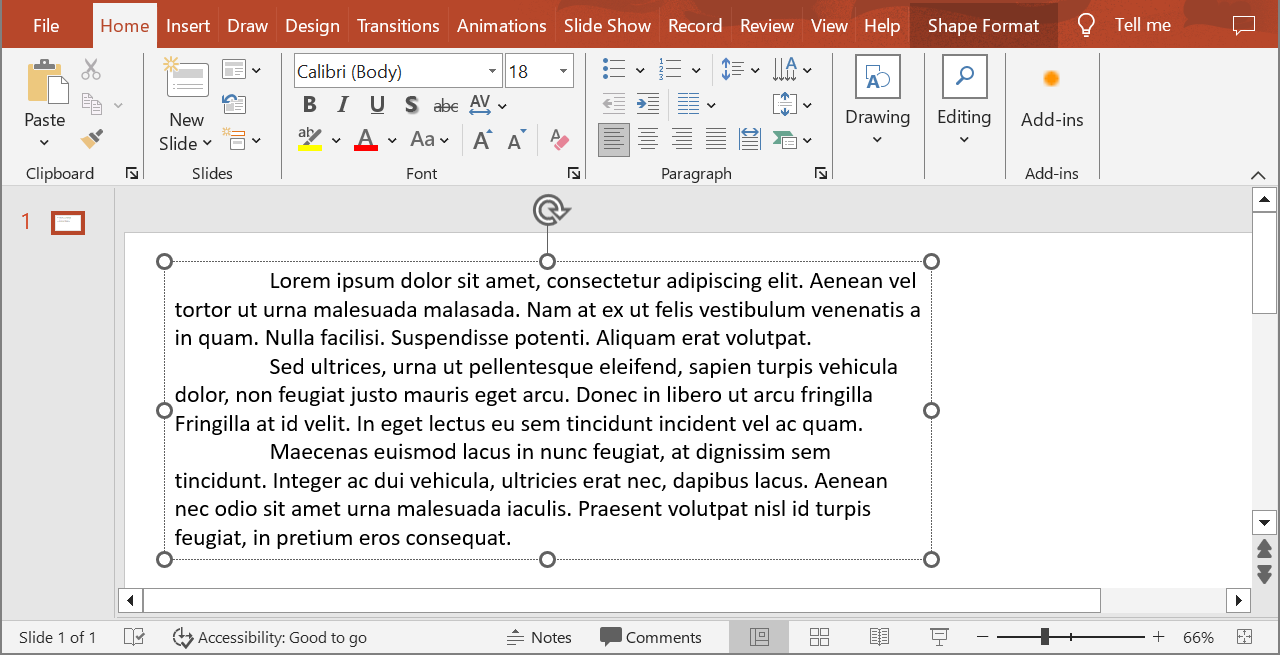
المثال التالي يعرض الفقرة الثانية في شكل نص عادي بالمقياس الافتراضي ويحفظ الصورة المرجعة بصيغة PNG:
import aspose.slides as slides

with slides.Presentation("sample.pptx") as presentation:
    shape = presentation.slides[0].shapes[0]

    if isinstance(shape, slides.AutoShape) and shape.text_frame is not None and shape.text_frame.paragraphs.count > 1:
        paragraph = shape.text_frame.paragraphs[1]
        paragraph_image = paragraph.get_image()

        if paragraph_image is not None:
            with paragraph_image:
                paragraph_image.save("paragraph.png", slides.ImageFormat.PNG)
        else:
            print("The paragraph could not be rendered.")
    else:
        print("The expected text shape or paragraph was not found.")
النتيجة:

عرض الفقرة في خلية جدول مع التحجيم
مرّر عوامل التحجيم الأفقية والعمودية إلى get_image للتحكم في حجم الفقرة المعروضة. المثال التالي ينشئ جدولًا، يعرض الفقرة في خليةه الأولى بعرض وارتفاع مضاعفين، ويحفظ النتيجة كصورة PNG:
import aspose.slides as slides

scale_x = 2
scale_y = 2

with slides.Presentation() as presentation:
    slide = presentation.slides[0]
    table = slide.shapes.add_table(50, 50, [300], [80])
    paragraph = table.rows[0][0].text_frame.paragraphs[0]
    paragraph.text = "Text in a table cell"

    paragraph_image = paragraph.get_image(scale_x, scale_y)
    if paragraph_image is not None:
        with paragraph_image:
            paragraph_image.save("table_paragraph.png", slides.ImageFormat.PNG)
    else:
        print("The paragraph could not be rendered.")
عامل التحجيم 1 يبقي هذا المحور بحجمه الأصلي بالبكسل. على سبيل المثال، 2 لكلا العاملين ينتج صورة عرضها وارتفاعها تقريباً ضعف الأبعاد الافتراضية، ما يساوي أربعة أضعاف عدد البكسلات. العوامل الأكبر عمومًا تنتج نصًا أوضح للتكبير أو الإخراج عالي الدقة، لكنها تزيد أيضًا من استهلاك الذاكرة وحجم الملف. العوامل الأقل من 1 تنتج صورًا أصغر بتفاصيل أقل. استخدم عوامل متساوية للحفاظ على نسبة عرض الفقرة إلى ارتفاعها؛ العوامل الأفقية والعمودية المختلفة تمدد الناتج بشكل مستقل.
ما زال عرض الشكل الكامل باستخدام Shape.get_image مفيدًا عندما يجب أن يتضمن المخرج تعبئة الشكل أو حدوده أو سياقه البصري الآخر. لعرض صورة فقرية فقط، استخدم Paragraph.get_image.
الأسئلة الشائعة
هل يمكنني تعطيل التفاف السطر تمامًا داخل إطار النص؟
نعم. عيّن TextFrameFormat.wrap_text لتعطيل الالتفاف بحيث لا تنكسر الأسطر على حواف إطار النص.
كيف يمكنني الحصول على حدود الفقرة على الشريحة بدقة؟
استخدم Paragraph.get_rect لاسترجاع المستطيل المحيط بالفقرة. توفر Portion.get_rect حدود الجزء الفردي.
أين يتم التحكم في محاذاة الفقرة (اليسار، اليمين، الوسط، أو الضبط)?
ParagraphFormat.alignment هو إعداد على مستوى الفقرة ويُطبّق على الفقرة بأكملها بغض النظر عن تنسيق الأجزاء الفردية.
لتحاذي الخطوط ذات الأحجام المختلفة داخل كل سطر رأسيًا، راجع محاذاة الخطوط داخل السطر.
هل يمكنني تعيين لغة التدقيق لجزء من الفقرة؟
نعم. عيّن PortionFormat.language_id للأجزاء الفردية، بحيث يمكن لفقرة واحدة أن تحتوي على نص بعدة لغات.