
Gérer le zoom de présentation en PHP
Introduction
Les zooms PowerPoint vous permettent de naviguer entre des diapositives et des sections spécifiques pendant un diaporama. Avec Aspose.Slides pour PHP via Java, vous pouvez créer des zooms de diapositive, de section et de résumé et personnaliser leurs aperçus, bordures et transitions.
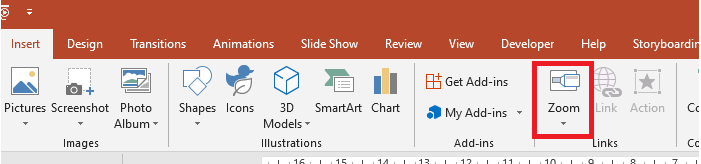
- Pour résumer toute une présentation sur une seule diapositive, utilisez un Summary Zoom.
- Pour n’afficher que des diapositives sélectionnées, utilisez un Slide Zoom.
- Pour n’afficher qu’une seule section, utilisez un Section Zoom.
Slide Zoom
Un zoom de diapositive peut rendre votre présentation plus dynamique, en vous permettant de naviguer librement entre les diapositives dans n’importe quel ordre choisi sans interrompre le déroulement de votre présentation. Les zooms de diapositive sont idéaux pour les présentations courtes sans nombreuses sections, mais vous pouvez également les utiliser dans différents scénarios de présentation.
Les zooms de diapositive vous permettent d’explorer des informations liées à partir d’une seule diapositive d’aperçu.
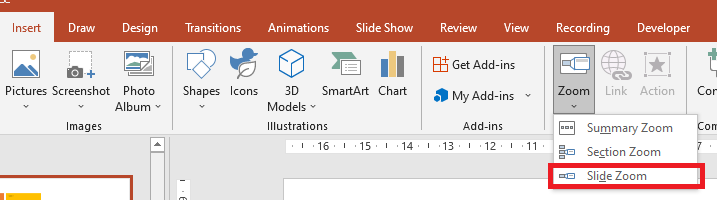
Pour les objets de zoom de diapositive, Aspose.Slides fournit l’énumération ZoomImageType, la classe ZoomFrame et les méthodes de la classe ShapeCollection .
Create Zoom Frames
Utilisez ShapeCollection::addZoomFrame pour placer des liens vers des diapositives individuelles sur une diapositive d’aperçu. Cet exemple crée deux diapositives cibles avec des arrière-plans et des libellés distincts, puis ajoute un aperçu de chacune à la première diapositive et enregistre la présentation au format PPTX. Les positions et dimensions des cadres sont spécifiées en points.
use aspose\slides\BackgroundType;
use aspose\slides\FillType;
use aspose\slides\Presentation;
use aspose\slides\SaveFormat;
use aspose\slides\ShapeType;

$presentation = new Presentation();
try {
    $overviewSlide = $presentation->getSlides()->get_Item(0);

    $secondSlide = $presentation->getSlides()->addEmptySlide($overviewSlide->getLayoutSlide());
    $thirdSlide = $presentation->getSlides()->addEmptySlide($overviewSlide->getLayoutSlide());

    $secondSlide->getBackground()->setType(BackgroundType::OwnBackground);
    $secondSlide->getBackground()->getFillFormat()->setFillType(FillType::Solid);
    $secondSlide->getBackground()->getFillFormat()->getSolidFillColor()->setColor(java("java.awt.Color")->CYAN);

    $textBox = $secondSlide->getShapes()->addAutoShape(ShapeType::Rectangle, 100, 200, 500, 200);
    $textBox->getTextFrame()->setText("Second Slide");

    $thirdSlide->getBackground()->setType(BackgroundType::OwnBackground);
    $thirdSlide->getBackground()->getFillFormat()->setFillType(FillType::Solid);
    $color = new Java("java.awt.Color", 189, 183, 107);
    $thirdSlide->getBackground()->getFillFormat()->getSolidFillColor()->setColor($color);

    $textBox = $thirdSlide->getShapes()->addAutoShape(ShapeType::Rectangle, 100, 200, 500, 200);
    $textBox->getTextFrame()->setText("Third Slide");

    $overviewSlide->getShapes()->addZoomFrame(20, 20, 250, 200, $secondSlide);
    $overviewSlide->getShapes()->addZoomFrame(200, 250, 250, 200, $thirdSlide);

    $presentation->save("presentation.pptx", SaveFormat::Pptx);
} finally {
    $presentation->dispose();
}
Create Zoom Frames with Custom Images
Passez une image personnalisée à ShapeCollection::addZoomFrame pour remplacer l’aperçu par défaut de la diapositive cible. Cet exemple nécessite une image locale, la charge avec Images::fromFile, et l’ajoute à la présentation en utilisant ImageCollection::addImage. Le cadre résultant affiche cette image tout en conservant le lien vers la deuxième diapositive.
use aspose\slides\BackgroundType;
use aspose\slides\FillType;
use aspose\slides\Images;
use aspose\slides\Presentation;
use aspose\slides\SaveFormat;
use aspose\slides\ShapeType;

$presentation = new Presentation();
try {
    $overviewSlide = $presentation->getSlides()->get_Item(0);

    $slide = $presentation->getSlides()->addEmptySlide($overviewSlide->getLayoutSlide());
    $slide->getBackground()->setType(BackgroundType::OwnBackground);
    $slide->getBackground()->getFillFormat()->setFillType(FillType::Solid);
    $slide->getBackground()->getFillFormat()->getSolidFillColor()->setColor(java("java.awt.Color")->CYAN);

    $textBox = $slide->getShapes()->addAutoShape(ShapeType::Rectangle, 100, 200, 500, 200);
    $textBox->getTextFrame()->setText("Second Slide");
    $image = Images::fromFile("image.png");
    try {
        $previewImage = $presentation->getImages()->addImage($image);
    } finally {
        $image->dispose();
    }

    $overviewSlide->getShapes()->addZoomFrame(20, 20, 300, 200, $slide, $previewImage);

    $presentation->save("presentation.pptx", SaveFormat::Pptx);
} finally {
    $presentation->dispose();
}
Format Zoom Frames
Cet exemple personnalise deux cadres de zoom de diapositive. Il assigne une image locale au premier cadre via ZoomObject::setZoomImage, et donne au deuxième cadre une bordure rose à cinq points, tiret‑point, via Shape::getLineFormat. Passer false à ZoomObject::setShowBackground masque l’arrière‑plan du deuxième cadre. Une image locale est requise pour l’aperçu personnalisé ; les deux cadres conservent leurs cibles de diapositive dans le PPTX enregistré.
use aspose\slides\BackgroundType;
use aspose\slides\FillType;
use aspose\slides\Images;
use aspose\slides\LineDashStyle;
use aspose\slides\Presentation;
use aspose\slides\SaveFormat;
use aspose\slides\ShapeType;

$presentation = new Presentation();
try {
    $overviewSlide = $presentation->getSlides()->get_Item(0);

    $secondSlide = $presentation->getSlides()->addEmptySlide($overviewSlide->getLayoutSlide());
    $thirdSlide = $presentation->getSlides()->addEmptySlide($overviewSlide->getLayoutSlide());

    $secondSlide->getBackground()->setType(BackgroundType::OwnBackground);
    $secondSlide->getBackground()->getFillFormat()->setFillType(FillType::Solid);
    $secondSlide->getBackground()->getFillFormat()->getSolidFillColor()->setColor(java("java.awt.Color")->CYAN);

    $textBox = $secondSlide->getShapes()->addAutoShape(ShapeType::Rectangle, 100, 200, 500, 200);
    $textBox->getTextFrame()->setText("Second Slide");

    $thirdSlide->getBackground()->setType(BackgroundType::OwnBackground);
    $thirdSlide->getBackground()->getFillFormat()->setFillType(FillType::Solid);
    $color = new Java("java.awt.Color", 189, 183, 107);
    $thirdSlide->getBackground()->getFillFormat()->getSolidFillColor()->setColor($color);

    $textBox = $thirdSlide->getShapes()->addAutoShape(ShapeType::Rectangle, 100, 200, 500, 200);
    $textBox->getTextFrame()->setText("Third Slide");

    $firstZoomFrame = $overviewSlide->getShapes()->addZoomFrame(20, 20, 250, 200, $secondSlide);
    $secondZoomFrame = $overviewSlide->getShapes()->addZoomFrame(200, 250, 250, 200, $thirdSlide);
    $image = Images::fromFile("image.png");
    try {
        $previewImage = $presentation->getImages()->addImage($image);
    } finally {
        $image->dispose();
    }

    $firstZoomFrame->setZoomImage($previewImage);

    $secondZoomFrame->getLineFormat()->setWidth(5);
    $secondZoomFrame->getLineFormat()->getFillFormat()->setFillType(FillType::Solid);
    $color = new Java("java.awt.Color", 255, 105, 180);
    $secondZoomFrame->getLineFormat()->getFillFormat()->getSolidFillColor()->setColor($color);
    $secondZoomFrame->getLineFormat()->setDashStyle(LineDashStyle::DashDot);

    $secondZoomFrame->setShowBackground(false);

    $presentation->save("presentation.pptx", SaveFormat::Pptx);
} finally {
    $presentation->dispose();
}
Section Zoom
Un zoom de section crée un lien vers une section de votre présentation. Utilisez‑le pour revisiter un sujet ou montrer comment différentes parties de la présentation sont reliées.
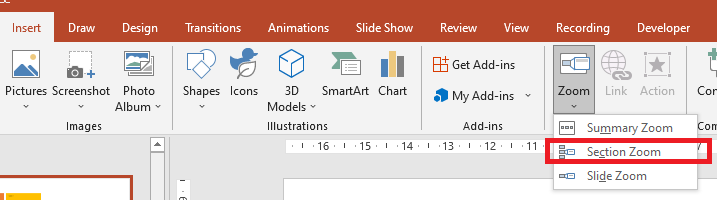
Pour les objets de zoom de section, Aspose.Slides fournit la classe SectionZoomFrame et les méthodes de la classe ShapeCollection .
Create Section Zoom Frames
Créez une section avec SectionCollection::addSection, puis transmettez la section retournée à ShapeCollection::addSectionZoomFrame. Cet exemple place un zoom de section sur la première diapositive et le lie à une section commençant par une diapositive colorée. La position et les dimensions du cadre sont spécifiées en points, et la présentation est enregistrée au format PPTX.
use aspose\slides\BackgroundType;
use aspose\slides\FillType;
use aspose\slides\Presentation;
use aspose\slides\SaveFormat;

$presentation = new Presentation();
try {
    $overviewSlide = $presentation->getSlides()->get_Item(0);

    $slide = $presentation->getSlides()->addEmptySlide($overviewSlide->getLayoutSlide());
    $slide->getBackground()->getFillFormat()->setFillType(FillType::Solid);
    $color = new Java("java.awt.Color", 154, 205, 50);
    $slide->getBackground()->getFillFormat()->getSolidFillColor()->setColor($color);
    $slide->getBackground()->setType(BackgroundType::OwnBackground);

    $section = $presentation->getSections()->addSection("Section 1", $slide);
    $sectionZoomFrame = $overviewSlide->getShapes()->addSectionZoomFrame(20, 20, 300, 200, $section);

    $presentation->save("presentation.pptx", SaveFormat::Pptx);
} finally {
    $presentation->dispose();
}
Create Section Zoom Frames with Custom Images
La surcharge image de ShapeCollection::addSectionZoomFrame vous permet d’afficher un aperçu personnalisé sans modifier la section de destination. Cet exemple nécessite une image locale, chargée avec Images::fromFile et ajoutée via ImageCollection::addImage. La présentation enregistrée contient un zoom de section sur la première diapositive lié à la section nouvellement créée.
use aspose\slides\BackgroundType;
use aspose\slides\FillType;
use aspose\slides\Images;
use aspose\slides\Presentation;
use aspose\slides\SaveFormat;

$presentation = new Presentation();
try {
    $overviewSlide = $presentation->getSlides()->get_Item(0);

    $slide = $presentation->getSlides()->addEmptySlide($overviewSlide->getLayoutSlide());
    $slide->getBackground()->getFillFormat()->setFillType(FillType::Solid);
    $color = new Java("java.awt.Color", 154, 205, 50);
    $slide->getBackground()->getFillFormat()->getSolidFillColor()->setColor($color);
    $slide->getBackground()->setType(BackgroundType::OwnBackground);
    $image = Images::fromFile("image.png");
    try {
        $previewImage = $presentation->getImages()->addImage($image);
    } finally {
        $image->dispose();
    }

    $section = $presentation->getSections()->addSection("Section 1", $slide);
    $sectionZoomFrame = $overviewSlide->getShapes()->addSectionZoomFrame(20, 20, 300, 200, $section, $previewImage);

    $presentation->save("presentation.pptx", SaveFormat::Pptx);
} finally {
    $presentation->dispose();
}
Change a Section Zoom’s Target Section
Utilisez SectionZoomFrame::setTargetSection pour rediriger un zoom de section existant sans le recréer. Choisissez une section remplie dans la collection Presentation::getSections de la même présentation. Affecter une section vide laisse la cible actuelle inchangée, il faut donc vérifier Section::getSlidesListOfSection avant de l’assigner. Consultez Manage Slide Sections pour plus d’informations sur les sections.
L’exemple suivant charge un fichier de présentation, qui doit contenir plusieurs sections remplies, un zoom de section existant nommé Section navigation, et une section portant le nom unique Results. Il parcourt toutes les diapositives à la recherche du zoom et trouve la destination par son nom plutôt que par un indice de collection qui peut changer lorsque les sections sont réordonnées. Si les noms ne sont pas uniques, utilisez Section::getSectionId pour identifier la destination à la place.
use aspose\slides\Presentation;
use aspose\slides\SaveFormat;

$presentation = new Presentation("section-zoom.pptx");
try {
    $zoom = null;
    $slideCount = java_values($presentation->getSlides()->size());
    for ($i = 0; $i < $slideCount; $i++) {
        $slide = $presentation->getSlides()->get_Item($i);
        $shapeCount = java_values($slide->getShapes()->size());
        for ($j = 0; $j < $shapeCount; $j++) {
            $shape = $slide->getShapes()->get_Item($j);
            if (java_instanceof($shape, new JavaClass("com.aspose.slides.ISectionZoomFrame")) && java_values($shape->getName()) === "Section navigation") {
                $zoom = $shape;
                break;
            }
        }
        if ($zoom != null) {
            break;
        }
    }

    $targetSection = null;
    $sectionCount = java_values($presentation->getSections()->size());
    for ($i = 0; $i < $sectionCount; $i++) {
        $section = $presentation->getSections()->get_Item($i);
        if (java_values($section->getName()) === "Results") {
            $targetSection = $section;
            break;
        }
    }

    if ($zoom == null || $targetSection == null) {
        echo "The section zoom or destination section was not found.", PHP_EOL;
    } else if (java_values($targetSection->getSlidesListOfSection()->size()) == 0) {
        echo "The destination section is empty.", PHP_EOL;
    } else {
        $currentSection = $zoom->getTargetSection();
        echo "Current section: " . (java_is_null($currentSection) ? "" : java_values($currentSection->getName())), PHP_EOL;
        $zoom->setTargetSection($targetSection);
        $presentation->save("section-zoom-updated.pptx", SaveFormat::Pptx);
    }
} finally {
    $presentation->dispose();
}
Format Section Zoom Frames
Cet exemple déplace et redimensionne un zoom de section à 100 × 75 points, assigne une image locale via ZoomObject::setZoomImage, et applique une bordure brune à 2,5 points, tiret‑point. Il active ZoomObject::setReturnToParent pour revenir à la diapositive d’origine après la section, désactive ZoomObject::setShowBackground, et définit ZoomObject::setTransitionDuration à 1,5 seconde. Une image locale est requise pour l’aperçu personnalisé.
use aspose\slides\BackgroundType;
use aspose\slides\FillType;
use aspose\slides\Images;
use aspose\slides\LineDashStyle;
use aspose\slides\Presentation;
use aspose\slides\SaveFormat;

$presentation = new Presentation();
try {
    $overviewSlide = $presentation->getSlides()->get_Item(0);

    $slide = $presentation->getSlides()->addEmptySlide($overviewSlide->getLayoutSlide());
    $slide->getBackground()->getFillFormat()->setFillType(FillType::Solid);
    $color = new Java("java.awt.Color", 154, 205, 50);
    $slide->getBackground()->getFillFormat()->getSolidFillColor()->setColor($color);
    $slide->getBackground()->setType(BackgroundType::OwnBackground);

    $section = $presentation->getSections()->addSection("Section 1", $slide);

    $sectionZoomFrame = $overviewSlide->getShapes()->addSectionZoomFrame(20, 20, 300, 200, $section);
    $sectionZoomFrame->setX(100);
    $sectionZoomFrame->setY(300);
    $sectionZoomFrame->setWidth(100);
    $sectionZoomFrame->setHeight(75);
    $image = Images::fromFile("image.png");
    try {
        $previewImage = $presentation->getImages()->addImage($image);
    } finally {
        $image->dispose();
    }

    $sectionZoomFrame->setZoomImage($previewImage);

    $sectionZoomFrame->setReturnToParent(true);
    $sectionZoomFrame->setShowBackground(false);

    $sectionZoomFrame->getLineFormat()->getFillFormat()->setFillType(FillType::Solid);
    $color = new Java("java.awt.Color", 165, 42, 42);
    $sectionZoomFrame->getLineFormat()->getFillFormat()->getSolidFillColor()->setColor($color);
    $sectionZoomFrame->getLineFormat()->setDashStyle(LineDashStyle::DashDot);
    $sectionZoomFrame->getLineFormat()->setWidth(2.5);

    $sectionZoomFrame->setTransitionDuration(1.5);

    $presentation->save("presentation.pptx", SaveFormat::Pptx);
} finally {
    $presentation->dispose();
}
Summary Zoom
Un zoom de résumé fournit un aperçu des sections de la présentation. Pendant un diaporama, vous pouvez l’utiliser pour accéder à une section, avancer rapidement ou revisiter un sujet sans suivre l’ordre des diapositives.
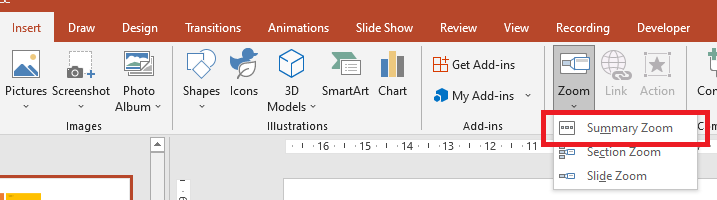
Pour les objets de zoom de résumé, Aspose.Slides fournit les classes SummaryZoomFrame, SummaryZoomSection, et SummaryZoomSectionCollection ainsi que les méthodes de la classe ShapeCollection .
Create a Summary Zoom
Utilisez ShapeCollection::addSummaryZoomFrame pour créer un aperçu des sections de la présentation. Cet exemple crée quatre sections avec des arrière-plans de diapositives distincts et ajoute un zoom de résumé à la première diapositive. La position et les dimensions du cadre sont spécifiées en points, et l’aperçu résultant est enregistré dans une présentation PPTX.
use aspose\slides\BackgroundType;
use aspose\slides\FillType;
use aspose\slides\Presentation;
use aspose\slides\SaveFormat;

$presentation = new Presentation();
try {
    $overviewSlide = $presentation->getSlides()->get_Item(0);

    $slide = $presentation->getSlides()->addEmptySlide($overviewSlide->getLayoutSlide());
    $slide->getBackground()->getFillFormat()->setFillType(FillType::Solid);
    $color = new Java("java.awt.Color", 165, 42, 42);
    $slide->getBackground()->getFillFormat()->getSolidFillColor()->setColor($color);
    $slide->getBackground()->setType(BackgroundType::OwnBackground);

    $presentation->getSections()->addSection("Section 1", $slide);

    $slide = $presentation->getSlides()->addEmptySlide($overviewSlide->getLayoutSlide());
    $slide->getBackground()->getFillFormat()->setFillType(FillType::Solid);
    $slide->getBackground()->getFillFormat()->getSolidFillColor()->setColor(java("java.awt.Color")->CYAN);
    $slide->getBackground()->setType(BackgroundType::OwnBackground);

    $presentation->getSections()->addSection("Section 2", $slide);

    $slide = $presentation->getSlides()->addEmptySlide($overviewSlide->getLayoutSlide());
    $slide->getBackground()->getFillFormat()->setFillType(FillType::Solid);
    $color = new Java("java.awt.Color", 127, 255, 0);
    $slide->getBackground()->getFillFormat()->getSolidFillColor()->setColor($color);
    $slide->getBackground()->setType(BackgroundType::OwnBackground);

    $presentation->getSections()->addSection("Section 3", $slide);

    $slide = $presentation->getSlides()->addEmptySlide($overviewSlide->getLayoutSlide());
    $slide->getBackground()->getFillFormat()->setFillType(FillType::Solid);
    $color = new Java("java.awt.Color", 0, 100, 0);
    $slide->getBackground()->getFillFormat()->getSolidFillColor()->setColor($color);
    $slide->getBackground()->setType(BackgroundType::OwnBackground);

    $presentation->getSections()->addSection("Section 4", $slide);

    $summaryZoomFrame = $overviewSlide->getShapes()->addSummaryZoomFrame(150, 50, 300, 200);

    $presentation->save("presentation.pptx", SaveFormat::Pptx);
} finally {
    $presentation->dispose();
}
Add and Remove a Summary Zoom Section
Un zoom de résumé stocke ses objets SummaryZoomSection dans SummaryZoomFrame::getSummaryZoomCollection. Cet exemple crée un aperçu de deux sections, ajoute une troisième section avec SummaryZoomSectionCollection::addSummaryZoomSection, et supprime l’entrée de la première section à l’aide de SummaryZoomSectionCollection::removeSummaryZoomSection. La suppression de l’entrée laisse la section de la présentation et ses diapositives intactes.
use aspose\slides\BackgroundType;
use aspose\slides\FillType;
use aspose\slides\Presentation;
use aspose\slides\SaveFormat;

$presentation = new Presentation();
try {
    $overviewSlide = $presentation->getSlides()->get_Item(0);

    $slide = $presentation->getSlides()->addEmptySlide($overviewSlide->getLayoutSlide());
    $slide->getBackground()->getFillFormat()->setFillType(FillType::Solid);
    $color = new Java("java.awt.Color", 165, 42, 42);
    $slide->getBackground()->getFillFormat()->getSolidFillColor()->setColor($color);
    $slide->getBackground()->setType(BackgroundType::OwnBackground);

    $firstSection = $presentation->getSections()->addSection("Section 1", $slide);

    $slide = $presentation->getSlides()->addEmptySlide($overviewSlide->getLayoutSlide());
    $slide->getBackground()->getFillFormat()->setFillType(FillType::Solid);
    $slide->getBackground()->getFillFormat()->getSolidFillColor()->setColor(java("java.awt.Color")->CYAN);
    $slide->getBackground()->setType(BackgroundType::OwnBackground);

    $presentation->getSections()->addSection("Section 2", $slide);

    $summaryZoomFrame = $overviewSlide->getShapes()->addSummaryZoomFrame(150, 50, 300, 200);

    $slide = $presentation->getSlides()->addEmptySlide($overviewSlide->getLayoutSlide());
    $slide->getBackground()->getFillFormat()->setFillType(FillType::Solid);
    $color = new Java("java.awt.Color", 127, 255, 0);
    $slide->getBackground()->getFillFormat()->getSolidFillColor()->setColor($color);
    $slide->getBackground()->setType(BackgroundType::OwnBackground);

    $thirdSection = $presentation->getSections()->addSection("Section 3", $slide);

    $summaryZoomFrame->getSummaryZoomCollection()->addSummaryZoomSection($thirdSection);

    $summaryZoomFrame->getSummaryZoomCollection()->removeSummaryZoomSection($firstSection);

    $presentation->save("presentation.pptx", SaveFormat::Pptx);
} finally {
    $presentation->dispose();
}
Format Summary Zoom Sections
Cet exemple formate la première entrée dans SummaryZoomFrame::getSummaryZoomCollection, en utilisant l’indice zéro 0. Il nécessite une image locale pour ZoomObject::setZoomImage, applique une bordure noire à 1,5 points, tiret‑point, et définit ZoomObject::setTransitionDuration à 1,5 seconde. Passer false à ZoomObject::setReturnToParent désactive le retour automatique à la diapositive de résumé pour cette entrée.
use aspose\slides\BackgroundType;
use aspose\slides\FillType;
use aspose\slides\Images;
use aspose\slides\LineDashStyle;
use aspose\slides\Presentation;
use aspose\slides\SaveFormat;

$presentation = new Presentation();
try {
    $overviewSlide = $presentation->getSlides()->get_Item(0);

    $slide = $presentation->getSlides()->addEmptySlide($overviewSlide->getLayoutSlide());
    $slide->getBackground()->getFillFormat()->setFillType(FillType::Solid);
    $color = new Java("java.awt.Color", 165, 42, 42);
    $slide->getBackground()->getFillFormat()->getSolidFillColor()->setColor($color);
    $slide->getBackground()->setType(BackgroundType::OwnBackground);

    $presentation->getSections()->addSection("Section 1", $slide);

    $slide = $presentation->getSlides()->addEmptySlide($overviewSlide->getLayoutSlide());
    $slide->getBackground()->getFillFormat()->setFillType(FillType::Solid);
    $slide->getBackground()->getFillFormat()->getSolidFillColor()->setColor(java("java.awt.Color")->CYAN);
    $slide->getBackground()->setType(BackgroundType::OwnBackground);

    $presentation->getSections()->addSection("Section 2", $slide);

    $summaryZoomFrame = $overviewSlide->getShapes()->addSummaryZoomFrame(150, 50, 300, 200);

    $summarySection = $summaryZoomFrame->getSummaryZoomCollection()->get_Item(0);
    $image = Images::fromFile("image.png");
    try {
        $previewImage = $presentation->getImages()->addImage($image);
    } finally {
        $image->dispose();
    }

    $summarySection->setZoomImage($previewImage);
    $summarySection->setReturnToParent(false);

    $summarySection->getLineFormat()->getFillFormat()->setFillType(FillType::Solid);
    $summarySection->getLineFormat()->getFillFormat()->getSolidFillColor()->setColor(java("java.awt.Color")->BLACK);
    $summarySection->getLineFormat()->setDashStyle(LineDashStyle::DashDot);
    $summarySection->getLineFormat()->setWidth(1.5);

    $summarySection->setTransitionDuration(1.5);

    $presentation->save("presentation.pptx", SaveFormat::Pptx);
} finally {
    $presentation->dispose();
}
FAQ
Puis-je contrôler le retour à la diapositive « parent » après l’affichage de la cible ?
Oui. Appelez ZoomObject::setReturnToParent avec true pour revenir à la diapositive d’origine après l’affichage du contenu ciblé.
Puis-je ajuster la « vitesse » ou la durée de la transition du Zoom ?
Oui. Utilisez ZoomObject::setTransitionDuration pour contrôler la durée de la transition en secondes.
Existe-t-il des limites au nombre d’objets Zoom qu’une présentation peut contenir ?
Il n’existe aucune limite API stricte documentée. Les limites pratiques dépendent de la complexité globale de la présentation et des performances du visualiseur. Vous pouvez ajouter de nombreux cadres Zoom, mais il faut tenir compte de la taille du fichier et du temps de rendu.