
Install Manually
Overview
Follow these steps to install Aspose.Slides for Reporting Services without the MSI installer, from the ZIP package Aspose.Slides for Reporting Services XX.XX (DLLs Only) on the download page. They register the same extensions as the MSI installer. Repeat them for each report server instance.
Before you start, check the system requirements. You need local administrator rights on the report server.
Choose the Assembly
The ZIP package contains several builds. Copy exactly one Aspose.Slides.ReportingServices.dll to the report server:
| File in the ZIP package | Use it for |
|---|---|
| Bin\Universal\Aspose.Slides.ReportingServices.dll | SQL Server 2008 and later Reporting Services, and Power BI Report Server |
| Bin\SSRS2005\Aspose.Slides.ReportingServices.dll | SQL Server 2005 Reporting Services |
| Bin\ReportViewer2010\Aspose.Slides.ReportingServices.dll | Not for a report server: applications that export from the ReportViewer 2010 or 2012 control, see Using Aspose.Slides with ReportViewer 2010 and 2012 |
| Bin\RplExport\Aspose.ReportingServices.Debug.Rpl.dll | Optional: saves reports in RPL format for problem reports, see Exporting Reports to RPL Format |
Find the Report Server Folder
The steps below refer to the report server’s ReportServer folder, which holds rsreportserver.config and rssrvpolicy.config. In a default installation, it is:
| Report server | Default ReportServer folder |
|---|---|
| SQL Server 2017 and later Reporting Services | C:\Program Files\Microsoft SQL Server Reporting Services\SSRS\ReportServer |
| Power BI Report Server | C:\Program Files\Microsoft Power BI Report Server\PBIRS\ReportServer |
| SQL Server 2016 and earlier Reporting Services | C:\Program Files\Microsoft SQL Server\<instance folder>\Reporting Services\ReportServer, where the instance folder is, for example, MSRS13.MSSQLSERVER for SQL Server 2016 or MSSQL.x for SQL Server 2005 |
For more locations, see Microsoft’s RsReportServer.config configuration file article.
Install the Extension
-
Copy the assembly you chose to the bin subfolder of the ReportServer folder.
The copied file must not carry explicitly assigned NTFS permissions, or the report server is denied access when it loads the assembly and the new export formats do not appear. Right-click the file, select Properties, and on the Security tab remove any explicitly assigned permissions, leaving only inherited ones. If the General tab shows an Unblock option, select it.
-
Save a copy of rsreportserver.config, and then open the file in a text editor. Add these entries inside the
<Render>element:<Extension Name="ASPPT" Type="Aspose.Slides.ReportingServices.PptRenderer,Aspose.Slides.ReportingServices"/> <Extension Name="ASPPS" Type="Aspose.Slides.ReportingServices.PpsRenderer,Aspose.Slides.ReportingServices"/> <Extension Name="ASPPTX" Type="Aspose.Slides.ReportingServices.PptxRenderer,Aspose.Slides.ReportingServices"/> <Extension Name="ASPPSX" Type="Aspose.Slides.ReportingServices.PpsxRenderer,Aspose.Slides.ReportingServices"/> <Extension Name="ASXPSS" Type="Aspose.Slides.ReportingServices.XpsRenderer,Aspose.Slides.ReportingServices"/> <Extension Name="ASODP" Type="Aspose.Slides.ReportingServices.OdpRenderer,Aspose.Slides.ReportingServices"/>Each entry registers one export format;
Namemust be unique among the rendering extensions. The MSI installer registers the same six names and types. Omit an entry if you do not want its format in the export list. -
Save a copy of rssrvpolicy.config, and then open the file in a text editor. Find the code group whose
Descriptionis “This code group grants MyComputer code Execution permission.” and add this code group as its last child:<CodeGroup class="UnionCodeGroup" version="1" PermissionSetName="FullTrust" Name="Aspose.Slides_for_Reporting_Services" Description="This code group grants full trust to the Aspose.Slides.ReportingServices.dll assembly."> <IMembershipCondition class="StrongNameMembershipCondition" version="1" PublicKeyBlob="00240000048000009400000006020000002400005253413100040000010001005542e99cecd28842dad186257b2c7b6ae9b5947e51e0b17b4ac6d8cecd3e01c4d20658c5e4ea1b9a6c8f854b2d796c4fde740dac65e834167758cff283eed1be5c9a812022b015a902e0b97d4e95569eb8c0971834744e633d9cb4c4a6d8eda03c12f486e13a1a0cb1aa101ad94943236384cbbf5c679944b994de9546e493bf"/> </CodeGroup>PublicKeyBlobis the public key of the Aspose.Slides.ReportingServices assembly. Keep it on one line. -
Save both files. The report server reads its configuration files again whenever they are saved. If a file contains malformed XML, the report server ignores it or does not start, so restore your copy if something goes wrong.
Check the Installation
Open a paginated report in the web portal (Report Manager on SQL Server 2014 and earlier) and open the Export list. It now includes these formats:
- PPT - PowerPoint Presentation via Aspose.Slides
- PPS - PowerPoint SlideShow via Aspose.Slides
- PPTX - PowerPoint 2007 Presentation via Aspose.Slides
- PPSX - PowerPoint 2007 SlideShow via Aspose.Slides
- ODP - OpenDocument Presentation via Aspose.Slides
- XPS - via Aspose.Slides
Select one of them to export the report. The file opens in the application associated with its format.
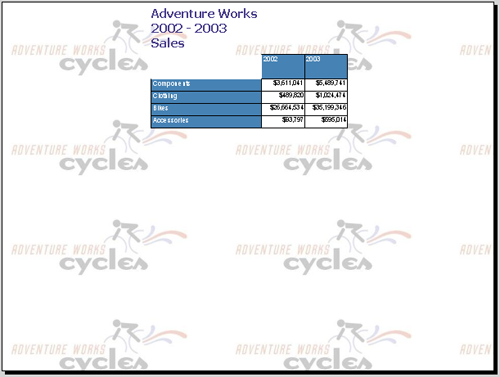
If the formats do not appear, check the NTFS permissions of the copied assembly. Without a license, exported files carry an evaluation watermark; see Licensing.