
Android で PowerPoint テキスト段落を管理する
概要
Aspose.Slides for Android via Java はテキストをテキストフレーム、段落、ポーションの階層として表現します:
- ITextFrame はシェイプ内のテキストコンテナを表し、その段落コレクションへのアクセスを提供します。
- IParagraph はテキストフレーム内の 1 つの段落を表し、ポーションと段落レベルの書式設定へのアクセスを提供します。
- IPortion は段落内のテキストランを表します。各ポーションは独自のテキストと文字レベルの書式設定を持つことができます。
したがって、段落は複数のポーションを使用して、フォント、色、サイズ、その他の書式設定が異なるテキストを含めることができます。
段落の作成と書式設定
シェイプのテキストフレーム内で段落を作成し、ポーションを使用して個々のテキストランの書式設定を行います。このセクションでは、各段落内で複数のポーションを組み合わせ、異なる色、フォントサイズ、スタイルを適用する方法を示します。
複数のポーションを使用した段落の作成
以下の Android via Java のサンプルは、IParagraph.getPortions が返すコレッシュンに 3 つのテキストランを含む 3 つの段落を作成します。デフォルトの段落と空のポーションを再利用し、残りの段落とポーションを追加します。書式設定は IPortion.getPortionFormat を介して適用されます。各段落の最初のポーションは赤、太字、15 ポイント、2 番目は青、斜体、18 ポイント、3 番目はデフォルトの書式設定のままです:
import com.aspose.slides.*;
import android.graphics.Color;

Presentation presentation = new Presentation();
try {
    ISlide slide = presentation.getSlides().get_Item(0);

    IAutoShape shape = slide.getShapes().addAutoShape(ShapeType.Rectangle, 50, 150, 300, 150);
    ITextFrame textFrame = shape.getTextFrame();

    IParagraph firstParagraph = textFrame.getParagraphs().get_Item(0);
    firstParagraph.getPortions().add(new Portion());
    firstParagraph.getPortions().add(new Portion());

    IParagraph secondParagraph = new Paragraph();
    secondParagraph.getPortions().add(new Portion());
    secondParagraph.getPortions().add(new Portion());
    secondParagraph.getPortions().add(new Portion());
    textFrame.getParagraphs().add(secondParagraph);

    IParagraph thirdParagraph = new Paragraph();
    thirdParagraph.getPortions().add(new Portion());
    thirdParagraph.getPortions().add(new Portion());
    thirdParagraph.getPortions().add(new Portion());
    textFrame.getParagraphs().add(thirdParagraph);

    int paragraphCount = textFrame.getParagraphs().getCount();
    for (int paragraphIndex = 0; paragraphIndex < paragraphCount; paragraphIndex++) {
        IParagraph paragraph = textFrame.getParagraphs().get_Item(paragraphIndex);
        int portionCount = paragraph.getPortions().getCount();
        for (int portionIndex = 0; portionIndex < portionCount; portionIndex++) {
            IPortion portion = paragraph.getPortions().get_Item(portionIndex);
            portion.setText("Portion " + (paragraphIndex + 1) + "." + (portionIndex + 1));

            if (portionIndex == 0) {
                portion.getPortionFormat().getFillFormat().setFillType(FillType.Solid);
                portion.getPortionFormat().getFillFormat().getSolidFillColor().setColor(Color.RED);
                portion.getPortionFormat().setFontBold(NullableBool.True);
                portion.getPortionFormat().setFontHeight(15);
            } else if (portionIndex == 1) {
                portion.getPortionFormat().getFillFormat().setFillType(FillType.Solid);
                portion.getPortionFormat().getFillFormat().getSolidFillColor().setColor(Color.BLUE);
                portion.getPortionFormat().setFontItalic(NullableBool.True);
                portion.getPortionFormat().setFontHeight(18);
            }
        }
    }

    presentation.save("paragraphs_with_portions.pptx", SaveFormat.Pptx);
} finally {
    presentation.dispose();
}
箇条書きと番号付きリストの作成
段落テキストを記号、番号、またはカスタム画像を使用したリストに整理します。このセクションの例は、箇条書きの書式設定、多層リスト、カスタム開始番号をカバーしています。
箇条書きまたは番号付きリストの作成
箇条書きと番号付けにより、関連項目を視認しやすくなります。Aspose.Slides では、リスト設定は IBulletFormat を通じて定義されます。
この Android via Java の例は、同じテキストフレームにシンボル箇条書きと番号付き項目を追加します。IBulletFormat.setType で箇条書きタイプを選択し、IBulletFormat.setChar で記号を指定し、IBulletFormat.setNumberedBulletStyle で番号付スタイルを選択します。両方の項目は黒い箇条書きで、高さは 100 パーセント、段落インデントは 25 ポイントです:
import com.aspose.slides.*;
import android.graphics.Color;

Presentation presentation = new Presentation();
try {
    ISlide slide = presentation.getSlides().get_Item(0);

    IAutoShape shape = slide.getShapes().addAutoShape(ShapeType.Rectangle, 200, 200, 400, 200);
    ITextFrame textFrame = shape.getTextFrame();
    textFrame.getParagraphs().clear();

    Paragraph symbolParagraph = new Paragraph();
    symbolParagraph.setText("Welcome to Aspose.Slides");
    symbolParagraph.getParagraphFormat().getBullet().setType(BulletType.Symbol);
    symbolParagraph.getParagraphFormat().getBullet().setChar((char) 0x2022);
    symbolParagraph.getParagraphFormat().setIndent(25);
    symbolParagraph.getParagraphFormat().getBullet().getColor().setColorType(ColorType.RGB);
    symbolParagraph.getParagraphFormat().getBullet().getColor().setColor(Color.BLACK);
    symbolParagraph.getParagraphFormat().getBullet().setBulletHardColor(NullableBool.True);
    symbolParagraph.getParagraphFormat().getBullet().setHeight(100);
    textFrame.getParagraphs().add(symbolParagraph);

    Paragraph numberedParagraph = new Paragraph();
    numberedParagraph.setText("This is a numbered item");
    numberedParagraph.getParagraphFormat().getBullet().setType(BulletType.Numbered);
    numberedParagraph.getParagraphFormat().getBullet().setNumberedBulletStyle(NumberedBulletStyle.BulletCircleNumWDBlackPlain);
    numberedParagraph.getParagraphFormat().setIndent(25);
    numberedParagraph.getParagraphFormat().getBullet().getColor().setColorType(ColorType.RGB);
    numberedParagraph.getParagraphFormat().getBullet().getColor().setColor(Color.BLACK);
    numberedParagraph.getParagraphFormat().getBullet().setBulletHardColor(NullableBool.True);
    numberedParagraph.getParagraphFormat().getBullet().setHeight(100);
    textFrame.getParagraphs().add(numberedParagraph);

    presentation.save("bulleted_and_numbered_list.pptx", SaveFormat.Pptx);
} finally {
    presentation.dispose();
}
画像箇条書きの使用
画像箇条書きを使用すると、記号や数字の代わりにカスタム画像を使用できます。
この Android via Java の例は、プレゼンテーションの画像コレクションに IPPImage として画像を追加し、それを段落の箇条書きとして使用します。IBulletFormat.setType で画像箇条書きを使用し、IBulletFormat.getPicture で画像を割り当てます。IBulletFormat.setHeight を 100 パーセントに設定して、段落テキストに対する相対サイズにします:
import com.aspose.slides.*;

Presentation presentation = new Presentation();
try {
    ISlide slide = presentation.getSlides().get_Item(0);

    IImage bulletImage = Images.fromFile("bullets.png");
    IPPImage presentationImage;
    try {
        presentationImage = presentation.getImages().addImage(bulletImage);
    } finally {
        bulletImage.dispose();
    }

    IAutoShape shape = slide.getShapes().addAutoShape(ShapeType.Rectangle, 200, 200, 400, 200);
    ITextFrame textFrame = shape.getTextFrame();
    textFrame.getParagraphs().clear();

    Paragraph paragraph = new Paragraph();
    paragraph.setText("Welcome to Aspose.Slides");
    paragraph.getParagraphFormat().getBullet().setType(BulletType.Picture);
    paragraph.getParagraphFormat().getBullet().getPicture().setImage(presentationImage);
    paragraph.getParagraphFormat().getBullet().setHeight(100);
    textFrame.getParagraphs().add(paragraph);

    presentation.save("picture_bullet.pptx", SaveFormat.Pptx);
    presentation.save("picture_bullet.ppt", SaveFormat.Ppt);
} finally {
    presentation.dispose();
}
多層リストの作成
IParagraphFormat.setDepth を設定して、リスト内の段落を異なるレベルに配置します。最上位レベルの深さは 0 です。
この Android via Java の例は、IParagraphFormat.setDepth の値を 0 から 3 まで設定し、1 つのテキストフレーム内に 4 つの段落で階層を作成します。各段落はシンボル箇条書きを使用し、IBulletFormat.setChar が丸い箇条書きとハイフンを交互に使用して隣接レベルを区別します:
import com.aspose.slides.*;
import android.graphics.Color;

Presentation presentation = new Presentation();
try {
    ISlide slide = presentation.getSlides().get_Item(0);

    IAutoShape shape = slide.getShapes().addAutoShape(ShapeType.Rectangle, 200, 200, 400, 200);
    ITextFrame textFrame = shape.getTextFrame();
    textFrame.getParagraphs().clear();

    IParagraph firstParagraph = new Paragraph();
    firstParagraph.setText("Content");
    firstParagraph.getParagraphFormat().getBullet().setType(BulletType.Symbol);
    firstParagraph.getParagraphFormat().getBullet().setChar((char) 0x2022);
    firstParagraph.getParagraphFormat().getDefaultPortionFormat().getFillFormat().setFillType(FillType.Solid);
    firstParagraph.getParagraphFormat().getDefaultPortionFormat().getFillFormat().getSolidFillColor().setColor(Color.BLACK);
    firstParagraph.getParagraphFormat().setDepth((short) 0);

    IParagraph secondParagraph = new Paragraph();
    secondParagraph.setText("Second level");
    secondParagraph.getParagraphFormat().getBullet().setType(BulletType.Symbol);
    secondParagraph.getParagraphFormat().getBullet().setChar('-');
    secondParagraph.getParagraphFormat().getDefaultPortionFormat().getFillFormat().setFillType(FillType.Solid);
    secondParagraph.getParagraphFormat().getDefaultPortionFormat().getFillFormat().getSolidFillColor().setColor(Color.BLACK);
    secondParagraph.getParagraphFormat().setDepth((short) 1);

    IParagraph thirdParagraph = new Paragraph();
    thirdParagraph.setText("Third level");
    thirdParagraph.getParagraphFormat().getBullet().setType(BulletType.Symbol);
    thirdParagraph.getParagraphFormat().getBullet().setChar((char) 0x2022);
    thirdParagraph.getParagraphFormat().getDefaultPortionFormat().getFillFormat().setFillType(FillType.Solid);
    thirdParagraph.getParagraphFormat().getDefaultPortionFormat().getFillFormat().getSolidFillColor().setColor(Color.BLACK);
    thirdParagraph.getParagraphFormat().setDepth((short) 2);

    IParagraph fourthParagraph = new Paragraph();
    fourthParagraph.setText("Fourth level");
    fourthParagraph.getParagraphFormat().getBullet().setType(BulletType.Symbol);
    fourthParagraph.getParagraphFormat().getBullet().setChar('-');
    fourthParagraph.getParagraphFormat().getDefaultPortionFormat().getFillFormat().setFillType(FillType.Solid);
    fourthParagraph.getParagraphFormat().getDefaultPortionFormat().getFillFormat().getSolidFillColor().setColor(Color.BLACK);
    fourthParagraph.getParagraphFormat().setDepth((short) 3);

    textFrame.getParagraphs().add(firstParagraph);
    textFrame.getParagraphs().add(secondParagraph);
    textFrame.getParagraphs().add(thirdParagraph);
    textFrame.getParagraphs().add(fourthParagraph);

    presentation.save("multilevel_list.pptx", SaveFormat.Pptx);
} finally {
    presentation.dispose();
}
カスタム開始番号で番号付きリスト項目を開始
IBulletFormat.setNumberedBulletStartWith を使用して、番号付き段落の最初に表示される番号を設定します。
この Android via Java の例は、3 つの段落で番号付けを使用するように IBulletFormat.setType を設定し、IBulletFormat.setNumberedBulletStartWith にそれぞれ 2、3、7 の値を割り当てます。開始値は各段落ごとに個別に設定され、表示される番号がスキップされます:
import com.aspose.slides.*;

Presentation presentation = new Presentation();
try {
    ISlide slide = presentation.getSlides().get_Item(0);

    IAutoShape shape = slide.getShapes().addAutoShape(ShapeType.Rectangle, 200, 200, 400, 200);
    ITextFrame textFrame = shape.getTextFrame();
    textFrame.getParagraphs().clear();

    Paragraph firstParagraph = new Paragraph();
    firstParagraph.setText("Start at 2");
    firstParagraph.getParagraphFormat().getBullet().setType(BulletType.Numbered);
    firstParagraph.getParagraphFormat().getBullet().setNumberedBulletStartWith((short) 2);
    textFrame.getParagraphs().add(firstParagraph);

    Paragraph secondParagraph = new Paragraph();
    secondParagraph.setText("Start at 3");
    secondParagraph.getParagraphFormat().getBullet().setType(BulletType.Numbered);
    secondParagraph.getParagraphFormat().getBullet().setNumberedBulletStartWith((short) 3);
    textFrame.getParagraphs().add(secondParagraph);

    Paragraph thirdParagraph = new Paragraph();
    thirdParagraph.setText("Start at 7");
    thirdParagraph.getParagraphFormat().getBullet().setType(BulletType.Numbered);
    thirdParagraph.getParagraphFormat().getBullet().setNumberedBulletStartWith((short) 7);
    textFrame.getParagraphs().add(thirdParagraph);

    presentation.save("custom_numbered_list.pptx", SaveFormat.Pptx);
} finally {
    presentation.dispose();
}
段落レイアウトと終端プロパティの制御
段落の余白とインデントを調整して、最初の行と折り返し行の位置を制御します。また、表示テキストのポーションとは別に段落終端マークの書式設定も可能です。
先頭行インデントの設定
IParagraphFormat.setIndent メソッドを使用して、段落の先頭行インデントを制御します。この設定は段落左余白に対して最初の行のみを移動させます。正の値は先頭行を右にシフトし、残りの行は段落本文に合わせて配置されたままです。
全体の段落を移動したい場合は IParagraphFormat.setMarginLeft を使用します。先頭行だけを移動したい場合は IParagraphFormat.setIndent を使用します。
以下の例は、3 つの段落に同じ IParagraphFormat.setMarginLeft 20 ポイントと、IParagraphFormat.setIndent をそれぞれ 0、20、40 ポイントの値を設定します。先頭行は徐々に大きいオフセットで開始し、折り返し行は同じ左余白を保持します:
import com.aspose.slides.*;
import android.graphics.Color;

Presentation presentation = new Presentation();
try {
    ISlide slide = presentation.getSlides().get_Item(0);

    IAutoShape shape = slide.getShapes().addAutoShape(ShapeType.Rectangle, 50, 50, 420, 220);
    shape.getFillFormat().setFillType(FillType.NoFill);
    shape.getLineFormat().getFillFormat().setFillType(FillType.Solid);
    shape.getLineFormat().getFillFormat().getSolidFillColor().setColor(Color.GRAY);

    ITextFrame textFrame = shape.getTextFrame();
    textFrame.getTextFrameFormat().setAutofitType(TextAutofitType.Shape);
    textFrame.getParagraphs().clear();

    Paragraph firstParagraph = new Paragraph();
    firstParagraph.setText("No first-line indent. Wrapped lines start at the same position as the first line.");
    firstParagraph.getParagraphFormat().getDefaultPortionFormat().getFillFormat().setFillType(FillType.Solid);
    firstParagraph.getParagraphFormat().getDefaultPortionFormat().getFillFormat().getSolidFillColor().setColor(Color.BLACK);
    firstParagraph.getParagraphFormat().setMarginLeft(20f);
    firstParagraph.getParagraphFormat().setIndent(0f);

    Paragraph secondParagraph = new Paragraph();
    secondParagraph.setText("First-line indent of 20 points. The first line moves to the right, while wrapped lines remain aligned to the paragraph body.");
    secondParagraph.getParagraphFormat().getDefaultPortionFormat().getFillFormat().setFillType(FillType.Solid);
    secondParagraph.getParagraphFormat().getDefaultPortionFormat().getFillFormat().getSolidFillColor().setColor(Color.BLACK);
    secondParagraph.getParagraphFormat().setMarginLeft(20f);
    secondParagraph.getParagraphFormat().setIndent(20f);

    Paragraph thirdParagraph = new Paragraph();
    thirdParagraph.setText("First-line indent of 40 points. This paragraph shows a larger first-line offset to make the effect easier to see.");
    thirdParagraph.getParagraphFormat().getDefaultPortionFormat().getFillFormat().setFillType(FillType.Solid);
    thirdParagraph.getParagraphFormat().getDefaultPortionFormat().getFillFormat().getSolidFillColor().setColor(Color.BLACK);
    thirdParagraph.getParagraphFormat().setMarginLeft(20f);
    thirdParagraph.getParagraphFormat().setIndent(40f);

    textFrame.getParagraphs().add(firstParagraph);
    textFrame.getParagraphs().add(secondParagraph);
    textFrame.getParagraphs().add(thirdParagraph);

    presentation.save("paragraph_indent.pptx", SaveFormat.Pptx);
} finally {
    presentation.dispose();
}
結果:

ハンギングインデントの設定
ハンギングインデントは、最初の行が残りの行より左側に開始する段落レイアウトです。Aspose.Slides では、IParagraphFormat.setIndent プロパティでこの効果を作成します。Indent に負の値を設定すると、段落本文に対して最初の行が左に移動します。
実際には、IParagraphFormat.setMarginLeft が段落本文の左位置を定義し、IParagraphFormat.setIndent がその余白に対する最初の行の位置を定義します。ハンギングインデントを作成するには、正の MarginLeft 値と負の Indent 値を設定します。
この書式設定は、参考文献、引用、用語集エントリなど、折り返し行が段落本文の下に揃う必要がある段落で便利です。
以下の Android via Java の例は、IParagraphFormat.setMarginLeft を 40 と 60 ポイント、IParagraphFormat.setIndent を -20 と -30 ポイントに設定します。各段落で最初の行は折り返し行の左側に開始し、2 番目の段落はより深いハンギングインデントになります:
import com.aspose.slides.*;
import android.graphics.Color;

Presentation presentation = new Presentation();
try {
    ISlide slide = presentation.getSlides().get_Item(0);

    IAutoShape shape = slide.getShapes().addAutoShape(ShapeType.Rectangle, 50, 50, 420, 220);
    shape.getFillFormat().setFillType(FillType.NoFill);
    shape.getLineFormat().getFillFormat().setFillType(FillType.Solid);
    shape.getLineFormat().getFillFormat().getSolidFillColor().setColor(Color.GRAY);

    ITextFrame textFrame = shape.getTextFrame();
    textFrame.getTextFrameFormat().setAutofitType(TextAutofitType.Shape);
    textFrame.getParagraphs().clear();

    Paragraph firstParagraph = new Paragraph();
    firstParagraph.setText("A hanging indent is created by combining a positive left margin with a negative indent. The first line starts to the left, while wrapped lines align with the paragraph body.");
    firstParagraph.getParagraphFormat().getDefaultPortionFormat().getFillFormat().setFillType(FillType.Solid);
    firstParagraph.getParagraphFormat().getDefaultPortionFormat().getFillFormat().getSolidFillColor().setColor(Color.BLACK);
    firstParagraph.getParagraphFormat().setMarginLeft(40f);
    firstParagraph.getParagraphFormat().setIndent(-20f);

    Paragraph secondParagraph = new Paragraph();
    secondParagraph.setText("This second example uses a deeper hanging indent so the difference between the first line and the wrapped lines is easier to compare.");
    secondParagraph.getParagraphFormat().getDefaultPortionFormat().getFillFormat().setFillType(FillType.Solid);
    secondParagraph.getParagraphFormat().getDefaultPortionFormat().getFillFormat().getSolidFillColor().setColor(Color.BLACK);
    secondParagraph.getParagraphFormat().setMarginLeft(60f);
    secondParagraph.getParagraphFormat().setIndent(-30f);

    textFrame.getParagraphs().add(firstParagraph);
    textFrame.getParagraphs().add(secondParagraph);

    presentation.save("hanging_indent.pptx", SaveFormat.Pptx);
} finally {
    presentation.dispose();
}
結果:

段落終端ランプロパティの設定
IParagraph.setEndParagraphPortionFormat メソッドは段落終端マークの書式設定を制御します。以下の例は、PortionFormat を作成し、IBasePortionFormat.setFontHeight を 48 ポイント、IBasePortionFormat.setLatinFont を Times New Roman に設定します。この書式を 2 番目の段落の終端マークに割り当て、可視テキストのポーションは変更しません:
import com.aspose.slides.*;

Presentation presentation = new Presentation("Test.pptx");
try {
    ISlide slide = presentation.getSlides().get_Item(0);

    IAutoShape shape = slide.getShapes().addAutoShape(ShapeType.Rectangle, 10, 10, 200, 250);
    ITextFrame textFrame = shape.getTextFrame();
    textFrame.getParagraphs().clear();

    Paragraph firstParagraph = new Paragraph();
    firstParagraph.getPortions().add(new Portion("Sample text"));

    Paragraph secondParagraph = new Paragraph();
    secondParagraph.getPortions().add(new Portion("Sample text 2"));

    PortionFormat endParagraphFormat = new PortionFormat();
    endParagraphFormat.setFontHeight(48);
    endParagraphFormat.setLatinFont(new FontData("Times New Roman"));
    secondParagraph.setEndParagraphPortionFormat(endParagraphFormat);

    textFrame.getParagraphs().add(firstParagraph);
    textFrame.getParagraphs().add(secondParagraph);

    presentation.save("end_paragraph_format.pptx", SaveFormat.Pptx);
} finally {
    presentation.dispose();
}
描画された行数のカウント
行末での自動折り返しや句読点に影響する段落ルールについては、Control Line Breaking および Control Hanging Punctuation を参照してください。
IParagraph.getLinesCount を使用して、テキスト配置後の段落が占有する行数をカウントできます。これは、プレゼンテーションテンプレートでテキスト長とレイアウトを確認する際に便利です。
段落は ITextFrame.getParagraphs の 1 つの項目であり、複数の描画行を占めることがあります。段落内の明示的な改行は別の段落を作成せずに新しい行を強制します。自動折り返しは利用可能な幅に基づいて行を生成し、テキストに明示的な改行文字を挿入しません。したがって、段落数や改行文字を数えても描画行数は得られません。
以下の例はテキストシェイプを作成し、行数をカウントし、シェイプを狭めてからテキストを短い文字列に置き換えます。例では ITextFrameFormat.setWrapText で折り返しを有効にし、ITextFrameFormat.setAutofitType で自動フィットを無効にして、シェイプ幅が折り返しを制御し、テキストやシェイプの自動縮小を防ぎます。各測定は IParagraph.getLinesCount を使用します。シェイプの寸法はポイント単位です。最後に、別の段落を追加し、テキストフレーム全体の行数を合計します。
import com.aspose.slides.*;

Presentation presentation = new Presentation();
try {
    ISlide slide = presentation.getSlides().get_Item(0);

    IAutoShape shape = slide.getShapes().addAutoShape(ShapeType.Rectangle, 50, 50, 400, 200);
    ITextFrame textFrame = shape.getTextFrame();
    textFrame.getTextFrameFormat().setWrapText(NullableBool.True);
    textFrame.getTextFrameFormat().setAutofitType(TextAutofitType.None);

    IParagraph paragraph = textFrame.getParagraphs().get_Item(0);
    paragraph.getParagraphFormat().getDefaultPortionFormat().setFontHeight(20);
    paragraph.setText("This text demonstrates how automatic wrapping changes the number of rendered lines.");
    System.out.println("Original width: " + paragraph.getLinesCount());

    shape.setWidth(150);
    System.out.println("Narrower shape: " + paragraph.getLinesCount());

    paragraph.setText("Short text.");
    System.out.println("Shorter text: " + paragraph.getLinesCount());

    Paragraph secondParagraph = new Paragraph();
    secondParagraph.setText("Another paragraph.");
    secondParagraph.getParagraphFormat().getDefaultPortionFormat().setFontHeight(20);
    textFrame.getParagraphs().add(secondParagraph);

    int totalLineCount = 0;
    for (IParagraph currentParagraph : textFrame.getParagraphs()) {
        totalLineCount += currentParagraph.getLinesCount();
    }
    System.out.println("Total lines in the text frame: " + totalLineCount);
} finally {
    presentation.dispose();
}
このテキストとこれらの寸法でシェイプを狭めると行数が増加し、短い文字列に置き換えると減少します。正確なカウントはフォントの可用性や代替、フォントサイズ、余白、インデント、折り返し、自動フィット設定により変わります。テンプレートを確認する際は、対象環境で使用するフォントとレイアウト設定を使用してください。
行数だけではテキストがコンテナをはみ出すかどうかは判断できません。利用可能な高さ、行の高さ、段落と行間のスペース、そして自動フィットの動作も重要です。折り返しが無効な場合、1 行だけでも利用可能な幅を超えることがあります。
段落コンテンツのインポートとエクスポート
HTML を使用してテキストをプレゼンテーションに取り込んだり、既存の段落を外部で使用できるようにエクスポートしたりします。このセクションでは、テーブルセル内の段落を含む、個々の段落を画像としてレンダリングする方法も示します。
HTML テキストを段落にインポート
ParagraphCollection.addFromHtml を使用して、HTML マークアップをテキストフレーム内の段落とポーションに変換します。
この Android via Java の例はファイルから HTML を読み取り、マークアップを ParagraphCollection.addFromHtml に渡します。テキストフレームのデフォルト段落をクリアし、フレームにインポートされたコンテンツだけが残るようにします。長方形シェイプはスライドの各側に 10 ポイントの余白を残します:
import com.aspose.slides.*;
import java.io.IOException;
import java.nio.charset.StandardCharsets;
import java.nio.file.Files;
import java.nio.file.Paths;

Presentation presentation = new Presentation();
try {
    ISlide slide = presentation.getSlides().get_Item(0);

    float shapeWidth = (float) presentation.getSlideSize().getSize().getWidth() - 20;
    float shapeHeight = (float) presentation.getSlideSize().getSize().getHeight() - 20;
    IAutoShape shape = slide.getShapes().addAutoShape(ShapeType.Rectangle, 10, 10, shapeWidth, shapeHeight);
    shape.getFillFormat().setFillType(FillType.NoFill);
    shape.getTextFrame().getParagraphs().clear();

    try {
        byte[] htmlBytes = Files.readAllBytes(Paths.get("file.html"));
        String html = new String(htmlBytes, StandardCharsets.UTF_8);
        shape.getTextFrame().getParagraphs().addFromHtml(html);
        presentation.save("html_text.pptx", SaveFormat.Pptx);
    } catch (IOException exception) {
        System.out.println("The HTML file could not be read: " + exception.getMessage());
    }
} finally {
    presentation.dispose();
}
段落テキストを HTML にエクスポート
ParagraphCollection.exportToHtml を使用して、選択した段落範囲を HTML としてエクスポートします。プレゼンテーションのテキストをウェブサイトで再利用する場合、フォントやサイズ、テキストボックスのスタイルを持ち込まずにローカルの強調表示だけを保持したいことがあります。TextToHtmlConversionOptions.setTextInheritanceLimit を設定して、エクスポーターが書式継承をどこまでたどるかを制御します。
サンプルプレゼンテーション をダウンロードし、アプリケーションの作業ディレクトリに配置します。1 枚目のスライドにはテキスト「Inherited text; explicit red 18pt」を含むテキストシェイプが 1 つあります。入力は意図的に複数の書式レベルを使用しています:
- プレゼンテーションのデフォルトテキストスタイルは Calibri、サイズ 28 pt を提供します。
- テキストフレームの第一レベルテキストスタイルは青いテキストと斜体を提供します。
- 段落は太字テキストを明示的に設定します。
- 2 番目のポーション「explicit red 18pt」は赤いテキストとサイズ 18 pt を明示的に設定します。
以下の完全な例は同じ段落を 3 回エクスポートします。TextToHtmlConversionOptions をエクスポートメソッドに渡し、各結果を別々の UTF-8 HTML ファイルとして書き出します:
import com.aspose.slides.*;
import java.io.IOException;
import java.nio.charset.StandardCharsets;
import java.nio.file.Files;
import java.nio.file.Paths;

Presentation presentation = new Presentation("text-inheritance.pptx");
try {
    IShape shape = presentation.getSlides().get_Item(0).getShapes().get_Item(0);

    if (shape instanceof IAutoShape) {
        IAutoShape textShape = (IAutoShape) shape;
        ITextFrame textFrame = textShape.getTextFrame();
        if (textFrame != null) {
            IParagraphCollection paragraphs = textFrame.getParagraphs();

            int[] modes = { TextInheritanceLimit.All, TextInheritanceLimit.TextBox, TextInheritanceLimit.ParagraphOnly };
            String[] fileNames = { "All.html", "TextBox.html", "ParagraphOnly.html" };

            for (int i = 0; i < modes.length; i++) {
                TextToHtmlConversionOptions options = new TextToHtmlConversionOptions();
                options.setTextInheritanceLimit(modes[i]);

                String html = paragraphs.exportToHtml(0, paragraphs.getCount(), options);
                byte[] htmlBytes = html.getBytes(StandardCharsets.UTF_8);
                try {
                    Files.write(Paths.get(fileNames[i]), htmlBytes);
                } catch (IOException exception) {
                    System.out.println("The HTML file could not be written: " + exception.getMessage());
                }
            }
        } else {
            System.out.println("The first shape does not contain a text frame.");
        }
    } else {
        System.out.println("The first shape is not a text shape.");
    }
} finally {
    presentation.dispose();
}
生成された HTML には、最初のポーション「Inherited text; 」に対する以下の CSS が含まれます。表には関連する宣言が掲載され、他の生成プロパティは簡潔さのため省略されています。
| 出力 | 最初のポーションの関連 CSS | 表示 |
|---|---|---|
All.html |
font-family:'Calibri'; font-size:28pt; color:#0000ff; font-style:italic; font-weight:bold |
Calibri が使用可能な場合、28 pt の青い太字・斜体テキスト。 |
TextBox.html |
color:#0000ff; font-style:italic; font-weight:bold |
青い太字・斜体テキスト。フォントファミリとサイズはページまたはブラウザが提供します。 |
ParagraphOnly.html |
font-weight:bold |
太字テキスト。フォントファミリ、サイズ、色、斜体はページまたはブラウザが提供します。 |
2 番目のポーションはすべての出力で color:#ff0000、font-size:18pt、font-weight:bold を保持します。また、All と TextBox では斜体も保持されますが、ParagraphOnly では保持されません。継承を制限しても、段落やポーションに明示的に割り当てられた書式は削除されません。
同じブラウザでファイルを開いて比較してください。2 つの制限モードでは、省略された CSS プロパティが宛先ページのスタイルやブラウザのデフォルトで解決されるため、最終的な表示は HTML の使用場所に依存します。
段落を画像としてレンダリング
IParagraph.getImage は個々の段落を直接レンダリングし、IImage を返します。結果は IImage.save でファイルまたはストリームに保存できます。包含シェイプ全体をレンダリングしたり、ビットマップを手動で切り取る必要はありません。
IParagraph.getImage は、段落が親コレクションに見つからない、レンダリング境界が有効でない、またはレンダリングできない場合に null を返すことがあります。保存する前に結果を確認し、使用後は返された画像を破棄してください。
デフォルトスケールで段落をレンダリング
例では、最初のシェイプが 3 段落を含むテキストボックスである 1 スライドのプレゼンテーションを使用します。
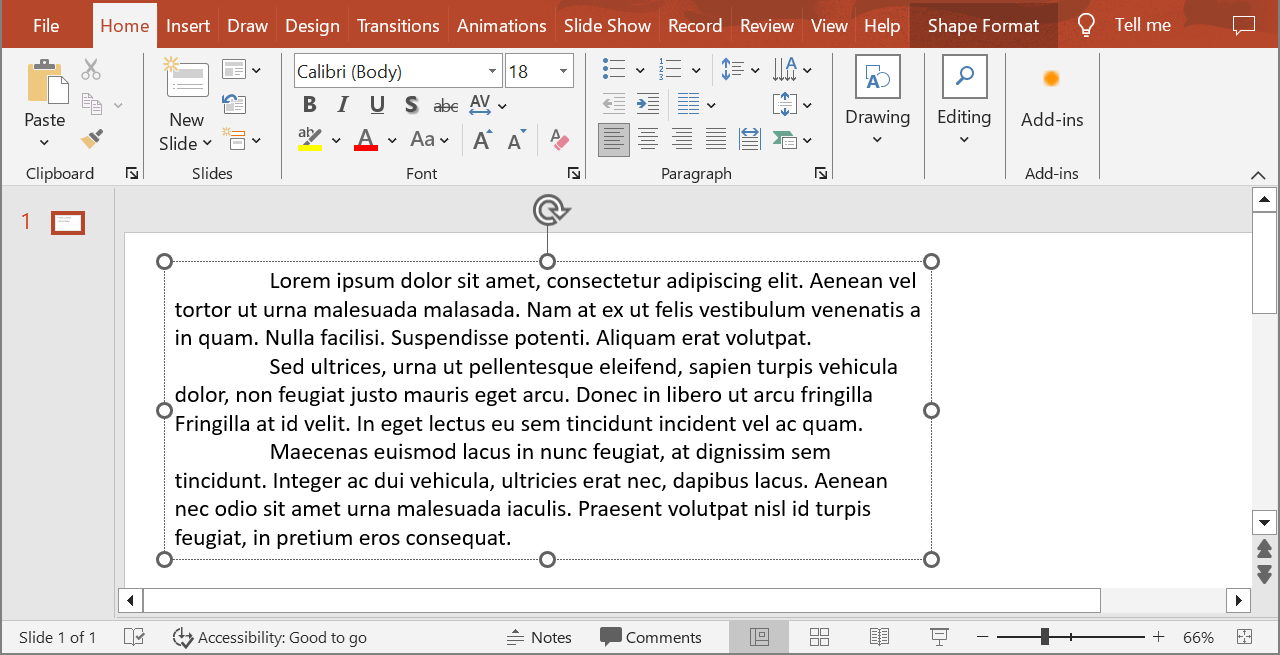
以下の例はインデックス 1 の 2 番目の段落を選択し、スケールパラメータなしで IParagraph.getImage を呼び出します。シェイプに必要な段落が含まれているか、レンダリングが画像を返すかを確認した上で、IImage.save で PNG 形式で保存します。finally ブロックで使用後に画像を破棄します。
import com.aspose.slides.*;

Presentation presentation = new Presentation("sample.pptx");
try {
    IShape shape = presentation.getSlides().get_Item(0).getShapes().get_Item(0);

    if (shape instanceof IAutoShape) {
        IAutoShape textShape = (IAutoShape) shape;
        ITextFrame textFrame = textShape.getTextFrame();
        if (textFrame != null && textFrame.getParagraphs().getCount() > 1) {
            IParagraph paragraph = textFrame.getParagraphs().get_Item(1);
            IImage paragraphImage = paragraph.getImage();

            if (paragraphImage != null) {
                try {
                    paragraphImage.save("paragraph.png", ImageFormat.Png);
                } finally {
                    paragraphImage.dispose();
                }
            } else {
                System.out.println("The paragraph could not be rendered.");
            }
        } else {
            System.out.println("The expected paragraph was not found.");
        }
    } else {
        System.out.println("The first shape is not a text shape.");
    }
} finally {
    presentation.dispose();
}
結果:

テーブルセル内の段落をスケーリングしてレンダリング
float scaleX と float scaleY パラメータを受け取る IParagraph.getImage のオーバーロードを使用して、横方向と縦方向のスケール係数を設定します。以下の例はテーブルを作成し、最初のセル内の段落をデフォルト幅と高さの 2 倍でレンダリングし、PNG 画像として保存します。
import com.aspose.slides.*;

float scaleX = 2f;
float scaleY = 2f;

Presentation presentation = new Presentation();
try {
    ISlide slide = presentation.getSlides().get_Item(0);

    ITable table = slide.getShapes().addTable(50, 50, new double[] { 300 }, new double[] { 80 });
    IParagraph paragraph = table.get_Item(0, 0).getTextFrame().getParagraphs().get_Item(0);
    paragraph.setText("Text in a table cell");

    IImage paragraphImage = paragraph.getImage(scaleX, scaleY);
    if (paragraphImage != null) {
        try {
            paragraphImage.save("table_paragraph.png", ImageFormat.Png);
        } finally {
            paragraphImage.dispose();
        }
    } else {
        System.out.println("The paragraph could not be rendered.");
    }
} finally {
    presentation.dispose();
}
1 のスケール係数はその軸をデフォルトピクセルサイズのままにします。たとえば、両方を 2 にすると、幅と高さが約 2 倍になり、ピクセル数は 4 倍になります。大きな係数はズームや高解像度出力でテキストをより鮮明にしますが、メモリ使用量とファイルサイズも増加します。1 未満の係数は詳細の少ない小さい画像を生成します。段落のアスペクト比を保つには同じ係数を使用し、横と縦で異なる係数を使用すると出力が個別に伸びます。
IShape.getImage でシェイプ全体をレンダリングすることは、シェイプの塗り、枠線、その他の視覚コンテキストを含める必要がある場合に依然有用です。段落のみの画像の場合は、IParagraph.getImage を使用してください。
FAQ
テキストフレーム内の折り返しを完全に無効にできますか?
はい。ITextFrameFormat.setWrapText を設定して折り返しを無効にすれば、行はテキストフレームの端で改行されません。
特定の段落のスライド上での正確な境界を取得するにはどうすればよいですか?
IParagraph.getRect を使用して段落の境界矩形を取得します。IPortion.getRect は個々のポーションの境界を提供します。
段落の配置(左揃え、右揃え、中央揃え、または両端揃え)はどこで制御されますか?
IParagraphFormat.setAlignment は段落レベルの設定であり、個々のポーション書式設定に関係なく段落全体に適用されます。
各行内でフォントサイズが異なるポーションを縦方向に揃える方法については、Align Fonts Within a Line を参照してください。
段落の一部に校正言語を設定できますか?
はい。個々のポーションに対して IBasePortionFormat.setLanguageId を設定すれば、1 つの段落内で複数の言語のテキストを含めることができます。