
Layout Slide
This article demonstrates how to work with Layout Slides in Aspose.Slides for .NET. A layout slide defines the design and formatting inherited by normal slides. You can add, access, clone, and remove layout slides, as well as clean up unused ones to reduce presentation size.
Copy a C# block into Program.cs in a .NET project with Aspose.Slides.NET6.CrossPlatform installed. Each block is a complete program. Run one block at a time. The ZIP contains the IDE-ready project and its verification checks. The copied code runs in evaluation mode. For licensed output, apply your license before creating a presentation, as described in the licensing guide.
Download and run
Download the complete project, extract it, and open Example.sln or run:
dotnet restore Example.sln
dotnet run --project Example.csproj -- --mode evaluation
The download includes every case below, its fixture helpers and inputs. Program.cs runs all cases; use --action block-001 to run one independently. Outputs and an action report are written to the printed output directory. No previous example or working-directory setup is required. Evaluation adds a watermark and can truncate read-back text; the short fixtures still have explicit structural checks. For full text and no watermark, use --mode licensed --license PATH with your own valid license. See the setup guide for supported SDKs and native prerequisites.
Add a Layout Slide
You can create a custom layout slide to define reusable formatting. For example, you might add a text box that appears on all slides using this layout.
using Aspose.Slides.Export;
using Aspose.Slides;

using var presentation = new Presentation();

var masterSlide = presentation.Masters[0];

// Create a layout slide with a blank layout type and a custom name.
var layoutSlide = presentation.LayoutSlides.Add(masterSlide, SlideLayoutType.Blank, "Main layout");

// Add a text box to the layout slide.
var layoutTextBox = layoutSlide.Shapes.AddAutoShape(ShapeType.Rectangle, x: 75, y: 75, width: 150, height: 150);
layoutTextBox.TextFrame.Text = "Base";

// Add two slides using this layout; both will inherit the text from the layout.
presentation.Slides.AddEmptySlide(layoutSlide);
presentation.Slides.AddEmptySlide(layoutSlide);

presentation.Save("layout-slide-01.pptx", SaveFormat.Pptx);
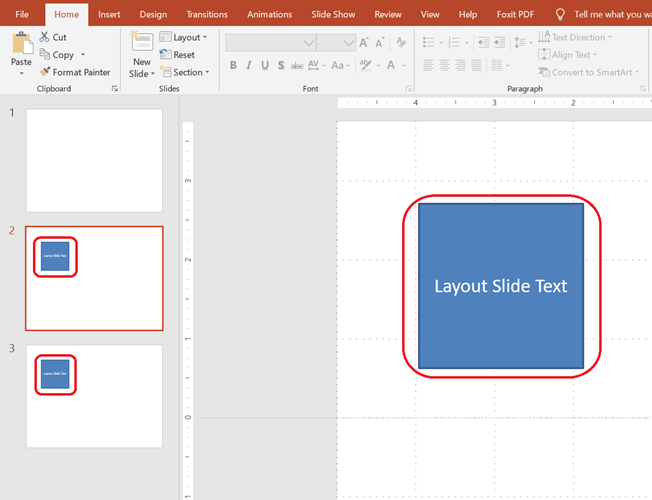
The two added slides inherit the text box from Main layout, as shown below. The default first slide keeps its original layout.
Access a Layout Slide
Layout slides can be accessed by index or by layout type (e.g., Blank, Title, SectionHeader, etc.).
using System;
using Aspose.Slides.Export;
using Aspose.Slides;

using var presentation = new Presentation();

// Access a layout slide by index.
var firstLayoutSlide = presentation.LayoutSlides[0];
Console.WriteLine($"Index 0: {firstLayoutSlide.Name}");

// Access a layout slide by type.
var blankLayoutSlide = presentation.LayoutSlides.GetByType(SlideLayoutType.Blank);
Console.WriteLine($"Blank layout: {blankLayoutSlide.Name}");

presentation.Save("layout-slide-02.pptx", SaveFormat.Pptx);
Remove a Layout Slide
Create and remove an unused layout. It is safe to remove because no normal slide references it.
using Aspose.Slides.Export;
using Aspose.Slides;

using var presentation = new Presentation();

// This new layout is safe to remove because no slide uses it.
var unusedLayout = presentation.LayoutSlides.Add(presentation.Masters[0], SlideLayoutType.Blank, "Unused");
presentation.LayoutSlides.Remove(unusedLayout);

presentation.Save("layout-slide-03.pptx", SaveFormat.Pptx);
Remove Unused Layout Slides
Keep the first slide’s active layout, add a named unused layout, then remove layouts that no normal slide references.
using Aspose.Slides.Export;
using Aspose.Slides;

using var presentation = new Presentation();

var activeLayout = presentation.Slides[0].LayoutSlide;
activeLayout.Name = "Active layout";
presentation.LayoutSlides.Add(presentation.Masters[0], SlideLayoutType.Blank, "Unused layout");

// Keep the referenced active layout and remove unreferenced layouts.
presentation.LayoutSlides.RemoveUnused();

presentation.Save("layout-slide-04.pptx", SaveFormat.Pptx);
Clone a Layout Slide
You can duplicate a layout slide using the AddClone method.
using Aspose.Slides.Export;
using Aspose.Slides;

using var presentation = new Presentation();

// Get an existing layout slide by type.
var blankLayoutSlide = presentation.LayoutSlides.GetByType(SlideLayoutType.Blank);

// Clone the layout slide to the end of the layout slide collection.
var clonedLayoutSlide = presentation.LayoutSlides.AddClone(blankLayoutSlide);
clonedLayoutSlide.Name = "Clone";

presentation.Save("layout-slide-05.pptx", SaveFormat.Pptx);
✅ Summary: Layout slides are powerful tools for managing consistent formatting across slides. Aspose.Slides allows full control over creating, managing, and optimizing layout slides.