

Analyzing your prompt, please hold on...
An error occurred while retrieving the results. Please refresh the page and try again.
When processing documents, acommon task is to extract all images found in the document and export them to an external location. This task becomes simple with the Aspose.Words API, which already provides the functionality for extracting and saving image data.However, sometimes you may want to similarly extract other types of graphic content that is represented by a different type of drawing object, for example, a text box containing paragraphs, arrow shapes, and a small image. There is no straightforward way of rendering this object since itis a combination of individual content elements. You may also encounter a case when the contents have been grouped together into the object that looks like a single image.
Aspose.Words provides functionality for extracting this type of content in the same way you can extract a simple image from shape as rendered content. This article describes how to utilize this functionality to render shapes independently of the document.
All the content in a document drawing layer is represented by theShapeorGroupShapenode in the Aspose.Words Document Object Module (DOM). Such contents can be text boxes, images, AutoShapes, OLE objects, etc. Some fields are also imported as shapes, for example, the INCLUDEPICTURE field.
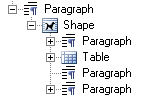
A simple image is represented by aShapenodeofShapeType.Image.This shape node has no child nodes but the image data contained within this shape node can be accessed by theShape.ImageDataproperty.On the other hand, a shape can also be made up of many child nodes.For instance, a text box shape, which is represented by theShapeType.TextBoxproperty, can be made up of many nodes, such asParagraphandTable.Most shapes can include theParagraphandTableblock-level nodes.These are the same nodes as those appearing in the main body. Shapesare always parts of some paragraph, either included directly inline or anchored to the**Paragraph,**but “floating” anywhere in the document page.
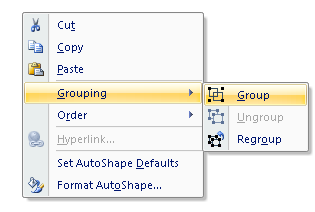
A document can also contain shapes which are grouped together. Grouping can be enabled in Microsoft Word by selecting multiple objects and clicking “Group” in the right-click menu.
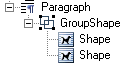
In Aspose.Words, these groups of shapes are represented by the GroupShape node.These can also be invoked in the same way to render the entire group to the image.
The DOCX format can contain special types of images, such as diagrams or charts. These shapes are also represented through theShapenode in Aspose.Words, which also provides a similar method for rendering them as images.By design, a shape cannot contain another shape as a child, unless that shape is an image (ShapeType.Image). For example, Microsoft Word does not allow you to insert a text box inside another text box.
The shape types described above provide a special method to render the shapes through theShapeRendererclass. An instance of theShapeRendererclass is retrieved for aShapeorGroupShapethrough theGetShapeRenderermethod or by passing theShapeto the constructor of theShapeRendererclass. This class provides access to members, which allow rendering a shape to the following:
Graphics Object by using theRenderToSizeandRenderToScalemethodsTheSavemethod provides overloads that render a shape directly to a file or stream. Both overloads accept an instance of theImageSaveOptionsclass, which allows defining options for rendering the shape. This works in the same way as theDocument.Savemethod. Even though this parameter is required, you can pass a null value, specifying that there are no custom options.
The shape can be exported in any image format specified in theSaveFormatenumeration. For example, the image can be rendered as a raster image, such as JPEG by specifying the SaveFormat.Jpegenumeration, or as a vector image, such as EMF by specifying the SaveFormat.Emf.
The code example below illustrates rendering a shape to an EMF image separately from document, and saving to disk:
The code example below illustratesrendering a shape to a JPEG image separately from document, and saving to a stream:
TheImageSaveOptionsclass allows you to specify a variety of options that control how the image is rendered.The functionality described above can be applied in the same manner to theGroupShapeandShapenodes.
Rendering directly to aGraphicsobject allows you to define your own settings and the state for theGraphicsobject. A common scenario involves rendering a shape directly into aGraphicsobject retrieved from a Windows Form or a Bitmap. When theShapenode is rendered, the settings will affect the shape appearance. For example, you can rotate or scale the shape by using theRotateTransformorScaleTransformmethods for theGraphicsobject.
The example belowshows how to render a shape to a .NET Graphicsobject separately from the document and apply rotation to the rendered image:
Similarly, to theRenderToSizemethod, theRenderToSizemethodinherited from theNodeRendererBaseis useful for creating thumbnails of document content. The shape size is specified through the constructor.TheRenderToSizemethod accepts theGraphicsobject, the X and Y coordinates of the image position, and the size of the image (width and height) that will be drawn onto theGraphicsobject.
TheShapecan be rendered to a certain scale using theShapeRenderer.RenderToScalemethodinherited from theNodeRendererBaseclass. This is similar to theDocument.RenderToScalemethod that accepts the same major parameters. The difference between these two methods is that with theShapeRenderer.RenderToScalemethod, instead of a literal size, you choose a float value that scales the shape during its rendering. If the float value equals 1.0causes the shape to be rendered at100% of its original size. A float value of 0.5 will reduce the image size by half.
TheShapeclass represents objects in the drawing layer, such as an AutoShape, text box, freeform, OLE object, ActiveX control, or a picture. Using theShapeclass, you can create or modify shapes in a Microsoft Word document. An important property of a shape is itsShapeType. Shapes of different types can have different capabilities in a Word document. For example, only images and OLE shapes can have images inside them while most of the shapes can have text only.
The following example shows how to render a Shape image to a JPEG image separately from the document and save it tothe disk:
TheShapeRendererclass also provides functionality to retrieve the size of the shape in pixels through theGetSizeInPixelsmethod. This method accepts two float type (Single) parameters – the scale and DPI, which are used in the calculation of the shape size when the shape is rendered. The method returns the Size object, which contains the width and height of the calculated size.This is useful when it is required to know the size of the rendered shape in advance, for examplewhen creating a new Bitmap from the rendered output.
The below example shows how to create a new Bitmap and Graphics object with the width and height of the shape to be rendered:
When using the RenderToSize or RenderToScale methods, the rendered image size is also returned in the SizeF object. This can be assigned to a variable and used if necessary.
The SizeInPointsproperty returns the Shape size measured in points (see ShapeRenderer. A result is a SizeF object containing the width and height.

Analyzing your prompt, please hold on...
An error occurred while retrieving the results. Please refresh the page and try again.