
Analyzing your prompt, please hold on...
An error occurred while retrieving the results. Please refresh the page and try again.
Use message handlers in Aspose.HTML for .NET to customize the network request and response pipeline. A handler can inspect, modify, block, authenticate, resolve, or measure requests before an HTMLDocument loads resources or a conversion workflow renders output.
Message handlers are useful when HTML processing depends on network behavior that must be controlled by your application. They can help load resources from a ZIP archive, implement a custom scheme, block unwanted external requests, set operation timeouts, log request duration, or add authentication credentials for protected resources.
Message handlers are a sequence of classes that are part of a process of a Web request and response through a pipeline. The key concept of message handlers work is chaining them together. The first handler receives a Web request, does some processing, and passes the request on to the next handler. At some point, the response is created and returned along the chain. This pattern is called a delegating handler.
Looking at the Figure, the sequence begins with the Request, then continues through the chain of message handlers. Once the message reaches the server, the Response is sent back through the chain of handlers in reverse order.
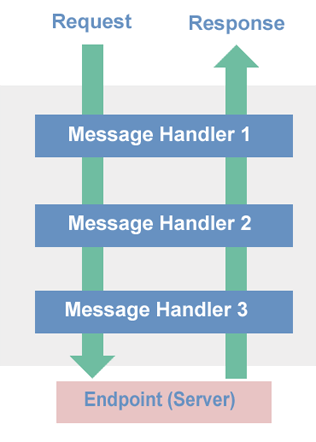
The request message goes through each handler in turn, reaching the last handler. This handler is also the first to receive the response. At this point, this response goes back through the chain of handlers in reverse order, and each handler can check or use the response as needed.
Handler behavior is governed by a set of protocols that describe what action message handlers can take in a given situation. The handlers, their protocols and their place in the chain may be defined by a system or user. For example, a message handler might: change the processing sequence of a pipeline, check requests or responses for errors, log the duration of an operation or other diagnostic information, etc.
MessageHandler, override Invoke(), and add the handler to the network pipeline.Use a custom message handler when you need to control resource loading, authentication, request filtering, timeout behavior, custom schemes, or diagnostics during HTML loading and rendering.
Create a Configuration, get INetworkService, and add or insert a custom MessageHandler into the MessageHandlers collection before loading the HTMLDocument.
Yes. Conversion output can change if a handler blocks resources, changes request URLs, resolves resources from ZIP archives, sets timeouts, or supplies authentication credentials.

Analyzing your prompt, please hold on...
An error occurred while retrieving the results. Please refresh the page and try again.