
用 Python 检索和更新演示文稿信息
概述
Aspose.Slides 可以识别演示文稿的格式并读取其文档元数据,而无需创建完整的演示文稿对象模型。这在需要对文件进行分类、构建清单或在决定是否加载和处理演示文稿内容之前检查属性时非常有用。
本文演示了通过 PresentationFactory 和 PresentationInfo 进行轻量级检查,以及通过 DocumentProperties 进行有针对性的更新。
检查演示文稿格式
如果您已经加载了演示文稿,请参阅 确定原始演示文稿格式 了解加载后检测以及传统 PPT、PPS、POT 流的限制。
使用 PresentationFactory.get_presentation_info 在不创建 Presentation 实例的情况下检查文件。PresentationInfo.load_format 属性报告检测到的格式,如 PPTX、PPT 或 ODP。
import aspose.slides as slides

file_names = ["pres.pptx", "pres.ppt", "pres.odp"]

for file_name in file_names:
    presentation_info = slides.PresentationFactory.instance.get_presentation_info(file_name)
    print(f"{file_name}: {presentation_info.load_format}")
构建轻量级演示文稿清单
在处理大量演示文稿文件时,您可能需要一个紧凑的清单用于验证、索引或文档管理系统。在这种情况下,使用 PresentationFactory.get_presentation_info 获取 PresentationInfo 对象,然后调用 PresentationInfo.read_document_properties 读取文档元数据。此方法不会创建 Presentation 实例,也不需要遍历完整的演示文稿对象模型。
DocumentProperties 暴露的扩展属性提供以下清单值:
| 属性 | 清单值 |
|---|---|
| slides | 幻灯片的总数。 |
| hidden_slides | 隐藏幻灯片的数量。 |
| notes | 包含备注的幻灯片数量。 |
| paragraphs | 段落的总数(如可用)。 |
| words | 单词的总数。 |
| multimedia_clips | 音频和视频剪辑的总数。 |
下面的示例在不创建 Presentation 对象的情况下读取这些值并打印紧凑的清单。它还将 heading_pairs 与 titles_of_parts 结合使用,以显示诸如字体、主题和幻灯片标题等内容组。
import os
import aspose.slides as slides

file_path = "sample.pptx"
presentation_info = slides.PresentationFactory.instance.get_presentation_info(file_path)
document_properties = presentation_info.read_document_properties()

print(f"File: {os.path.basename(file_path)}")
print(f"Format: {presentation_info.load_format}")
print(f"Title: {document_properties.title}")
print(f"Author: {document_properties.author}")
print("Statistics:")
print(f"  Slides: {document_properties.slides}")
print(f"  Hidden slides: {document_properties.hidden_slides}")
print(f"  Slides with notes: {document_properties.notes}")
print(f"  Paragraphs: {document_properties.paragraphs}")
print(f"  Words: {document_properties.words}")
print(f"  Multimedia clips: {document_properties.multimedia_clips}")

heading_pairs = document_properties.heading_pairs or []
titles_of_parts = document_properties.titles_of_parts or []
part_index = 0

if not heading_pairs or not titles_of_parts:
    print("Content groups: not available")
else:
    print("Content groups:")

    for heading_pair in heading_pairs:
        print(f"  {heading_pair.name} ({heading_pair.count})")

        for _ in range(heading_pair.count):
            if part_index >= len(titles_of_parts):
                break

            print(f"    - {titles_of_parts[part_index]}")
            part_index += 1

    if part_index < len(titles_of_parts):
        print("  Other parts:")

        while part_index < len(titles_of_parts):
            print(f"    - {titles_of_parts[part_index]}")
            part_index += 1
每个 HeadingPair 提供一个组名以及该组中项目的数量。DocumentProperties.titles_of_parts 是一个扁平的有序集合,因此按照每个 heading pair 指定的连续标题数量进行消费。
存储的元数据和格式限制
PresentationInfo.read_document_properties 返回的清单属性反映了源文档中可用的元数据。Aspose.Slides 并未加载并遍历演示文稿对象模型来重新计算这些值。缺失的属性以默认值表示,如果最后保存文件的应用程序未更新其文档属性,则存储的值可能已过时。
- PPTX: 该格式为幻灯片、备注、隐藏幻灯片、段落、单词和多媒体计数以及 heading pairs 和 part titles 提供扩展文档属性。可用性取决于文档生成者写入了哪些属性。
- PPT: 二进制格式可以存储相应的文档摘要属性。如果属性缺失或未被文档生成者刷新,Aspose.Slides 将返回其存储的或默认值,而不是从幻灯片计算得到的值。
- ODP: OpenDocument 元数据提供一般的文档统计信息,例如页面、段落和单词计数,但这些值并不映射到每个 PowerPoint 特定的扩展属性。隐藏幻灯片、备注幻灯片、多媒体、heading‑pair 和 part‑title 元数据可能不可用,清单属性可能返回默认值。不要将零值或空集合视为对应内容不存在的权威证明。
在进行清单和初步检查时使用轻量级元数据方法。当结果必须反映内存中的更改或需要验证实际演示文稿内容时,请加载演示文稿并检查其实时对象模型。
更新演示文稿属性
PresentationInfo.read_document_properties 返回的属性也可以在不创建 Presentation 实例的情况下进行更改。使用 PresentationInfo.update_document_properties 应用更改,然后使用 PresentationInfo.write_binded_presentation 将绑定的演示文稿写出。
下面的图像显示了原始文档属性。
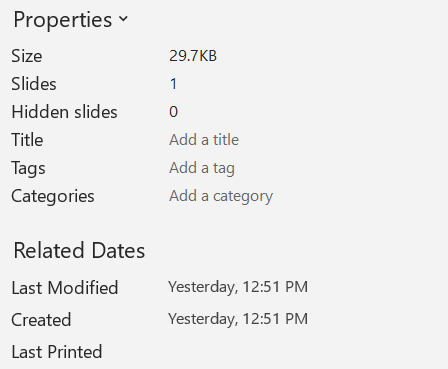
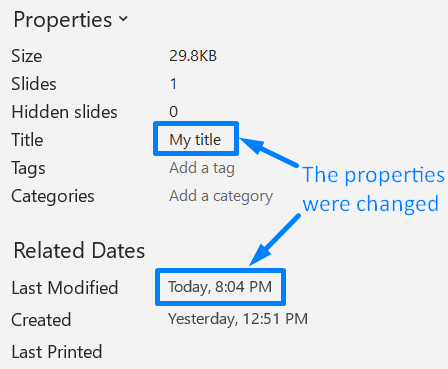
下面的示例更改标题和最后保存时间,并将结果写入新文件:
import datetime
import aspose.slides as slides

source_file = "sample.pptx"
output_file = "sample_with_updated_properties.pptx"
presentation_info = slides.PresentationFactory.instance.get_presentation_info(source_file)
document_properties = presentation_info.read_document_properties()

document_properties.title = "Quarterly sales report"
document_properties.last_saved_time = datetime.datetime.now(datetime.timezone.utc)

presentation_info.update_document_properties(document_properties)

with open(output_file, "wb") as output_stream:
    presentation_info.write_binded_presentation(output_stream)
下面的图像显示了更新后的文档属性。
有用的链接
有关相关安全检查和保护设置,请参阅下列文章:
常见问题
如何检查字体是否已嵌入以及具体哪些字体已嵌入?
加载演示文稿并使用 Presentation.fonts_manager。调用 FontsManager.get_embedded_fonts 获取已嵌入的字体,调用 FontsManager.get_fonts 获取演示文稿使用的字体。将两者结果进行比较,即可找出需要渲染但未嵌入的字体。
如何快速判断文件是否包含隐藏幻灯片以及数量?
当存储的文档元数据足够时,可通过 PresentationFactory.get_presentation_info 和 PresentationInfo.read_document_properties 读取 DocumentProperties.hidden_slides。这适用于轻量级清单。如果演示文稿已在内存中修改,存储的元数据可能缺失或过时,或需要验证实时值,则遍历 Presentation.slides 并检查每个幻灯片的 Slide.hidden 属性。
我能否检测是否使用了自定义幻灯片尺寸和方向,以及它们是否与默认值不同?
可以。加载演示文稿并读取 Presentation.slide_size。检查 SlideSize.type、SlideSize.size 和 SlideSize.orientation 以将当前设置与预期的预设和尺寸进行比较。
有没有快速方法查看图表是否引用外部数据源?
有。定位每个 Chart 并检查 ChartData.data_source_type。对于外部工作簿,读取 ChartData.external_workbook_path。数据源类型和路径可识别外部引用,但是否可用需要另外的资源检查。
如何评估可能导致渲染或 PDF 导出变慢的“重量”幻灯片?
没有单一的复杂度属性。遍历 Presentation.slides 并检查每个幻灯片的 BaseSlide.shapes 集合。使用形状计数以及是否包含大图像、效果、动画或多媒体作为筛选信号,并在将幻灯片视为确定的性能瓶颈之前进行代表性的渲染或导出测量。