
使用 Python 取得與更新簡報資訊
概覽
Aspose.Slides 能夠辨識簡報的格式,並在不建立完整簡報物件模型的情況下讀取其文件中繼資料。當您需要對檔案進行分類、建立清單,或在決定是否載入與處理簡報內容之前檢查屬性時,這非常有用。
本文展示如何透過 PresentationFactory 與 PresentationInfo 進行輕量級檢查,以及如何透過 DocumentProperties 進行目標更新。
檢查簡報格式
如果您已經載入簡報,請參閱 Determine the Original Presentation Format 以了解載入後的偵測方式以及舊版 PPT、PPS 與 POT 串流的限制。
使用 PresentationFactory.get_presentation_info 可在不建立 Presentation 實例的情況下檢查檔案。PresentationInfo.load_format 屬性會回報偵測到的格式,如 PPTX、PPT 或 ODP。
import aspose.slides as slides

file_names = ["pres.pptx", "pres.ppt", "pres.odp"]

for file_name in file_names:
    presentation_info = slides.PresentationFactory.instance.get_presentation_info(file_name)
    print(f"{file_name}: {presentation_info.load_format}")
建立輕量級簡報清單
當您處理大量簡報檔案時,可能需要一個緊湊的清單來進行驗證、索引或文件管理系統。在此情境下,使用 PresentationFactory.get_presentation_info 取得 PresentationInfo 物件,然後呼叫 PresentationInfo.read_document_properties 讀取文件中繼資料。此方法不會建立 Presentation 實例,也不需要遍歷完整的簡報物件模型。
由 DocumentProperties 提供的擴充屬性提供以下清單值:
| 屬性 | 庫存值 |
|---|---|
| slides | 幻燈片總數。 |
| hidden_slides | 隱藏幻燈片的數量。 |
| notes | 包含備註的幻燈片數量。 |
| paragraphs | 段落總數(若有提供)。 |
| words | 字數總計。 |
| multimedia_clips | 音訊與視訊剪輯總數。 |
以下範例在不建立 Presentation 物件的情況下讀取這些值,並輸出緊湊的清單。它同時結合 heading_pairs 與 titles_of_parts 以顯示如字型、主題與幻燈片標題等內容群組。
import os
import aspose.slides as slides

file_path = "sample.pptx"
presentation_info = slides.PresentationFactory.instance.get_presentation_info(file_path)
document_properties = presentation_info.read_document_properties()

print(f"File: {os.path.basename(file_path)}")
print(f"Format: {presentation_info.load_format}")
print(f"Title: {document_properties.title}")
print(f"Author: {document_properties.author}")
print("Statistics:")
print(f"  Slides: {document_properties.slides}")
print(f"  Hidden slides: {document_properties.hidden_slides}")
print(f"  Slides with notes: {document_properties.notes}")
print(f"  Paragraphs: {document_properties.paragraphs}")
print(f"  Words: {document_properties.words}")
print(f"  Multimedia clips: {document_properties.multimedia_clips}")

heading_pairs = document_properties.heading_pairs or []
titles_of_parts = document_properties.titles_of_parts or []
part_index = 0

if not heading_pairs or not titles_of_parts:
    print("Content groups: not available")
else:
    print("Content groups:")

    for heading_pair in heading_pairs:
        print(f"  {heading_pair.name} ({heading_pair.count})")

        for _ in range(heading_pair.count):
            if part_index >= len(titles_of_parts):
                break

            print(f"    - {titles_of_parts[part_index]}")
            part_index += 1

    if part_index < len(titles_of_parts):
        print("  Other parts:")

        while part_index < len(titles_of_parts):
            print(f"    - {titles_of_parts[part_index]}")
            part_index += 1
每個 HeadingPair 提供一個群組名稱與該群組中的項目數量。DocumentProperties.titles_of_parts 為平坦且有序的集合,因此請根據每個 heading pair 指定的連續標題數量來讀取。
儲存的中繼資料與格式限制
由 PresentationInfo.read_document_properties 回傳的清單屬性反映來源文件中可用的中繼資料。Aspose.Slides 不會載入並遍歷簡報物件模型以重新計算此呼叫的值。缺少的屬性會以預設值表示;若最後儲存檔案的應用程式未更新其文件屬性,儲存的值可能已過時。
- PPTX: 此格式提供幻燈片、備註、隱藏幻燈片、段落、單字與多媒體計數的擴充文件屬性,以及 heading pairs 與 part titles。可用性取決於文件製作者寫入了哪些屬性。
- PPT: 此二進位格式可以儲存相應的文件摘要屬性。若屬性缺失或未由文件製作者重新整理,Aspose.Slides 會回傳其儲存的或預設的值,而不是從幻燈片重新計算。
- ODP: OpenDocument 中繼資料提供一般文件統計資訊,例如頁面、段落與字數計數,但這些值並不對應每個 PowerPoint 特有的擴充屬性。隱藏幻燈片、備註幻燈片、多媒體、heading‑pair 與 part‑title 中繼資料可能不可用,清單屬性可能回傳預設值。不要將零值或空集合視為相應內容缺失的權威證明。
對於清單與初步檢查,請使用輕量級的中繼資料方法。當結果必須反映記憶體中的變更或需要驗證實際簡報內容時,請載入簡報並檢查其即時物件模型。
更新簡報屬性
由 PresentationInfo.read_document_properties 回傳的屬性亦可在不建立 Presentation 實例的情況下變更。使用 PresentationInfo.update_document_properties 套用變更,然後使用 PresentationInfo.write_binded_presentation 寫入繫結的簡報。
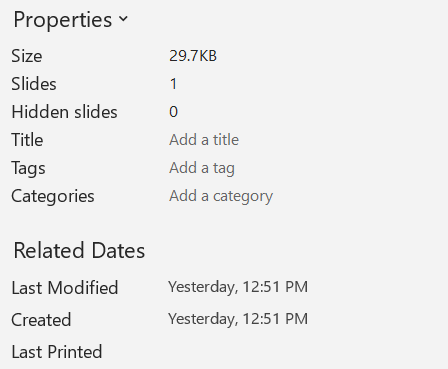
下圖顯示原始文件屬性。
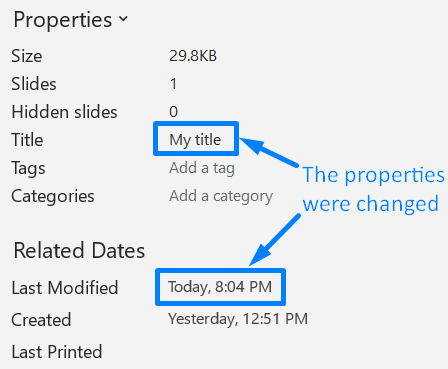
以下範例變更標題與最後儲存時間,並將結果寫入新檔案:
import datetime
import aspose.slides as slides

source_file = "sample.pptx"
output_file = "sample_with_updated_properties.pptx"
presentation_info = slides.PresentationFactory.instance.get_presentation_info(source_file)
document_properties = presentation_info.read_document_properties()

document_properties.title = "Quarterly sales report"
document_properties.last_saved_time = datetime.datetime.now(datetime.timezone.utc)

presentation_info.update_document_properties(document_properties)

with open(output_file, "wb") as output_stream:
    presentation_info.write_binded_presentation(output_stream)
下圖顯示更新後的文件屬性。
實用連結
有關相關的安全檢查與保護設定,請參閱以下文章:
常見問題
如何檢查字型是否已嵌入以及是哪一些字型?
載入簡報後使用 Presentation.fonts_manager。呼叫 FontsManager.get_embedded_fonts 取得已嵌入的字型,並呼叫 FontsManager.get_fonts 取得簡報使用的字型。比較兩者結果即可找出渲染所需但未嵌入的字型。
如何快速判斷檔案是否有隱藏幻燈片以及其數量?
當儲存的文件中繼資料足夠時,可透過 PresentationFactory.get_presentation_info 與 PresentationInfo.read_document_properties 讀取 DocumentProperties.hidden_slides。這適用於輕量級清單。若簡報在記憶體中已被修改,儲存的中繼資料可能缺失或過時,或需驗證即時值,則必須遍歷 Presentation.slides 並檢查每張幻燈片的 Slide.hidden 屬性。
我能偵測是否使用自訂投影片大小與方向,且是否與預設不同嗎?
可以。載入簡報後讀取 Presentation.slide_size。檢查 SlideSize.type、SlideSize.size 與 SlideSize.orientation 以將目前設定與預設的配置與尺寸作比較。
是否有快速方法查看圖表是否引用外部資料來源?
可以。定位每個 Chart 並檢查 ChartData.data_source_type。若為外部工作簿,則讀取 ChartData.external_workbook_path。資料來源類型與路徑可識別外部參考,但驗證目標是否可用需另行資源檢查。
如何評估可能會減慢渲染或 PDF 匯出的「大型」投影片?
沒有單一的複雜度屬性。遍歷 Presentation.slides 與每張幻燈片的 BaseSlide.shapes 集合。利用形狀數量以及大型影像、特效、動畫或多媒體的存在作為篩選訊號,並在將幻燈片視為確定的效能瓶頸之前,測量具代表性的渲染或匯出時間。