
在 C++ 中向演示文稿图表添加趋势线
概述
本文解释了如何使用 Aspose.Slides 向演示文稿图表添加趋势线。它展示了如何创建图表、向图表系列添加趋势线,以及如何使用多种趋势线类型,包括指数、线性、对数、移动平均、多项式和幂。
它还描述了如何通过插入线形状向图表添加自定义线,并提供了一个简短的 FAQ,说明趋势线的前向和后向投影值的含义,以及在导出为 PDF 或 SVG 或将图表渲染为图像时趋势线是否会被保留。
添加趋势线
使用 ITrendlineCollection::Add 向图表系列添加趋势线,并使用 TrendlineType 选择其类型。示例创建了一个带有默认数据的簇状柱形图,并为其三个系列中的每个系列添加了两条趋势线。
指数趋势线通过 ITrendline::set_DisplayEquation 和 ITrendline::set_DisplayRSquaredValue 隐藏其方程式和 R 平方值,而线性趋势线为红色。对数趋势线使用 IOverridableText::AddTextFrameForOverriding 添加自定义标签。移动平均使用 ITrendline::set_Period 将三个数据点求平均,并使用 ITrendline::set_TrendlineName 设置自定义名称。
多项式趋势线使用 ITrendline::set_Order 将其次数设为三,并通过 ITrendline::set_Forward 向前延伸一个类别。幂趋势线通过 ITrendline::set_Backward 向后延伸一个类别。
#include <system/shared_ptr.h>
#include <drawing/color.h>
#include <DOM/Presentation.h>
#include <DOM/ISlide.h>
#include <DOM/IShapeCollection.h>
#include <DOM/ILineFormat.h>
#include <DOM/IFillFormat.h>
#include <DOM/IColorFormat.h>
#include <DOM/FillType.h>
#include <DOM/IChart.h>
#include <DOM/Chart/ChartType.h>
#include <DOM/Chart/IChartData.h>
#include <DOM/Chart/IChartSeries.h>
#include <DOM/Chart/IChartSeriesCollection.h>
#include <DOM/Chart/ITrendline.h>
#include <DOM/Chart/ITrendlineCollection.h>
#include <DOM/Chart/TrendlineType.h>
#include <DOM/Chart/IFormat.h>
#include <Export/SaveFormat.h>

using namespace System;
using namespace System::Drawing;
using namespace Aspose::Slides;
using namespace Aspose::Slides::Charts;
using namespace Aspose::Slides::Export;

auto presentation = MakeObject<Presentation>();
auto slide = presentation->get_Slide(0);

auto chart = slide->get_Shapes()->AddChart(ChartType::ClusteredColumn, 20, 20, 500, 400);

auto firstSeries = chart->get_ChartData()->get_Series()->idx_get(0);

auto exponentialTrendline = firstSeries->get_TrendLines()->Add(TrendlineType::Exponential);
exponentialTrendline->set_DisplayEquation(false);
exponentialTrendline->set_DisplayRSquaredValue(false);

auto linearTrendline = firstSeries->get_TrendLines()->Add(TrendlineType::Linear);
linearTrendline->get_Format()->get_Line()->get_FillFormat()->set_FillType(FillType::Solid);
linearTrendline->get_Format()->get_Line()->get_FillFormat()->get_SolidFillColor()->set_Color(Color::get_Red());

auto secondSeries = chart->get_ChartData()->get_Series()->idx_get(1);

auto logarithmicTrendline = secondSeries->get_TrendLines()->Add(TrendlineType::Logarithmic);
logarithmicTrendline->AddTextFrameForOverriding(u"New log trend line");

auto movingAverageTrendline = secondSeries->get_TrendLines()->Add(TrendlineType::MovingAverage);
movingAverageTrendline->set_Period(3);
movingAverageTrendline->set_TrendlineName(u"New TrendLine Name");

auto thirdSeries = chart->get_ChartData()->get_Series()->idx_get(2);

auto polynomialTrendline = thirdSeries->get_TrendLines()->Add(TrendlineType::Polynomial);
polynomialTrendline->set_Forward(1);
polynomialTrendline->set_Order(3);

auto powerTrendline = thirdSeries->get_TrendLines()->Add(TrendlineType::Power);
powerTrendline->set_Backward(1);

presentation->Save(u"ChartTrendLines.pptx", SaveFormat::Pptx);
设置趋势线截距
使用 ITrendline::set_Intercept 将趋势线在 X = 0 时的 Y 值固定。此设置支持线性、指数和多项式趋势线。
例如,生产成本模型可能需要在已知的固定成本 100 处开始,即使在非零生产量的测量数据暗示不同的基线。对于线性趋势线,将截距固定会将方程 y = ax + b 约束为 b = 100;斜率在该约束下拟合数据。这并不是简单地移动已拟合的直线。轴交叉设置决定图表坐标轴的交点位置,而不是已拟合趋势线的系数。
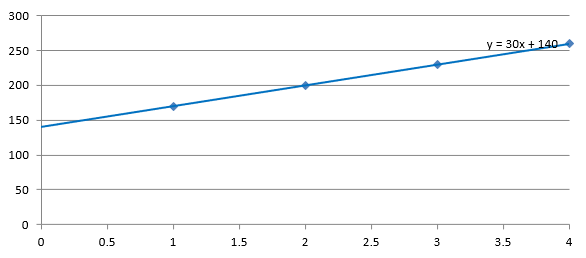
下面的示例创建了一个散点 (XY) 图表,生产量为 1 到 4,成本分别为 170、200、230 和 260。它先使用默认自动截距保存图表,然后将截距设为 100 再保存为第二个 PPTX。两个文件唯一的区别在于截距设置。趋势线显示其方程式并向后延伸至 X = 0。
#include <system/shared_ptr.h>
#include <system/object_ext.h>
#include <DOM/Chart/IChartDataWorkbook.h>
#include <DOM/Chart/IChartDataCell.h>
#include <DOM/Chart/IChartCategoryCollection.h>
#include <DOM/Chart/IChartDataPointCollection.h>
#include <DOM/Presentation.h>
#include <DOM/ISlide.h>
#include <DOM/IShapeCollection.h>
#include <DOM/IChart.h>
#include <DOM/Chart/ChartType.h>
#include <DOM/Chart/IChartData.h>
#include <DOM/Chart/IChartSeries.h>
#include <DOM/Chart/IChartSeriesCollection.h>
#include <DOM/Chart/ITrendline.h>
#include <DOM/Chart/ITrendlineCollection.h>
#include <DOM/Chart/TrendlineType.h>
#include <Export/SaveFormat.h>

using namespace System;
using namespace Aspose::Slides;
using namespace Aspose::Slides::Charts;
using namespace Aspose::Slides::Export;

auto presentation = MakeObject<Presentation>();
auto slide = presentation->get_Slide(0);

auto chart = slide->get_Shapes()->AddChart(ChartType::ScatterWithMarkers, 20, 20, 480, 210);
chart->set_HasLegend(false);

chart->get_ChartData()->get_Series()->Clear();
chart->get_ChartData()->get_Categories()->Clear();

auto workbook = chart->get_ChartData()->get_ChartDataWorkbook();
workbook->Clear(0);

auto nameCell = workbook->GetCell(0, 0, 1, ObjectExt::Box<String>(u"Production cost"));
auto series = chart->get_ChartData()->get_Series()->Add(nameCell, ChartType::ScatterWithMarkers);
const double costs[] = { 170, 200, 230, 260 };

for (auto i = 0; i < 4; i++)
{
    auto xCell = workbook->GetCell(0, i + 1, 0, ObjectExt::Box<int32_t>(i + 1));
    auto yCell = workbook->GetCell(0, i + 1, 1, ObjectExt::Box<double>(costs[i]));
    series->get_DataPoints()->AddDataPointForScatterSeries(xCell, yCell);
}

auto trendline = series->get_TrendLines()->Add(TrendlineType::Linear);
trendline->set_DisplayEquation(true);
trendline->set_Backward(1);

presentation->Save(u"AutomaticIntercept.pptx", SaveFormat::Pptx);

trendline->set_Intercept(100);
presentation->Save(u"FixedIntercept.pptx", SaveFormat::Pptx);
在自动计算情况下,这些数据得到 y = 30x + 140。将截距设为 100 时得到约 y = 43.33x + 100:零点的拟合值与已知基线相匹配,但线条不再经过所有数据点。
| 自动截距 | 固定截距为 100 |
|---|---|
 |
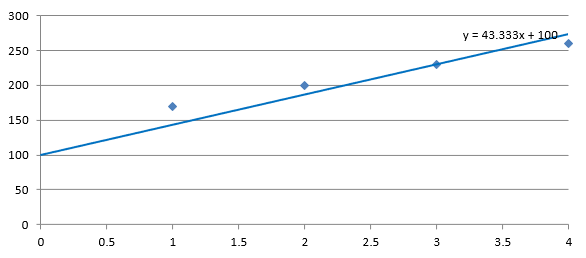 |
两张图片使用相同的数据和坐标轴比例。趋势线向后延伸至 X = 0,以显示其截距。
默认情况下,该属性包含 std::numeric_limits<double>::quiet_NaN(),表示截距未指定而非零。随后截距会根据数据自动计算。
添加自定义线
自定义线是一种在图表上方绘制的形状,而不是从系列数据计算得到的趋势线。此示例使用 IShapeCollection::AddAutoShape 向包含图表的幻灯片添加一条水平线。该线的位置以幻灯片坐标(点)指定,因此从图表的左边缘开始,位于图表中部的高度。其宽度与图表宽度相同。通过 IShape::get_LineFormat 返回的线条格式为该线设置了实心红色。
#include <system/shared_ptr.h>
#include <drawing/color.h>
#include <DOM/Presentation.h>
#include <DOM/ISlide.h>
#include <DOM/IShapeCollection.h>
#include <DOM/IAutoShape.h>
#include <DOM/ShapeType.h>
#include <DOM/ILineFormat.h>
#include <DOM/IFillFormat.h>
#include <DOM/IColorFormat.h>
#include <DOM/FillType.h>
#include <DOM/IChart.h>
#include <DOM/Chart/ChartType.h>
#include <Export/SaveFormat.h>

using namespace System;
using namespace System::Drawing;
using namespace Aspose::Slides;
using namespace Aspose::Slides::Charts;
using namespace Aspose::Slides::Export;

auto presentation = MakeObject<Presentation>();
auto slide = presentation->get_Slide(0);

auto chart = slide->get_Shapes()->AddChart(ChartType::ClusteredColumn, 100, 100, 500, 400);

auto line = slide->get_Shapes()->AddAutoShape(ShapeType::Line, chart->get_X(), chart->get_Y() + chart->get_Height() / 2, chart->get_Width(), 0);
line->get_LineFormat()->get_FillFormat()->set_FillType(FillType::Solid);
line->get_LineFormat()->get_FillFormat()->get_SolidFillColor()->set_Color(Color::get_Red());

presentation->Save(u"AddCustomLines.pptx", SaveFormat::Pptx);
FAQ
“前向”和“后向”在趋势线中是什么意思?
它们指的是趋势线向前/向后投影的长度:对于散点 (XY) 图表,以坐标轴单位表示;对于非散点图表,以类别数量表示。仅允许非负值。
在将演示文稿导出为 PDF 或 SVG,或将幻灯片渲染为图像时,趋势线会被保留吗?
会。Aspose.Slides 可将演示文稿转换为 PDF 或 SVG,并将图表渲染为图像;趋势线作为图表的一部分,在这些操作中会被保留。还提供了将图表本身导出为图像的 export an image of the chart 方法。