
Formatieren von Präsentationstext in C++
Übersicht
Dieser Artikel zeigt, wie Text in PowerPoint- und OpenDocument-Präsentationen mit Aspose.Slides für C++ formatiert wird. Er behandelt Hintergrundfarben, Transparenz, Zeichenabstand, Schriftarteigenschaften, Drehung, Absatzabstand, Autofit‑Verhalten, Textausrichtung, Tabstopps und Spracheinstellungen.
Sofern nicht anders angegeben, verwenden die Beispiele sample.pptx. Die erste Form auf seiner ersten Folie ist ein Textfeld, und ihr erster Absatz enthält den unten gezeigten Text. Sowohl Folien‑ als auch Form‑Indizes beginnen bei null. Beispiele, die fette Abschnitte auswählen, verwenden die effektive Formatierung, einschließlich vererbter Fettschrift:

Um literal Text oder reguläre‑Ausdruck‑Übereinstimmungen zu finden und hervorzuheben, siehe Suche und ersetze Text.
Texthintergrundfarbe festlegen
Verwenden Sie IParagraphFormat::get_DefaultPortionFormat, um die Standard‑Hervorhebungsfarbe für einen Absatz festzulegen, oder verwenden Sie IBasePortionFormat::get_HighlightColor, um einzelne Textabschnitte zu formatieren.
Das folgende Beispiel legt eine hellgraue Hervorhebung als Standard für den ersten Absatz fest. Explizite Hervorhebungsfarben für einzelne Abschnitte haben Vorrang vor diesem Standard:
#include <DOM/IAutoShape.h>
#include <DOM/IColorFormat.h>
#include <DOM/IParagraph.h>
#include <DOM/IParagraphFormat.h>
#include <DOM/IPortionFormat.h>
#include <DOM/ISlide.h>
#include <DOM/ITextFrame.h>
#include <DOM/Presentation.h>
#include <Export/SaveFormat.h>
#include <drawing/color.h>

using namespace Aspose::Slides;
using namespace Aspose::Slides::Export;

auto presentation = System::MakeObject<Presentation>(u"sample.pptx");
auto firstShape = presentation->get_Slide(0)->get_Shape(0);

auto autoShape = System::ExplicitCast<IAutoShape>(firstShape);

auto paragraph = autoShape->get_TextFrame()->get_Paragraph(0);
auto defaultPortionFormat = paragraph->get_ParagraphFormat()->get_DefaultPortionFormat();
auto highlightColor = System::Drawing::Color::get_LightGray();

// Setze die Hervorhebungsfarbe für den gesamten Absatz.
defaultPortionFormat->get_HighlightColor()->set_Color(highlightColor);

presentation->Save(u"gray_paragraph.pptx", SaveFormat::Pptx);
presentation->Dispose();
Das Ergebnis:

Das folgende Codebeispiel zeigt, wie die Hintergrundfarbe für Textabschnitte mit fetter Schrift festgelegt wird:
#include <DOM/IAutoShape.h>
#include <DOM/IColorFormat.h>
#include <DOM/IParagraph.h>
#include <DOM/IPortion.h>
#include <DOM/IPortionCollection.h>
#include <DOM/IPortionFormat.h>
#include <DOM/IPortionFormatEffectiveData.h>
#include <DOM/ISlide.h>
#include <DOM/ITextFrame.h>
#include <DOM/Presentation.h>
#include <Export/SaveFormat.h>
#include <drawing/color.h>

using namespace Aspose::Slides;
using namespace Aspose::Slides::Export;

auto presentation = System::MakeObject<Presentation>(u"sample.pptx");
auto firstShape = presentation->get_Slide(0)->get_Shape(0);

auto autoShape = System::ExplicitCast<IAutoShape>(firstShape);

auto paragraph = autoShape->get_TextFrame()->get_Paragraph(0);
auto portions = paragraph->get_Portions();
int portionCount = portions->get_Count();
auto highlightColor = System::Drawing::Color::get_LightGray();

for (int portionIndex = 0; portionIndex < portionCount; portionIndex++)
{
    auto portion = paragraph->get_Portion(portionIndex);
    auto portionFormat = portion->get_PortionFormat();
    if (portionFormat->GetEffective()->get_FontBold())
    {
        // Setze die Hervorhebungsfarbe für den Textabschnitt.
        portionFormat->get_HighlightColor()->set_Color(highlightColor);
    }
}

presentation->Save(u"gray_text_portions.pptx", SaveFormat::Pptx);
presentation->Dispose();
Das Ergebnis:

Textabsätze ausrichten
Verwenden Sie IParagraphFormat::set_Alignment, um die Absatzausrichtung innerhalb eines Textfelds festzulegen. Der Wert kann zentriert, linksbündig, rechtsbündig, im Blocksatz usw. sein.
Das folgende Codebeispiel zeigt, wie der Absatz mittig ausgerichtet wird:
#include <DOM/IAutoShape.h>
#include <DOM/IParagraph.h>
#include <DOM/IParagraphFormat.h>
#include <DOM/ISlide.h>
#include <DOM/ITextFrame.h>
#include <DOM/Presentation.h>
#include <DOM/TextAlignment.h>
#include <Export/SaveFormat.h>

using namespace Aspose::Slides;
using namespace Aspose::Slides::Export;

auto presentation = System::MakeObject<Presentation>(u"sample.pptx");
auto firstShape = presentation->get_Slide(0)->get_Shape(0);

auto autoShape = System::ExplicitCast<IAutoShape>(firstShape);
auto paragraph = autoShape->get_TextFrame()->get_Paragraph(0);

// Setze die Ausrichtung des Absatzes auf Mitte.
paragraph->get_ParagraphFormat()->set_Alignment(TextAlignment::Center);

presentation->Save(u"aligned_paragraph.pptx", SaveFormat::Pptx);
presentation->Dispose();
Das Ergebnis:

Schriftarten innerhalb einer Zeile ausrichten
Verwenden Sie IParagraphFormat::set_FontAlignment, um Textabschnitte mit unterschiedlichen Schriftgrößen innerhalb einer Zeile vertikal auszurichten. Diese Einstellung gilt für den gesamten Absatz und steuert die Ausrichtung innerhalb jeder Zeile.
Das folgende eigenständige Beispiel erstellt vier beschriftete Textfelder auf einer Folie. Jeder Absatz enthält denselben Text mit 18, 36 bzw. 54 Punkten und einer anderen Schrift‑ausrichtung. Es verwendet Arial, deaktiviert Autofit und Zeilenumbruch und hält die Textfelder groß genug für eine einzelne Zeile.
#include <DOM/FontAlignment.h>
#include <DOM/Fonts/FontData.h>
#include <DOM/IAutoShape.h>
#include <DOM/IColorFormat.h>
#include <DOM/IFillFormat.h>
#include <DOM/ILineFormat.h>
#include <DOM/IParagraph.h>
#include <DOM/IParagraphCollection.h>
#include <DOM/IParagraphFormat.h>
#include <DOM/IPortionCollection.h>
#include <DOM/IPortionFormat.h>
#include <DOM/IShapeCollection.h>
#include <DOM/ISlide.h>
#include <DOM/ITextFrame.h>
#include <DOM/ITextFrameFormat.h>
#include <DOM/FillType.h>
#include <DOM/NullableBool.h>
#include <DOM/Paragraph.h>
#include <DOM/Portion.h>
#include <DOM/Presentation.h>
#include <DOM/ShapeType.h>
#include <DOM/TextAlignment.h>
#include <DOM/TextAnchorType.h>
#include <DOM/TextAutofitType.h>
#include <Export/SaveFormat.h>
#include <drawing/color.h>

using namespace Aspose::Slides;
using namespace Aspose::Slides::Export;
using namespace System;
using namespace System::Drawing;

auto presentation = MakeObject<Presentation>();
auto slide = presentation->get_Slide(0);

FontAlignment alignments[] = { FontAlignment::Baseline, FontAlignment::Top, FontAlignment::Center, FontAlignment::Bottom };
String labels[] = { u"Baseline", u"Top", u"Center", u"Bottom" };
float fontSizes[] = { 18.0f, 36.0f, 54.0f };
auto font = MakeObject<FontData>(u"Arial");

for (auto i = 0; i < 4; i++)
{
    auto shape = slide->get_Shapes()->AddAutoShape(ShapeType::Rectangle, 30, 20 + i * 130, 660, 120);
    shape->get_FillFormat()->set_FillType(FillType::NoFill);
    shape->get_LineFormat()->get_FillFormat()->set_FillType(FillType::NoFill);

    auto textFrame = shape->get_TextFrame();
    textFrame->get_TextFrameFormat()->set_AnchoringType(TextAnchorType::Top);
    textFrame->get_TextFrameFormat()->set_AutofitType(TextAutofitType::None);
    textFrame->get_TextFrameFormat()->set_WrapText(NullableBool::False);

    auto label = textFrame->get_Paragraph(0);
    label->set_Text(labels[i]);
    label->get_ParagraphFormat()->set_Alignment(TextAlignment::Left);
    auto labelFormat = label->get_ParagraphFormat()->get_DefaultPortionFormat();
    labelFormat->set_FontHeight(14);
    labelFormat->set_LatinFont(font);
    labelFormat->get_FillFormat()->set_FillType(FillType::Solid);
    labelFormat->get_FillFormat()->get_SolidFillColor()->set_Color(Color::get_Gray());

    auto paragraph = MakeObject<Paragraph>();
    paragraph->get_ParagraphFormat()->set_FontAlignment(alignments[i]);
    paragraph->get_ParagraphFormat()->set_Alignment(TextAlignment::Left);
    auto portionFormat = paragraph->get_ParagraphFormat()->get_DefaultPortionFormat();
    portionFormat->set_LatinFont(font);
    portionFormat->get_FillFormat()->set_FillType(FillType::Solid);
    portionFormat->get_FillFormat()->get_SolidFillColor()->set_Color(Color::get_Black());

    for (auto fontSize : fontSizes)
    {
        auto portion = MakeObject<Portion>(u"Ag ");
        portion->get_PortionFormat()->set_FontHeight(fontSize);
        paragraph->get_Portions()->Add(portion);
    }

    textFrame->get_Paragraphs()->Add(paragraph);
}

presentation->Save(u"font_alignment.pptx", SaveFormat::Pptx);
presentation->Dispose();
Das Ergebnis:
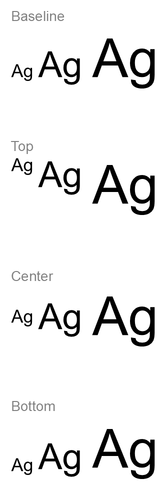
Die Schrift‑ausrichtung verwendet Schrift‑metriken, sodass die sichtbaren Kanten einzelner Buchstaben nicht unbedingt exakt übereinstimmen. Das Beispiel enthält sowohl einen Großbuchstaben als auch einen Unterlaufführer, um den Unterschied zwischen Grundlinie‑ und Unter‑Ausrichtung zu verdeutlichen. Schriftartenverfügbarkeit und -ersatz, die verwendeten Zeichen und die Unterschiedlichkeit der Schriftgrößen beeinflussen das Ergebnis. Rahmen‑Abmessungen, Ränder, Zeilenabstand, Zeilenumbruch und Autofit wirken sich ebenfalls auf das Layout aus; verwenden Sie dieselben Schriften und Layouteinstellungen beim Vergleich der Modi.
Diese Einstellung unterscheidet sich von IParagraphFormat::set_Alignment, die die horizontale Absatzausrichtung steuert, und von ITextFrameFormat::set_AnchoringType, die den Textblock vertikal innerhalb seiner Form positioniert. Hoch- und Tiefgestellt‑Formatierung über IBasePortionFormat::set_Escapement verschiebt einzelne Abschnitte relativ zur Grundlinie, anstatt die Schrift‑ausrichtung für die Zeilen des Absatzes festzulegen.
Transparenz für Text festlegen
Die Texttransparenz wird über die Alpha‑Komponente der über IBasePortionFormat::get_FillFormat zugewiesenen Farbe gesteuert. In den nachfolgenden Beispielen ist alpha = 50 ein ARGB‑Alpha‑Kanalwert im Bereich 0–255 und keine Transparenz‑Prozentsatz.
Das folgende Codebeispiel zeigt, wie Transparenz auf den gesamten Absatz angewendet wird:
#include <DOM/FillType.h>
#include <DOM/IAutoShape.h>
#include <DOM/IColorFormat.h>
#include <DOM/IFillFormat.h>
#include <DOM/IParagraph.h>
#include <DOM/IParagraphFormat.h>
#include <DOM/IPortionFormat.h>
#include <DOM/ISlide.h>
#include <DOM/ITextFrame.h>
#include <DOM/Presentation.h>
#include <Export/SaveFormat.h>
#include <drawing/color.h>

using namespace Aspose::Slides;
using namespace Aspose::Slides::Export;

int alpha = 50;

auto presentation = System::MakeObject<Presentation>(u"sample.pptx");
auto firstShape = presentation->get_Slide(0)->get_Shape(0);

auto autoShape = System::ExplicitCast<IAutoShape>(firstShape);

auto paragraph = autoShape->get_TextFrame()->get_Paragraph(0);
auto defaultPortionFormat = paragraph->get_ParagraphFormat()->get_DefaultPortionFormat();

// Setze die Füllfarbe des Textes auf eine transparente Farbe.
defaultPortionFormat->get_FillFormat()->set_FillType(FillType::Solid);
auto baseColor = System::Drawing::Color::get_Black();
auto transparentColor = System::Drawing::Color::FromArgb(alpha, baseColor);
defaultPortionFormat->get_FillFormat()->get_SolidFillColor()->set_Color(transparentColor);

presentation->Save(u"transparent_paragraph.pptx", SaveFormat::Pptx);
presentation->Dispose();
Das Ergebnis:

Das folgende Codebeispiel zeigt, wie Transparenz auf Textabschnitte mit fetter Schrift angewendet wird:
#include <DOM/FillType.h>
#include <DOM/IAutoShape.h>
#include <DOM/IColorFormat.h>
#include <DOM/IFillFormat.h>
#include <DOM/IParagraph.h>
#include <DOM/IPortion.h>
#include <DOM/IPortionCollection.h>
#include <DOM/IPortionFormat.h>
#include <DOM/IPortionFormatEffectiveData.h>
#include <DOM/ISlide.h>
#include <DOM/ITextFrame.h>
#include <DOM/Presentation.h>
#include <Export/SaveFormat.h>
#include <drawing/color.h>

using namespace Aspose::Slides;
using namespace Aspose::Slides::Export;

int alpha = 50;

auto presentation = System::MakeObject<Presentation>(u"sample.pptx");
auto firstShape = presentation->get_Slide(0)->get_Shape(0);

auto autoShape = System::ExplicitCast<IAutoShape>(firstShape);

auto paragraph = autoShape->get_TextFrame()->get_Paragraph(0);
auto portions = paragraph->get_Portions();
int portionCount = portions->get_Count();

for (int portionIndex = 0; portionIndex < portionCount; portionIndex++)
{
    auto portion = paragraph->get_Portion(portionIndex);
    auto portionFormat = portion->get_PortionFormat();
    if (portionFormat->GetEffective()->get_FontBold())
    {
        // Setze die Transparenz des Textabschnitts.
        portionFormat->get_FillFormat()->set_FillType(FillType::Solid);
        auto baseColor = System::Drawing::Color::get_Black();
        auto transparentColor = System::Drawing::Color::FromArgb(alpha, baseColor);
        portionFormat->get_FillFormat()->get_SolidFillColor()->set_Color(transparentColor);
    }
}

presentation->Save(u"transparent_text_portions.pptx", SaveFormat::Pptx);
presentation->Dispose();
Das Ergebnis:

Zeichenabstand für Text festlegen
Verwenden Sie IBasePortionFormat::set_Spacing, um den Abstand zwischen Zeichen in einem Textfeld zu vergrößern oder zu verringern. In den Beispielen wird ein Abstand von 3 Punkten hinzugefügt; negative Werte reduzieren den Text.
Der folgende C++‑Code zeigt, wie der Zeichenabstand im gesamten Absatz erweitert wird:
#include <DOM/IAutoShape.h>
#include <DOM/IParagraph.h>
#include <DOM/IParagraphFormat.h>
#include <DOM/IPortionFormat.h>
#include <DOM/ISlide.h>
#include <DOM/ITextFrame.h>
#include <DOM/Presentation.h>
#include <Export/SaveFormat.h>

using namespace Aspose::Slides;
using namespace Aspose::Slides::Export;

auto presentation = System::MakeObject<Presentation>(u"sample.pptx");
auto firstShape = presentation->get_Slide(0)->get_Shape(0);

auto autoShape = System::ExplicitCast<IAutoShape>(firstShape);
auto paragraph = autoShape->get_TextFrame()->get_Paragraph(0);

// Hinweis: Verwenden Sie negative Werte, um den Zeichenabstand zu komprimieren.
paragraph->get_ParagraphFormat()->get_DefaultPortionFormat()->set_Spacing(3.0f); // Zeichenabstand erweitern.

presentation->Save(u"character_spacing_in_paragraph.pptx", SaveFormat::Pptx);
presentation->Dispose();
Das Ergebnis:

Das folgende Codebeispiel zeigt, wie der Zeichenabstand in Textabschnitten mit fetter Schrift erweitert wird:
#include <DOM/IAutoShape.h>
#include <DOM/IParagraph.h>
#include <DOM/IPortion.h>
#include <DOM/IPortionCollection.h>
#include <DOM/IPortionFormat.h>
#include <DOM/IPortionFormatEffectiveData.h>
#include <DOM/ISlide.h>
#include <DOM/ITextFrame.h>
#include <DOM/Presentation.h>
#include <Export/SaveFormat.h>

using namespace Aspose::Slides;
using namespace Aspose::Slides::Export;

auto presentation = System::MakeObject<Presentation>(u"sample.pptx");
auto firstShape = presentation->get_Slide(0)->get_Shape(0);

auto autoShape = System::ExplicitCast<IAutoShape>(firstShape);

auto paragraph = autoShape->get_TextFrame()->get_Paragraph(0);
auto portions = paragraph->get_Portions();
int portionCount = portions->get_Count();

for (int portionIndex = 0; portionIndex < portionCount; portionIndex++)
{
    auto portion = paragraph->get_Portion(portionIndex);
    auto portionFormat = portion->get_PortionFormat();
    if (portionFormat->GetEffective()->get_FontBold())
    {
        // Hinweis: Verwenden Sie negative Werte, um den Zeichenabstand zu komprimieren.
        portionFormat->set_Spacing(3.0f); // Zeichenabstand erweitern.
    }
}

presentation->Save(u"character_spacing_in_text_portions.pptx", SaveFormat::Pptx);
presentation->Dispose();
Das Ergebnis:

Kerning für bestimmte Schriften deaktivieren
In einigen Fällen kann der von Aspose.Slides gerenderte Text etwas enger wirken als derselbe Text in PowerPoint. Das kann passieren, weil PowerPoint Kerning‑Daten für bestimmte Schriften ignorieren kann, selbst wenn die Schrift gültige Kerning‑Informationen enthält und Kerning in den PowerPoint‑Einstellungen aktiviert ist.
Um die gerenderte Ausgabe in solchen Fällen PowerPoint anzunähern, können Sie Kerning für Textabschnitte deaktivieren, die die betroffene Schrift verwenden. Verwenden Sie IBasePortionFormat::set_KerningMinimalSize, um einen Wert größer als die tatsächliche Schriftgröße festzulegen. Dieses Beispiel erfordert „presentation.pptx“ mit einem Textfeld als erster Form auf der ersten Folie. Es prüft die effektiven Schriftarten, einschließlich vererbter Schriften, und setzt einen Schwellenwert von 100 Punkten für Abschnitte, die Roboto verwenden. Dadurch wird Kerning für passende Abschnitte mit einer Schriftgröße unter 100 Punkten deaktiviert:
#include <DOM/IAutoShape.h>
#include <DOM/IFontData.h>
#include <DOM/IPortionFormatEffectiveData.h>
#include <DOM/IParagraph.h>
#include <DOM/IParagraphCollection.h>
#include <DOM/IPortion.h>
#include <DOM/IPortionCollection.h>
#include <DOM/IPortionFormat.h>
#include <DOM/ISlide.h>
#include <DOM/ITextFrame.h>
#include <DOM/Presentation.h>
#include <Export/SaveFormat.h>

using namespace Aspose::Slides;
using namespace Aspose::Slides::Export;

auto presentation = System::MakeObject<Presentation>(u"presentation.pptx");
auto firstShape = presentation->get_Slide(0)->get_Shape(0);

auto autoShape = System::ExplicitCast<IAutoShape>(firstShape);
System::String targetFont = u"Roboto";
auto textFrame = autoShape->get_TextFrame();
auto paragraphs = textFrame->get_Paragraphs();
int paragraphCount = paragraphs->get_Count();

for (int paragraphIndex = 0; paragraphIndex < paragraphCount; paragraphIndex++)
{
    auto paragraph = textFrame->get_Paragraph(paragraphIndex);
    auto portions = paragraph->get_Portions();
    int portionCount = portions->get_Count();

    for (int portionIndex = 0; portionIndex < portionCount; portionIndex++)
    {
        auto portion = paragraph->get_Portion(portionIndex);
        auto portionFormat = portion->get_PortionFormat();
        auto textFormat = portionFormat->GetEffective();
        auto latinFont = textFormat->get_LatinFont();
        auto eastAsianFont = textFormat->get_EastAsianFont();
        auto complexScriptFont = textFormat->get_ComplexScriptFont();

        bool isLatinFont = latinFont != nullptr && latinFont->get_FontName() == targetFont;
        bool isEastAsianFont = eastAsianFont != nullptr && eastAsianFont->get_FontName() == targetFont;
        bool isComplexScriptFont = complexScriptFont != nullptr && complexScriptFont->get_FontName() == targetFont;

        if (isLatinFont || isEastAsianFont || isComplexScriptFont)
        {
            portionFormat->set_KerningMinimalSize(100.0f);
        }
    }
}

presentation->Save(u"output.pptx", SaveFormat::Pptx);
presentation->Dispose();
Bei passendem Text unterhalb des Schwellenwerts verhindert diese Einstellung Kerning und kann helfen, die Darstellung von Aspose.Slides an die visuelle Ausgabe von PowerPoint für von diesem PowerPoint‑spezifischen Verhalten betroffene Schriften anzupassen.
Text‑Schrifteigenschaften verwalten
Schrifteigenschaften können auf Absatzebene über IParagraphFormat::get_DefaultPortionFormat oder für einzelne Abschnitte über IPortionFormat festgelegt werden.
Das folgende Beispiel legt die Standardschrift für den ersten Absatz auf 12 Punkt Times New Roman mit fetter, kursiver und gepunkteter Unterstreichung fest. Explizite Formatierung einzelner Abschnitte hat Vorrang vor diesen Vorgaben.
#include <DOM/Fonts/FontData.h>
#include <DOM/IAutoShape.h>
#include <DOM/IParagraph.h>
#include <DOM/IParagraphFormat.h>
#include <DOM/IPortionFormat.h>
#include <DOM/ISlide.h>
#include <DOM/ITextFrame.h>
#include <DOM/NullableBool.h>
#include <DOM/Presentation.h>
#include <DOM/TextUnderlineType.h>
#include <Export/SaveFormat.h>

using namespace Aspose::Slides;
using namespace Aspose::Slides::Export;

auto presentation = System::MakeObject<Presentation>(u"sample.pptx");
auto firstShape = presentation->get_Slide(0)->get_Shape(0);

auto autoShape = System::ExplicitCast<IAutoShape>(firstShape);
auto paragraph = autoShape->get_TextFrame()->get_Paragraph(0);
auto defaultPortionFormat = paragraph->get_ParagraphFormat()->get_DefaultPortionFormat();

// Setze die Schriftarteigenschaften für den Absatz.
defaultPortionFormat->set_FontHeight(12.0f);
defaultPortionFormat->set_FontBold(NullableBool::True);
defaultPortionFormat->set_FontItalic(NullableBool::True);
defaultPortionFormat->set_FontUnderline(TextUnderlineType::Dotted);
auto font = System::MakeObject<FontData>(u"Times New Roman");
defaultPortionFormat->set_LatinFont(font);

presentation->Save(u"font_properties_for_paragraph.pptx", SaveFormat::Pptx);
presentation->Dispose();
Das Ergebnis:

Das folgende Beispiel wendet 13‑Punkt Times New Roman, kursive Formatierung und eine gepunktete Unterstreichung auf Abschnitte an, deren effektive Formatierung fett ist:
#include <DOM/Fonts/FontData.h>
#include <DOM/IAutoShape.h>
#include <DOM/IParagraph.h>
#include <DOM/IPortion.h>
#include <DOM/IPortionCollection.h>
#include <DOM/IPortionFormat.h>
#include <DOM/IPortionFormatEffectiveData.h>
#include <DOM/ISlide.h>
#include <DOM/ITextFrame.h>
#include <DOM/NullableBool.h>
#include <DOM/Presentation.h>
#include <DOM/TextUnderlineType.h>
#include <Export/SaveFormat.h>

using namespace Aspose::Slides;
using namespace Aspose::Slides::Export;

auto presentation = System::MakeObject<Presentation>(u"sample.pptx");
auto firstShape = presentation->get_Slide(0)->get_Shape(0);

auto autoShape = System::ExplicitCast<IAutoShape>(firstShape);
auto paragraph = autoShape->get_TextFrame()->get_Paragraph(0);
auto portions = paragraph->get_Portions();
int portionCount = portions->get_Count();
auto font = System::MakeObject<FontData>(u"Times New Roman");

for (int portionIndex = 0; portionIndex < portionCount; portionIndex++)
{
    auto portion = paragraph->get_Portion(portionIndex);
    auto portionFormat = portion->get_PortionFormat();
    if (portionFormat->GetEffective()->get_FontBold())
    {
        // Setze die Schriftarteigenschaften für den Textabschnitt.
        portionFormat->set_FontHeight(13.0f);
        portionFormat->set_FontItalic(NullableBool::True);
        portionFormat->set_FontUnderline(TextUnderlineType::Dotted);
        portionFormat->set_LatinFont(font);
    }
}

presentation->Save(u"font_properties_for_text_portions.pptx", SaveFormat::Pptx);
presentation->Dispose();
Das Ergebnis:

Textrotation festlegen
Verwenden Sie ITextFrameFormat::set_TextVerticalType, um eine vordefinierte Textorientierung innerhalb einer Form festzulegen.
Das folgende Codebeispiel setzt die Textorientierung in der Form auf TextVerticalType::Vertical270, was den Text 90 Grad gegen den Uhrzeigersinn dreht:
#include <DOM/IAutoShape.h>
#include <DOM/ISlide.h>
#include <DOM/ITextFrame.h>
#include <DOM/ITextFrameFormat.h>
#include <DOM/Presentation.h>
#include <DOM/TextVerticalType.h>
#include <Export/SaveFormat.h>

using namespace Aspose::Slides;
using namespace Aspose::Slides::Export;

auto presentation = System::MakeObject<Presentation>(u"sample.pptx");
auto firstShape = presentation->get_Slide(0)->get_Shape(0);

auto autoShape = System::ExplicitCast<IAutoShape>(firstShape);
autoShape->get_TextFrame()->get_TextFrameFormat()->set_TextVerticalType(TextVerticalType::Vertical270);

presentation->Save(u"text_rotation.pptx", SaveFormat::Pptx);
presentation->Dispose();
Das Ergebnis:

Benutzerdefinierte Rotation für Textfelder festlegen
Verwenden Sie ITextFrameFormat::set_RotationAngle, um einen benutzerdefinierten Rotationswinkel für ein ITextFrame festzulegen.
Das nachstehende Codebeispiel dreht das Textfeld um 3 Grad im Uhrzeigersinn innerhalb der Form:
#include <DOM/IAutoShape.h>
#include <DOM/ISlide.h>
#include <DOM/ITextFrame.h>
#include <DOM/ITextFrameFormat.h>
#include <DOM/Presentation.h>
#include <Export/SaveFormat.h>

using namespace Aspose::Slides;
using namespace Aspose::Slides::Export;

auto presentation = System::MakeObject<Presentation>(u"sample.pptx");
auto firstShape = presentation->get_Slide(0)->get_Shape(0);

auto autoShape = System::ExplicitCast<IAutoShape>(firstShape);
autoShape->get_TextFrame()->get_TextFrameFormat()->set_RotationAngle(3.0f);

presentation->Save(u"custom_text_rotation.pptx", SaveFormat::Pptx);
presentation->Dispose();
Das Ergebnis:

Zeilenabstand von Absätzen festlegen
Aspose.Slides bietet IParagraphFormat::set_SpaceAfter, IParagraphFormat::set_SpaceBefore und IParagraphFormat::set_SpaceWithin, um den Absatzabstand zu steuern. Diese Methoden werden wie folgt verwendet:
- Verwenden Sie einen positiven Wert, um den Zeilenabstand als Prozentsatz der Zeilenhöhe anzugeben.
- Verwenden Sie einen negativen Wert, um den Zeilenabstand in Punkten anzugeben.
Das folgende Beispiel setzt den Abstand innerhalb des ersten Absatzes auf 200 % der Zeilenhöhe (doppelter Abstand):
#include <DOM/IAutoShape.h>
#include <DOM/IParagraph.h>
#include <DOM/IParagraphFormat.h>
#include <DOM/ISlide.h>
#include <DOM/ITextFrame.h>
#include <DOM/Presentation.h>
#include <Export/SaveFormat.h>

using namespace Aspose::Slides;
using namespace Aspose::Slides::Export;

auto presentation = System::MakeObject<Presentation>(u"sample.pptx");
auto firstShape = presentation->get_Slide(0)->get_Shape(0);

auto autoShape = System::ExplicitCast<IAutoShape>(firstShape);

auto paragraph = autoShape->get_TextFrame()->get_Paragraph(0);
paragraph->get_ParagraphFormat()->set_SpaceWithin(200.0f);

presentation->Save(u"line_spacing.pptx", SaveFormat::Pptx);
presentation->Dispose();
Das Ergebnis:

Zeilenumbruch steuern
Regeln für den Absatz‑Zeilenumbruch sind nützlich in schmalen Textblöcken und Präsentationen, die lateinischen und ostasiatischen Text mischen. Die folgenden Methoden gehören zu IParagraphFormat, sodass sie auf einen gesamten Absatz angewendet werden:
- IParagraphFormat::set_LatinLineBreak steuert die lateinischen Zeilenumbruch‑Regeln. In gemischtem Text kann eine Änderung auch beeinflussen, wo angrenzender ostasiatischer Text und Interpunktion umbrechen.
- IParagraphFormat::set_EastAsianLineBreak steuert die ostasiatischen Zeilenumbruch‑Regeln, einschließlich Beschränkungen für Zeichen am Anfang und Ende einer Zeile.
Diese Regeln ersetzen nicht ITextFrameFormat::set_WrapText, das automatischen Zeilenumbruch innerhalb eines Textfelds aktiviert. Sie beeinflussen das Layout, wenn ein Umbruch erfolgt; sie fügen keine Zeilenumbruch‑Zeichen ein. Ein expliziter Zeilenumbruch erzwingt eine neue Zeile im Absatz, unabhängig von der verfügbaren Breite.
Das folgende eigenständige Beispiel erstellt einen schmalen Textblock mit chinesischem und lateinischem Text. Es legt beide Zeilenumbruch‑Regeln explizit fest und speichert “line_breaking.pptx”. Um mit einer Regel zu experimentieren, ändern Sie den an den Setter übergebenen Wert, während die anderen Einstellungen unverändert bleiben. Das Beispiel verwendet 24‑Punkt Arial und SimSun mit einer Rahmenbreite von 160 Punkt und null horizontalen Textfeld‑Rändern. ITextFrameFormat::set_AutofitType wird mit TextAutofitType::None aufgerufen, damit Textgröße und Rahmenabmessungen fest bleiben.
#include <DOM/Fonts/FontData.h>
#include <DOM/IAutoShape.h>
#include <DOM/IColorFormat.h>
#include <DOM/IFillFormat.h>
#include <DOM/IParagraph.h>
#include <DOM/IParagraphFormat.h>
#include <DOM/IPortionFormat.h>
#include <DOM/IShapeCollection.h>
#include <DOM/ISlide.h>
#include <DOM/ITextFrame.h>
#include <DOM/ITextFrameFormat.h>
#include <DOM/FillType.h>
#include <DOM/NullableBool.h>
#include <DOM/Presentation.h>
#include <DOM/ShapeType.h>
#include <DOM/TextAlignment.h>
#include <DOM/TextAutofitType.h>
#include <Export/SaveFormat.h>
#include <drawing/color.h>

using namespace Aspose::Slides;
using namespace Aspose::Slides::Export;

auto presentation = System::MakeObject<Presentation>();
auto slide = presentation->get_Slide(0);

auto shape = slide->get_Shapes()->AddAutoShape(ShapeType::Rectangle, 50.0f, 50.0f, 160.0f, 300.0f);
shape->get_FillFormat()->set_FillType(FillType::NoFill);

auto textFrame = shape->get_TextFrame();
textFrame->get_TextFrameFormat()->set_WrapText(NullableBool::True);
textFrame->get_TextFrameFormat()->set_AutofitType(TextAutofitType::None);
textFrame->get_TextFrameFormat()->set_MarginLeft(0);
textFrame->get_TextFrameFormat()->set_MarginRight(0);

auto paragraph = textFrame->get_Paragraph(0);
paragraph->set_Text(u"中文排版测试,PowerPoint 中文演示。");

auto format = paragraph->get_ParagraphFormat();
format->set_Alignment(TextAlignment::Left);
auto portionFormat = format->get_DefaultPortionFormat();
portionFormat->set_FontHeight(24.0f);
auto latinFont = System::MakeObject<FontData>(u"Arial");
portionFormat->set_LatinFont(latinFont);
auto eastAsianFont = System::MakeObject<FontData>(u"SimSun");
portionFormat->set_EastAsianFont(eastAsianFont);
portionFormat->get_FillFormat()->set_FillType(FillType::Solid);
portionFormat->get_FillFormat()->get_SolidFillColor()->set_Color(System::Drawing::Color::get_Black());
format->set_LatinLineBreak(NullableBool::False);
format->set_EastAsianLineBreak(NullableBool::True);

presentation->Save(u"line_breaking.pptx", SaveFormat::Pptx);
presentation->Dispose();
Hängende Interpunktion steuern
IParagraphFormat::set_HangingPunctuation ermöglicht es zulässiger Interpunktion, über den rechten Rand der Textzeile hinauszuragen, anstatt die nächste Zeile zu belegen. Sie gilt für den gesamten Absatz und unterscheidet sich von einem hängenden Einzug.
Das folgende eigenständige Beispiel aktiviert hängende Interpunktion in einem 100 Punkt breiten Textfeld und speichert “hanging_punctuation.pptx”. Mit 24‑Punkt Arial und null horizontalen Textfeld‑Rändern bleibt der abschließende Punkt hinter „sentence“ und ragt über den rechten Textrand hinaus. Übergeben Sie NullableBool::False an den Setter, um zu vergleichen: Mit diesen Einstellungen belegt der Punkt eine separate Zeile. Zeilenumbruch ist aktiviert und Autofit ist deaktiviert, um die verfügbare Breite fest zu halten.
#include <DOM/Fonts/FontData.h>
#include <DOM/IAutoShape.h>
#include <DOM/IColorFormat.h>
#include <DOM/IFillFormat.h>
#include <DOM/IParagraph.h>
#include <DOM/IParagraphFormat.h>
#include <DOM/IPortionFormat.h>
#include <DOM/IShapeCollection.h>
#include <DOM/ISlide.h>
#include <DOM/ITextFrame.h>
#include <DOM/ITextFrameFormat.h>
#include <DOM/FillType.h>
#include <DOM/NullableBool.h>
#include <DOM/Presentation.h>
#include <DOM/ShapeType.h>
#include <DOM/TextAlignment.h>
#include <DOM/TextAutofitType.h>
#include <Export/SaveFormat.h>
#include <drawing/color.h>

using namespace Aspose::Slides;
using namespace Aspose::Slides::Export;

auto presentation = System::MakeObject<Presentation>();
auto slide = presentation->get_Slide(0);

auto shape = slide->get_Shapes()->AddAutoShape(ShapeType::Rectangle, 50.0f, 50.0f, 100.0f, 200.0f);
shape->get_FillFormat()->set_FillType(FillType::NoFill);

auto textFrame = shape->get_TextFrame();
textFrame->get_TextFrameFormat()->set_WrapText(NullableBool::True);
textFrame->get_TextFrameFormat()->set_AutofitType(TextAutofitType::None);
textFrame->get_TextFrameFormat()->set_MarginLeft(0);
textFrame->get_TextFrameFormat()->set_MarginRight(0);

auto paragraph = textFrame->get_Paragraph(0);
paragraph->set_Text(u"Simple text, next sentence.");

auto format = paragraph->get_ParagraphFormat();
format->set_Alignment(TextAlignment::Left);
auto portionFormat = format->get_DefaultPortionFormat();
portionFormat->set_FontHeight(24.0f);
auto latinFont = System::MakeObject<FontData>(u"Arial");
portionFormat->set_LatinFont(latinFont);
portionFormat->get_FillFormat()->set_FillType(FillType::Solid);
portionFormat->get_FillFormat()->get_SolidFillColor()->set_Color(System::Drawing::Color::get_Black());
format->set_HangingPunctuation(NullableBool::True);

presentation->Save(u"hanging_punctuation.pptx", SaveFormat::Pptx);
presentation->Dispose();
Nicht jedes Satzzeichen kann hängen. Die oben beschriebenen Schrift‑ und Layout‑Bedingungen gelten ebenfalls für diesen Vergleich: Durch Ändern der Schrift, verfügbaren Breite, Ränder oder Autofit‑Einstellungen kann der sichtbare Unterschied verschwinden.
Autofit‑Typ für Textfelder festlegen
ITextFrameFormat::set_AutofitType bestimmt, wie sich Text verhält, wenn er die Grenzen seines Containers überschreitet. Verwenden Sie ihn, um zu steuern, ob der Text verkleinert, überläuft oder die Form automatisch in der Größe anpasst. Das folgende Beispiel konfiguriert die Form so, dass sie sich an den Text anpasst und speichert das Ergebnis in “autofit_type.pptx”.
#include <DOM/IAutoShape.h>
#include <DOM/ISlide> // (Keine Kommentare zu übersetzen, da kein Kommentartext vorhanden)
#include <DOM/ITextFrame.h>
#include <DOM/ITextFrameFormat.h>
#include <DOM/Presentation.h>
#include <DOM/TextAutofitType.h>
#include <Export/SaveFormat.h>

using namespace Aspose::Slides;
using namespace Aspose::Slides::Export;

auto [...]
Um Zeilen nach automatischem Umbruch zu zählen und zu sehen, wie Text‑ oder Formbreite das Ergebnis ändern, siehe Count Rendered Lines. Die reine Zeilenzahl sagt nicht aus, ob Text seinen Container überläuft.
Anker von Textfeldern festlegen
ITextFrameFormat::set_AnchoringType definiert, wie Text vertikal in einer Form positioniert wird, zum Beispiel oben, in der Mitte oder unten. Das folgende Beispiel verankert den Text am unteren Rand der ersten Form und speichert das Ergebnis in “text_anchor.pptx”.
#include <DOM/IAutoShape.h>
#include <DOM/ISlide.h>
#include <DOM/ITextFrame.h>
#include <DOM/ITextFrameFormat.h>
#include <DOM/Presentation.h>
#include <DOM/TextAnchorType.h>
#include <Export/SaveFormat.h>

using namespace Aspose::Slides;
using namespace Aspose::Slides::Export;

auto presentation = System::MakeObject<Presentation>(u"sample.pptx");
auto firstShape = presentation->get_Slide(0)->get_Shape(0);

auto autoShape = System::ExplicitCast<IAutoShape>(firstShape);
autoShape->get_TextFrame()->get_TextFrameFormat()->set_AnchoringType(TextAnchorType::Bottom);

presentation->Save(u"text_anchor.pptx", SaveFormat::Pptx);
presentation->Dispose();
Text‑Tabulatoren festlegen
Verwenden Sie IParagraphFormat::set_DefaultTabSize und IParagraphFormat::get_Tabs , um Tabstopps in einem Absatz zu konfigurieren. Das folgende Beispiel setzt das Standard‑Tab‑Intervall auf 100 Punkte und fügt einen linksbündigen Tab‑Stopp bei 30 Punkten hinzu. Diese Einstellungen beeinflussen Text, der Tab‑Zeichen enthält.
#include <DOM/IAutoShape.h>
#include <DOM/IParagraph.h>
#include <DOM/IParagraphFormat.h>
#include <DOM/ISlide.h>
#include <DOM/ITabCollection.h>
#include <DOM/ITextFrame.h>
#include <DOM/Presentation.h>
#include <DOM/TabAlignment.h>
#include <Export/SaveFormat.h>

using namespace Aspose::Slides;
using namespace Aspose::Slides::Export;

auto presentation = System::MakeObject<Presentation>(u"sample.pptx");
auto firstShape = presentation->get_Slide(0)->get_Shape(0);

auto autoShape = System::ExplicitCast<IAutoShape>(firstShape);

auto paragraph = autoShape->get_TextFrame()->get_Paragraph(0);
paragraph->get_ParagraphFormat()->set_DefaultTabSize(100.0f);
paragraph->get_ParagraphFormat()->get_Tabs()->Add(30.0f, TabAlignment::Left);

presentation->Save(u"paragraph_tabs.pptx", SaveFormat::Pptx);
presentation->Dispose();
Das Ergebnis:

Korrektursprache festlegen
Aspose.Slides bietet IBasePortionFormat::set_LanguageId, mit dem Sie die Korrektursprache für einen Textabschnitt festlegen können. Die Korrektursprache bestimmt die Sprache, die für Rechtschreib‑ und Grammatikprüfungen in PowerPoint verwendet wird.
Das folgende Beispiel erfordert “presentation.pptx” mit einem Textfeld als erster Form auf der ersten Folie und mindestens einem Absatz. Es ersetzt den Inhalt des ersten Absatzes durch “1。”, setzt SimSun als Schrift und weist die vereinfachte chinesische Korrektursprache (zh-CN) zu. Es speichert das Ergebnis in “proofing_language.pptx”:
#include <DOM/Fonts/FontData.h>
#include <DOM/IAutoShape.h>
#include <DOM/IParagraph.h>
#include <DOM/IPortionCollection.h>
#include <DOM/IPortionFormat.h>
#include <DOM/ISlide.h>
#include <DOM/ITextFrame.h>
#include <DOM/Portion.h>
#include <DOM/Presentation.h>
#include <Export/SaveFormat.h>

using namespace Aspose::Slides;
using namespace Aspose::Slides::Export;

auto presentation = System::MakeObject<Presentation>(u"presentation.pptx");
auto firstShape = presentation->get_Slide(0)->get_Shape(0);

auto autoShape = System::ExplicitCast<IAutoShape>(firstShape);

auto paragraph = autoShape->get_TextFrame()->get_Paragraph(0);
paragraph->get_Portions()->Clear();

auto font = System::MakeObject<FontData>(u"SimSun");

auto textPortion = System::MakeObject<Portion>();
auto portionFormat = textPortion->get_PortionFormat();
portionFormat->set_ComplexScriptFont(font);
portionFormat->set_EastAsianFont(font);
portionFormat->set_LatinFont(font);

// Setze die Korrektursprache auf vereinfachtes Chinesisch.
portionFormat->set_LanguageId(u"zh-CN");

textPortion->set_Text(u"1。");
paragraph->get_Portions()->Add(textPortion);

presentation->Save(u"proofing_language.pptx", SaveFormat::Pptx);
presentation->Dispose();
Standard‑Sprache festlegen
Verwenden Sie LoadOptions::set_DefaultTextLanguage, um die Standardsprache für beim Laden oder Erstellen einer Präsentation erzeugten Text festzulegen. Das folgende Beispiel erstellt eine Präsentation mit US‑Englisch als Standardsprache, fügt ein Textfeld hinzu und gibt en-US für dessen ersten Textabschnitt aus.
#include <DOM/IAutoShape.h>
#include <DOM/IParagraph.h>
#include <DOM/IPortion.h>
#include <DOM/IPortionFormat.h>
#include <DOM/IShapeCollection.h>
#include <DOM/ISlide.h>
#include <DOM/ITextFrame.h>
#include <DOM/LoadOptions.h>
#include <DOM/Presentation.h>
#include <DOM/ShapeType.h>
#include <system/console.h>

using namespace Aspose::Slides;

auto loadOptions = System::MakeObject<LoadOptions>();
loadOptions->set_DefaultTextLanguage(u"en-US");

auto presentation = System::MakeObject<Presentation>(loadOptions);
auto slide = presentation->get_Slide(0);

// Neue Rechteckform mit Text hinzufügen.
auto shape = slide->get_Shapes()->AddAutoShape(ShapeType::Rectangle, 20.0f, 20.0f, 150.0f, 50.0f);
shape->get_TextFrame()->set_Text(u"Sample text");

// Prüfe die Sprache des ersten Textabschnitts.
auto portion = shape->get_TextFrame()->get_Paragraph(0)->get_Portion(0);
auto languageId = portion->get_PortionFormat()->get_LanguageId();
System::Console::WriteLine(languageId);

presentation->Dispose();
Standard‑Textstil festlegen
Um die Standard‑Textformatierung auf Präsentationsebene anzuwenden, verwenden Sie IPresentation::get_DefaultTextStyle.
Das folgende Beispiel legt eine 14‑Punkt fette Schrift als Standard für Absätze der obersten Ebene in einer neuen Präsentation fest und speichert sie in “default_text_style.pptx”. Text kann diese Vorgaben erben, sofern keine spezifischere Formatierung diese überschreibt.
#include <DOM/IParagraphFormat.h>
#include <DOM/IPortionFormat.h>
#include <DOM/ITextStyle.h>
#include <DOM/NullableBool.h>
#include <DOM/Presentation.h>
#include <Export/SaveFormat.h>

using namespace Aspose::Slides;
using namespace Aspose::Slides::Export;

auto presentation = System::MakeObject<Presentation>();

// Rufe das Absatzformat der obersten Ebene ab.
auto paragraphFormat = presentation->get_DefaultTextStyle()->GetLevel(0);

if (paragraphFormat != nullptr)
{
    auto defaultPortionFormat = paragraphFormat->get_DefaultPortionFormat();
    defaultPortionFormat->set_FontHeight(14.0f);
    defaultPortionFormat->set_FontBold(NullableBool::True);
}

presentation->Save(u"default_text_style.pptx", SaveFormat::Pptx);
presentation->Dispose();
Text mit dem Großschreibungseffekt extrahieren
In PowerPoint führt das Anwenden des All Caps‑Schrifteffekts dazu, dass Text auf der Folie in Großbuchstaben angezeigt wird, obwohl er ursprünglich in Kleinbuchstaben eingegeben wurde. Wenn Sie einen solchen Textabschnitt mit Aspose.Slides abrufen, gibt die Bibliothek den Text exakt so zurück, wie er eingegeben wurde. Um den angezeigten Text übereinzustimmen, prüfen Sie TextCapType und konvertieren Sie die zurückgegebene Zeichenkette in Großbuchstaben, wenn der Wert TextCapType::All ist.
Dieses Beispiel erfordert “sample2.pptx” mit einem Textfeld als erster Form auf der ersten Folie. Der erste Abschnitt des ersten Absatzes enthält “Hello, Aspose!” mit angewendetem All Caps‑Effekt, wie unten gezeigt.

Das folgende Codebeispiel zeigt, wie der Text mit angewendetem All Caps‑Effekt extrahiert wird:
#include <DOM/IAutoShape.h>
#include <DOM/IParagraph.h>
#include <DOM/IPortion.h>
#include <DOM/IPortionFormat.h>
#include <DOM/IPortionFormatEffectiveData.h>
#include <DOM/ISlide.h>
#include <DOM/ITextFrame.h>
#include <DOM/Presentation.h>
#include <DOM/TextCapType.h>
#include <system/console.h>

using namespace Aspose::Slides;

auto presentation = System::MakeObject<Presentation>(u"sample2.pptx");
auto firstShape = presentation->get_Slide(0)->get_Shape(0);

auto autoShape = System::ExplicitCast<IAutoShape>(firstShape);
auto textPortion = autoShape->get_TextFrame()->get_Paragraph(0)->get_Portion(0);

auto originalText = textPortion->get_Text();
System::Console::WriteLine(u"Original text: " + originalText);

auto textFormat = textPortion->get_PortionFormat()->GetEffective();
if (textFormat->get_TextCapType() == TextCapType::All)
{
    auto uppercaseText = originalText.ToUpper();
    System::Console::WriteLine(u"All-Caps effect: " + uppercaseText);
}

presentation->Dispose();
Ausgabe:
Original text: Hello, Aspose!
All-Caps effect: HELLO, ASPOSE!
FAQ
Wie kann ich Text in einer Tabelle auf einer Folie ändern?
Verwenden Sie zum Ändern von Text in einer Tabelle auf einer Folie ITable. Durchlaufen Sie die Zellen und aktualisieren Sie jede Zelle über ICell::get_TextFrame sowie die Absatzformatierung über IParagraph::get_ParagraphFormat.
Wie wende ich einen Farbverlauf auf Text in einer PowerPoint‑Folie an?
Um einen Farbverlauf auf Text anzuwenden, verwenden Sie IBasePortionFormat::get_FillFormat. Setzen Sie IFillFormat::set_FillType auf FillType::Gradient und konfigurieren Sie die Farbverlaufspunkte, Richtung und Transparenz.