
Formatar Texto da Apresentação em C++
Visão geral
Este artigo mostra como formatar texto em apresentações PowerPoint e OpenDocument usando Aspose.Slides para C++. Ele abrange cores de fundo, transparência, espaçamento entre caracteres, propriedades de fonte, rotação, espaçamento de parágrafos, comportamento de ajuste automático, ancoragem de texto, tabulações e configurações de idioma.
Salvo indicação em contrário, os exemplos utilizam sample.pptx. A primeira forma em seu primeiro slide é uma caixa de texto, e seu primeiro parágrafo contém o texto mostrado abaixo. Tanto os índices de slides quanto de formas são baseados em zero. Exemplos que selecionam trechos em negrito usam formatação efetiva, incluindo formatação de negrito herdada:

Para encontrar e destacar texto literal ou correspondências de expressões regulares, veja Pesquisar e Substituir Texto.
Definir Cor de Fundo do Texto
Use IParagraphFormat::get_DefaultPortionFormat para definir a cor de destaque padrão para um parágrafo, ou use IBasePortionFormat::get_HighlightColor para porções de texto individuais.
O exemplo a seguir define um destaque cinza claro como padrão para o primeiro parágrafo. Cores de destaque explícitas em porções individuais têm precedência sobre este padrão:
#include <DOM/IAutoShape.h>
#include <DOM/IColorFormat.h>
#include <DOM/IParagraph.h>
#include <DOM/IParagraphFormat.h>
#include <DOM/IPortionFormat.h>
#include <DOM/ISlide.h>
#include <DOM/ITextFrame.h>
#include <DOM/Presentation.h>
#include <Export/SaveFormat.h>
#include <drawing/color.h>

using namespace Aspose::Slides;
using namespace Aspose::Slides::Export;

auto presentation = System::MakeObject<Presentation>(u"sample.pptx");
auto firstShape = presentation->get_Slide(0)->get_Shape(0);

auto autoShape = System::ExplicitCast<IAutoShape>(firstShape);

auto paragraph = autoShape->get_TextFrame()->get_Paragraph(0);
auto defaultPortionFormat = paragraph->get_ParagraphFormat()->get_DefaultPortionFormat();
auto highlightColor = System::Drawing::Color::get_LightGray();

// Set the highlight color for the entire paragraph.
defaultPortionFormat->get_HighlightColor()->set_Color(highlightColor);

presentation->Save(u"gray_paragraph.pptx", SaveFormat::Pptx);
presentation->Dispose();
O resultado:

O exemplo de código abaixo demonstra como definir a cor de fundo para porções de texto com fonte em negrito:
#include <DOM/IAutoShape.h>
#include <DOM/IColorFormat.h>
#include <DOM/IParagraph.h>
#include <DOM/IPortion.h>
#include <DOM/IPortionCollection.h>
#include <DOM/IPortionFormat.h>
#include <DOM/IPortionFormatEffectiveData.h>
#include <DOM/ISlide.h>
#include <DOM/ITextFrame.h>
#include <DOM/Presentation.h>
#include <Export/SaveFormat.h>
#include <drawing/color.h>

using namespace Aspose::Slides;
using namespace Aspose::Slides::Export;

auto presentation = System::MakeObject<Presentation>(u"sample.pptx");
auto firstShape = presentation->get_Slide(0)->get_Shape(0);

auto autoShape = System::ExplicitCast<IAutoShape>(firstShape);

auto paragraph = autoShape->get_TextFrame()->get_Paragraph(0);
auto portions = paragraph->get_Portions();
int portionCount = portions->get_Count();
auto highlightColor = System::Drawing::Color::get_LightGray();

for (int portionIndex = 0; portionIndex < portionCount; portionIndex++)
{
    auto portion = paragraph->get_Portion(portionIndex);
    auto portionFormat = portion->get_PortionFormat();
    if (portionFormat->GetEffective()->get_FontBold())
    {
        // Definir a cor de destaque para a porção de texto.
        portionFormat->get_HighlightColor()->set_Color(highlightColor);
    }
}

presentation->Save(u"gray_text_portions.pptx", SaveFormat::Pptx);
presentation->Dispose();
O resultado:

Alinhar Parágrafos de Texto
Use IParagraphFormat::set_Alignment para definir o alinhamento do parágrafo dentro de uma caixa de texto. O valor pode ser centralizado, alinhado à esquerda, alinhado à direita, justificado, etc.
O exemplo de código a seguir mostra como alinhar o parágrafo ao centro:
#include <DOM/IAutoShape.h>
#include <DOM/IParagraph.h>
#include <DOM/IParagraphFormat.h>
#include <DOM/ISlide.h>
#include <DOM/ITextFrame.h>
#include <DOM/Presentation.h>
#include <DOM/TextAlignment.h>
#include <Export/SaveFormat.h>

using namespace Aspose::Slides;
using namespace Aspose::Slides::Export;

auto presentation = System::MakeObject<Presentation>(u"sample.pptx");
auto firstShape = presentation->get_Slide(0)->get_Shape(0);

auto autoShape = System::ExplicitCast<IAutoShape>(firstShape);
auto paragraph = autoShape->get_TextFrame()->get_Paragraph(0);

// Definir o alinhamento do parágrafo para o centro.
paragraph->get_ParagraphFormat()->set_Alignment(TextAlignment::Center);

presentation->Save(u"aligned_paragraph.pptx", SaveFormat::Pptx);
presentation->Dispose();
O resultado:

Alinhar Fontes Dentro de uma Linha
Use IParagraphFormat::set_FontAlignment para alinhar verticalmente porções de texto com tamanhos de fonte diferentes dentro de uma linha. Essa configuração se aplica ao parágrafo inteiro e controla o alinhamento dentro de cada uma de suas linhas.
O exemplo autocontido a seguir cria quatro caixas de texto rotuladas em um único slide. Cada parágrafo contém o mesmo texto em 18, 36 e 54 pontos, com um alinhamento de fonte diferente. Ele usa Arial, desabilita ajuste automático e quebra de linha, e mantém as caixas de texto grandes o suficiente para uma única linha.
#include <DOM/FontAlignment.h>
#include <DOM/Fonts/FontData.h>
#include <DOM/IAutoShape.h>
#include <DOM/IColorFormat.h>
#include <DOM/IFillFormat.h>
#include <DOM/ILineFormat.h>
#include <DOM/IParagraph.h>
#include <DOM/IParagraphCollection.h>
#include <DOM/IParagraphFormat.h>
#include <DOM/IPortionCollection.h>
#include <DOM/IPortionFormat.h>
#include <DOM/IShapeCollection.h>
#include <DOM/ISlide.h>
#include <DOM/ITextFrame.h>
#include <DOM/ITextFrameFormat.h>
#include <DOM/FillType.h>
#include <DOM/NullableBool.h>
#include <DOM/Paragraph.h>
#include <DOM/Portion.h>
#include <DOM/Presentation.h>
#include <DOM/ShapeType.h>
#include <DOM/TextAlignment.h>
#include <DOM/TextAnchorType.h>
#include <DOM/TextAutofitType.h>
#include <Export/SaveFormat.h>
#include <drawing/color.h>

using namespace Aspose::Slides;
using namespace Aspose::Slides::Export;
using namespace System;
using namespace System::Drawing;

auto presentation = MakeObject<Presentation>();
auto slide = presentation->get_Slide(0);

FontAlignment alignments[] = { FontAlignment::Baseline, FontAlignment::Top, FontAlignment::Center, FontAlignment::Bottom };
String labels[] = { u"Baseline", u"Top", u"Center", u"Bottom" };
float fontSizes[] = { 18.0f, 36.0f, 54.0f };
auto font = MakeObject<FontData>(u"Arial");

for (auto i = 0; i < 4; i++)
{
    auto shape = slide->get_Shapes()->AddAutoShape(ShapeType::Rectangle, 30, 20 + i * 130, 660, 120);
    shape->get_FillFormat()->set_FillType(FillType::NoFill);
    shape->get_LineFormat()->get_FillFormat()->set_FillType(FillType::NoFill);

    auto textFrame = shape->get_TextFrame();
    textFrame->get_TextFrameFormat()->set_AnchoringType(TextAnchorType::Top);
    textFrame->get_TextFrameFormat()->set_AutofitType(TextAutofitType::None);
    textFrame->get_TextFrameFormat()->set_WrapText(NullableBool::False);

    auto label = textFrame->get_Paragraph(0);
    label->set_Text(labels[i]);
    label->get_ParagraphFormat()->set_Alignment(TextAlignment::Left);
    auto labelFormat = label->get_ParagraphFormat()->get_DefaultPortionFormat();
    labelFormat->set_FontHeight(14);
    labelFormat->set_LatinFont(font);
    labelFormat->get_FillFormat()->set_FillType(FillType::Solid);
    labelFormat->get_FillFormat()->get_SolidFillColor()->set_Color(Color::get_Gray());

    auto paragraph = MakeObject<Paragraph>();
    paragraph->get_ParagraphFormat()->set_FontAlignment(alignments[i]);
    paragraph->get_ParagraphFormat()->set_Alignment(TextAlignment::Left);
    auto portionFormat = paragraph->get_ParagraphFormat()->get_DefaultPortionFormat();
    portionFormat->set_LatinFont(font);
    portionFormat->get_FillFormat()->set_FillType(FillType::Solid);
    portionFormat->get_FillFormat()->get_SolidFillColor()->set_Color(Color::get_Black());

    for (auto fontSize : fontSizes)
    {
        auto portion = MakeObject<Portion>(u"Ag ");
        portion->get_PortionFormat()->set_FontHeight(fontSize);
        paragraph->get_Portions()->Add(portion);
    }

    textFrame->get_Paragraphs()->Add(paragraph);
}

presentation->Save(u"font_alignment.pptx", SaveFormat::Pptx);
presentation->Dispose();
O resultado:
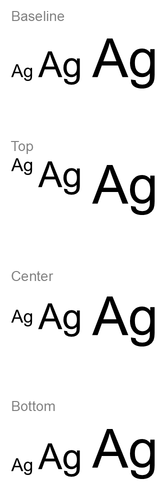
O alinhamento de fonte usa métricas de fonte, portanto as bordas visíveis das letras individuais não necessariamente se alinham exatamente. O exemplo inclui tanto uma letra maiúscula quanto um descendente para ajudar a mostrar a diferença entre o alinhamento baseline e o inferior. A disponibilidade e substituição de fontes, os caracteres usados e a diferença nos tamanhos de fonte afetam o resultado. As dimensões da caixa, margens, espaçamento entre linhas, quebra de linha e ajuste automático também influenciam o layout; use as mesmas fontes e configurações de layout ao comparar os modos.
Esta configuração difere de IParagraphFormat::set_Alignment, que controla o alinhamento horizontal do parágrafo, e de ITextFrameFormat::set_AnchoringType, que posiciona o bloco de texto verticalmente dentro de sua forma. A formatação de sobrescrito e subscrito através de IBasePortionFormat::set_Escapement desloca as porções individuais em relação à linha de base ao invés de definir o alinhamento de fonte para as linhas do parágrafo.
Definir Transparência para Texto
A transparência do texto é controlada através do componente alfa da cor atribuída por IBasePortionFormat::get_FillFormat. Nos exemplos abaixo, alpha = 50 é um valor de canal alfa ARGB na escala 0–255, não uma porcentagem de transparência.
O exemplo de código abaixo mostra como aplicar transparência ao parágrafo inteiro:
#include <DOM/FillType.h>
#include <DOM/IAutoShape.h>
#include <DOM/IColorFormat.h>
#include <DOM/IFillFormat.h>
#include <DOM/IParagraph.h>
#include <DOM/IParagraphFormat.h>
#include <DOM/IPortionFormat.h>
#include <DOM/ISlide.h>
#include <DOM/ITextFrame.h>
#include <DOM/Presentation.h>
#include <Export/SaveFormat.h>
#include <drawing/color.h>

using namespace Aspose::Slides;
using namespace Aspose::Slides::Export;

int alpha = 50;

auto presentation = System::MakeObject<Presentation>(u"sample.pptx");
auto firstShape = presentation->get_Slide(0)->get_Shape(0);

auto autoShape = System::ExplicitCast<IAutoShape>(firstShape);

auto paragraph = autoShape->get_TextFrame()->get_Paragraph(0);
auto defaultPortionFormat = paragraph->get_ParagraphFormat()->get_DefaultPortionFormat();

// Definir a cor de preenchimento do texto como cor transparente.
defaultPortionFormat->get_FillFormat()->set_FillType(FillType::Solid);
auto baseColor = System::Drawing::Color::get_Black();
auto transparentColor = System::Drawing::Color::FromArgb(alpha, baseColor);
defaultPortionFormat->get_FillFormat()->get_SolidFillColor()->set_Color(transparentColor);

presentation->Save(u"transparent_paragraph.pptx", SaveFormat::Pptx);
presentation->Dispose();
O resultado:

O exemplo de código a seguir mostra como aplicar transparência a porções de texto com fonte em negrito:
#include <DOM/FillType.h>
#include <DOM/IAutoShape.h>
#include <DOM/IColorFormat.h>
#include <DOM/IFillFormat.h>
#include <DOM/IParagraph.h>
#include <DOM/IPortion.h>
#include <DOM/IPortionCollection.h>
#include <DOM/IPortionFormat.h>
#include <DOM/IPortionFormatEffectiveData.h>
#include <DOM/ISlide.h>
#include <DOM/ITextFrame.h>
#include <DOM/Presentation.h>
#include <Export/SaveFormat.h>
#include <drawing/color.h>

using namespace Aspose::Slides;
using namespace Aspose::Slides::Export;

int alpha = 50;

auto presentation = System::MakeObject<Presentation>(u"sample.pptx");
auto firstShape = presentation->get_Slide(0)->get_Shape(0);

auto autoShape = System::ExplicitCast<IAutoShape>(firstShape);

auto paragraph = autoShape->get_TextFrame()->get_Paragraph(0);
auto portions = paragraph->get_Portions();
int portionCount = portions->get_Count();

for (int portionIndex = 0; portionIndex < portionCount; portionIndex++)
{
    auto portion = paragraph->get_Portion(portionIndex);
    auto portionFormat = portion->get_PortionFormat();
    if (portionFormat->GetEffective()->get_FontBold())
    {
        // Definir a transparência da porção de texto.
        portionFormat->get_FillFormat()->set_FillType(FillType::Solid);
        auto baseColor = System::Drawing::Color::get_Black();
        auto transparentColor = System::Drawing::Color::FromArgb(alpha, baseColor);
        portionFormat->get_FillFormat()->get_SolidFillColor()->set_Color(transparentColor);
    }
}

presentation->Save(u"transparent_text_portions.pptx", SaveFormat::Pptx);
presentation->Dispose();
O resultado:

Definir Espaçamento de Caracteres para Texto
Use IBasePortionFormat::set_Spacing para expandir ou condensar o espaçamento entre caracteres em uma caixa de texto. Os exemplos adicionam 3 pontos de espaçamento; valores negativos condensam o texto.
O código C++ a seguir mostra como expandir o espaçamento de caracteres no parágrafo inteiro:
#include <DOM/IAutoShape.h>
#include <DOM/IParagraph.h>
#include <DOM/IParagraphFormat.h>
#include <DOM/IPortionFormat.h>
#include <DOM/ISlide.h>
#include <DOM/ITextFrame.h>
#include <DOM/Presentation.h>
#include <Export/SaveFormat.h>

using namespace Aspose::Slides;
using namespace Aspose::Slides::Export;

auto presentation = System::MakeObject<Presentation>(u"sample.pptx");
auto firstShape = presentation->get_Slide(0)->get_Shape(0);

auto autoShape = System::ExplicitCast<IAutoShape>(firstShape);
auto paragraph = autoShape->get_TextFrame()->get_Paragraph(0);

// Observação: Use valores negativos para comprimir o espaçamento entre caracteres.
paragraph->get_ParagraphFormat()->get_DefaultPortionFormat()->set_Spacing(3.0f); // Expandir o espaçamento entre caracteres.

presentation->Save(u"character_spacing_in_paragraph.pptx", SaveFormat::Pptx);
presentation->Dispose();
O resultado:

O exemplo de código abaixo mostra como expandir o espaçamento de caracteres em porções de texto com fonte em negrito:
#include <DOM/IAutoShape.h>
#include <DOM/IParagraph.h>
#include <DOM/IPortion.h>
#include <DOM/IPortionCollection.h>
#include <DOM/IPortionFormat.h>
#include <DOM/IPortionFormatEffectiveData.h>
#include <DOM/ISlide.h>
#include <DOM/ITextFrame.h>
#include <DOM/Presentation.h>
#include <Export/SaveFormat.h>

using namespace Aspose::Slides;
using namespace Aspose::Slides::Export;

auto presentation = System::MakeObject<Presentation>(u"sample.pptx");
auto firstShape = presentation->get_Slide(0)->get_Shape(0);

auto autoShape = System::ExplicitCast<IAutoShape>(firstShape);

auto paragraph = autoShape->get_TextFrame()->get_Paragraph(0);
auto portions = paragraph->get_Portions();
int portionCount = portions->get_Count();

for (int portionIndex = 0; portionIndex < portionCount; portionIndex++)
{
    auto portion = paragraph->get_Portion(portionIndex);
    auto portionFormat = portion->get_PortionFormat();
    if (portionFormat->GetEffective()->get_FontBold())
    {
        // Observação: Use valores negativos para comprimir o espaçamento entre caracteres.
        portionFormat->set_Spacing(3.0f); // Expandir o espaçamento entre caracteres.
    }
}

presentation->Save(u"character_spacing_in_text_portions.pptx", SaveFormat::Pptx);
presentation->Dispose();
O resultado:

Desabilitar Kerning para Fontes Específicas
Em alguns casos, o texto renderizado pelo Aspose.Slides pode parecer ligeiramente mais apertado do que o mesmo texto exibido no PowerPoint. Isso pode acontecer porque o PowerPoint pode ignorar os dados de kerning para determinadas fontes, mesmo quando a fonte contém informações de kerning válidas e o kerning está habilitado nas configurações do PowerPoint.
Para que a saída renderizada se aproxime do PowerPoint nesses casos, você pode desabilitar o kerning para as porções de texto que utilizam a fonte afetada. Use IBasePortionFormat::set_KerningMinimalSize para definir um valor maior que o tamanho real da fonte. Este exemplo requer “presentation.pptx” com uma caixa de texto como a primeira forma no primeiro slide. Ele verifica os nomes de fontes efetivas, incluindo fontes herdadas, e define um limite de 100 pontos para as porções que usam Roboto. Isso desabilita o kerning para as porções correspondentes com tamanho de fonte abaixo de 100 pontos:
#include <DOM/IAutoShape.h>
#include <DOM/IFontData.h>
#include <DOM/IPortionFormatEffectiveData.h>
#include <DOM/IParagraph.h>
#include <DOM/IParagraphCollection.h>
#include <DOM/IPortion.h>
#include <DOM/IPortionCollection.h>
#include <DOM/IPortionFormat.h>
#include <DOM/ISlide.h>
#include <DOM/ITextFrame.h>
#include <DOM/Presentation.h>
#include <Export/SaveFormat.h>

using namespace Aspose::Slides;
using namespace Aspose::Slides::Export;

auto presentation = System::MakeObject<Presentation>(u"presentation.pptx");
auto firstShape = presentation->get_Slide(0)->get_Shape(0);

auto autoShape = System::ExplicitCast<IAutoShape>(firstShape);
System::String targetFont = u"Roboto";
auto textFrame = autoShape->get_TextFrame();
auto paragraphs = textFrame->get_Paragraphs();
int paragraphCount = paragraphs->get_Count();

for (int paragraphIndex = 0; paragraphIndex < paragraphCount; paragraphIndex++)
{
    auto paragraph = textFrame->get_Paragraph(paragraphIndex);
    auto portions = paragraph->get_Portions();
    int portionCount = portions->get_Count();

    for (int portionIndex = 0; portionIndex < portionCount; portionIndex++)
    {
        auto portion = paragraph->get_Portion(portionIndex);
        auto portionFormat = portion->get_PortionFormat();
        auto textFormat = portionFormat->GetEffective();
        auto latinFont = textFormat->get_LatinFont();
        auto eastAsianFont = textFormat->get_EastAsianFont();
        auto complexScriptFont = textFormat->get_ComplexScriptFont();

        bool isLatinFont = latinFont != nullptr && latinFont->get_FontName() == targetFont;
        bool isEastAsianFont = eastAsianFont != nullptr && eastAsianFont->get_FontName() == targetFont;
        bool isComplexScriptFont = complexScriptFont != nullptr && complexScriptFont->get_FontName() == targetFont;

        if (isLatinFont || isEastAsianFont || isComplexScriptFont)
        {
            portionFormat->set_KerningMinimalSize(100.0f);
        }
    }
}

presentation->Save(u"output.pptx", SaveFormat::Pptx);
presentation->Dispose();
Para textos correspondentes abaixo do limite, esta configuração impede o kerning e pode ajudar a alinhar a renderização do Aspose.Slides com a saída visual do PowerPoint para fontes afetadas por esse comportamento específico do PowerPoint.
Gerenciar Propriedades de Fonte do Texto
As propriedades de fonte podem ser definidas no nível do parágrafo através de IParagraphFormat::get_DefaultPortionFormat ou em porções individuais através de IPortionFormat.
O exemplo a seguir define a fonte padrão do primeiro parágrafo como Times New Roman de 12 pontos com formatação em negrito, itálico e sublinhado pontilhado. A formatação explícita em porções individuais tem precedência sobre esses padrões:
#include <DOM/Fonts/FontData.h>
#include <DOM/IAutoShape.h>
#include <DOM/IParagraph.h>
#include <DOM/IParagraphFormat.h>
#include <DOM/IPortionFormat.h>
#include <DOM/ISlide.h>
#include <DOM/ITextFrame.h>
#include <DOM/NullableBool.h>
#include <DOM/Presentation.h>
#include <DOM/TextUnderlineType.h>
#include <Export/SaveFormat.h>

using namespace Aspose::Slides;
using namespace Aspose::Slides::Export;

auto presentation = System::MakeObject<Presentation>(u"sample.pptx");
auto firstShape = presentation->get_Slide(0)->get_Shape(0);

auto autoShape = System::ExplicitCast<IAutoShape>(firstShape);
auto paragraph = autoShape->get_TextFrame()->get_Paragraph(0);
auto defaultPortionFormat = paragraph->get_ParagraphFormat()->get_DefaultPortionFormat();

// Definir as propriedades da fonte para o parágrafo.
defaultPortionFormat->set_FontHeight(12.0f);
defaultPortionFormat->set_FontBold(NullableBool::True);
defaultPortionFormat->set_FontItalic(NullableBool::True);
defaultPortionFormat->set_FontUnderline(TextUnderlineType::Dotted);
auto font = System::MakeObject<FontData>(u"Times New Roman");
defaultPortionFormat->set_LatinFont(font);

presentation->Save(u"font_properties_for_paragraph.pptx", SaveFormat::Pptx);
presentation->Dispose();
O resultado:

O exemplo a seguir aplica Times New Roman de 13 pontos, formatação itálica e sublinhado pontilhado às porções cujo formatação efetiva é negrito:
#include <DOM/Fonts/FontData.h>
#include <DOM/IAutoShape.h>
#include <DOM/IParagraph.h>
#include <DOM/IPortion.h>
#include <DOM/IPortionCollection.h>
#include <DOM/IPortionFormat.h>
#include <DOM/IPortionFormatEffectiveData.h>
#include <DOM/ISlide.h>
#include <DOM/ITextFrame.h>
#include <DOM/NullableBool.h>
#include <DOM/Presentation.h>
#include <DOM/TextUnderlineType.h>
#include <Export/SaveFormat.h>

using namespace Aspose::Slides;
using namespace Aspose::Slides::Export;

auto presentation = System::MakeObject<Presentation>(u"sample.pptx");
auto firstShape = presentation->get_Slide(0)->get_Shape(0);

auto autoShape = System::ExplicitCast<IAutoShape>(firstShape);
auto paragraph = autoShape->get_TextFrame()->get_Paragraph(0);
auto portions = paragraph->get_Portions();
int portionCount = portions->get_Count();
auto font = System::MakeObject<FontData>(u"Times New Roman");

for (int portionIndex = 0; portionIndex < portionCount; portionIndex++)
{
    auto portion = paragraph->get_Portion(portionIndex);
    auto portionFormat = portion->get_PortionFormat();
    if (portionFormat->GetEffective()->get_FontBold())
    {
        // Definir as propriedades da fonte para a porção de texto.
        portionFormat->set_FontHeight(13.0f);
        portionFormat->set_FontItalic(NullableBool::True);
        portionFormat->set_FontUnderline(TextUnderlineType::Dotted);
        portionFormat->set_LatinFont(font);
    }
}

presentation->Save(u"font_properties_for_text_portions.pptx", SaveFormat::Pptx);
presentation->Dispose();
O resultado:

Definir Rotação de Texto
Use ITextFrameFormat::set_TextVerticalType para definir uma orientação de texto predefinida dentro de uma forma.
O exemplo de código a seguir define a orientação do texto na forma para TextVerticalType::Vertical270, que rotaciona o texto 90 graus no sentido anti-horário:
#include <DOM/IAutoShape.h>
#include <DOM/ISlide.h>
#include <DOM/ITextFrame.h>
#include <DOM/ITextFrameFormat.h>
#include <DOM/Presentation.h>
#include <DOM/TextVerticalType.h>
#include <Export/SaveFormat.h>

using namespace Aspose::Slides;
using namespace Aspose::Slides::Export;

auto presentation = System::MakeObject<Presentation>(u"sample.pptx");
auto firstShape = presentation->get_Slide(0)->get_Shape(0);

auto autoShape = System::ExplicitCast<IAutoShape>(firstShape);
autoShape->get_TextFrame()->get_TextFrameFormat()->set_TextVerticalType(TextVerticalType::Vertical270);

presentation->Save(u"text_rotation.pptx", SaveFormat::Pptx);
presentation->Dispose();
O resultado:

Definir Rotação Personalizada para Quadros de Texto
Use ITextFrameFormat::set_RotationAngle para definir um ângulo de rotação personalizado para um ITextFrame.
O exemplo de código abaixo rotaciona o quadro de texto em 3 graus no sentido horário dentro da forma:
#include <DOM/IAutoShape.h>
#include <DOM/ISlide.h>
#include <DOM/ITextFrame.h>
#include <DOM/ITextFrameFormat.h>
#include <DOM/Presentation.h>
#include <Export/SaveFormat.h>

using namespace Aspose::Slides;
using namespace Aspose::Slides::Export;

auto presentation = System::MakeObject<Presentation>(u"sample.pptx");
auto firstShape = presentation->get_Slide(0)->get_Shape(0);

auto autoShape = System::ExplicitCast<IAutoShape>(firstShape);
autoShape->get_TextFrame()->get_TextFrameFormat()->set_RotationAngle(3.0f);

presentation->Save(u"custom_text_rotation.pptx", SaveFormat::Pptx);
presentation->Dispose();
O resultado:

Definir Espaçamento de Linha dos Parágrafos
Aspose.Slides fornece IParagraphFormat::set_SpaceAfter, IParagraphFormat::set_SpaceBefore, e IParagraphFormat::set_SpaceWithin para controlar o espaçamento de parágrafos. Esses métodos são usados da seguinte forma:
- Use um valor positivo para especificar o espaçamento de linha como uma porcentagem da altura da linha.
- Use um valor negativo para especificar o espaçamento de linha em pontos.
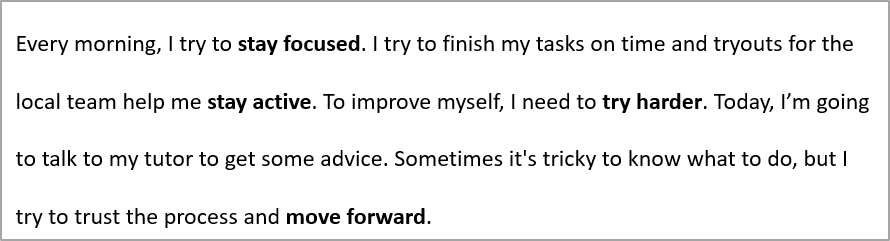
O exemplo a seguir define o espaçamento dentro do primeiro parágrafo como 200% da altura da linha (espaçamento duplo):
#include <DOM/IAutoShape.h>
#include <DOM/IParagraph.h>
#include <DOM/IParagraphFormat.h>
#include <DOM/ISlide.h>
#include <DOM/ITextFrame.h>
#include <DOM/Presentation.h>
#include <Export/SaveFormat.h>

using namespace Aspose::Slides;
using namespace Aspose::Slides::Export;

auto presentation = System::MakeObject<Presentation>(u"sample.pptx");
auto firstShape = presentation->get_Slide(0)->get_Shape(0);

auto autoShape = System::ExplicitCast<IAutoShape>(firstShape);

auto paragraph = autoShape->get_TextFrame()->get_Paragraph(0);
paragraph->get_ParagraphFormat()->set_SpaceWithin(200.0f);

presentation->Save(u"line_spacing.pptx", SaveFormat::Pptx);
presentation->Dispose();
O resultado:
Controlar Quebra de Linha
As regras de quebra de linha de parágrafo são úteis em blocos de texto estreitos e apresentações que misturam texto latino e asiático oriental. Os seguintes métodos pertencem a IParagraphFormat, portanto se aplicam a um parágrafo inteiro:
- IParagraphFormat::set_LatinLineBreak controla as regras de quebra de linha latina. Em texto misto, alterá-lo também pode mudar onde o texto e pontuação asiáticos adjacentes são quebrados.
- IParagraphFormat::set_EastAsianLineBreak controla as regras de quebra de linha asiática oriental, incluindo restrições de caracteres no início e fim de uma linha.
Essas regras não substituem ITextFrameFormat::set_WrapText, que habilita a quebra automática dentro de um quadro de texto. Elas influenciam o layout quando a quebra ocorre; não inserem caracteres de quebra de linha. Uma quebra de linha explícita força uma nova linha dentro do parágrafo independentemente da largura disponível.
O exemplo autocontido a seguir cria um bloco de texto estreito contendo texto chinês e latino. Ele define ambas as regras de quebra de linha explicitamente e salva “line_breaking.pptx”. Para experimentar cada regra, altere o valor passado ao seu setter mantendo as outras configurações fixas. O exemplo usa Arial de 24 pontos e SimSun com largura de quadro de 160 pontos e margem horizontal zero. ITextFrameFormat::set_AutofitType é chamado com TextAutofitType::None para que o tamanho do texto e as dimensões do quadro permaneçam fixos.
#include <DOM/Fonts/FontData.h>
#include <DOM/IAutoShape.h>
#include <DOM/IColorFormat.h>
#include <DOM/IFillFormat.h>
#include <DOM/IParagraph.h>
#include <DOM/IParagraphFormat.h>
#include <DOM/IPortionFormat.h>
#include <DOM/IShapeCollection.h>
#include <DOM/ISlide.h>
#include <DOM/ITextFrame.h>
#include <DOM/ITextFrameFormat.h>
#include <DOM/FillType.h>
#include <DOM/NullableBool.h>
#include <DOM/Presentation.h>
#include <DOM/ShapeType.h>
#include <DOM/TextAlignment.h>
#include <DOM/TextAutofitType.h>
#include <Export/SaveFormat.h>
#include <drawing/color.h>

using namespace Aspose::Slides;
using namespace Aspose::Slides::Export;

auto presentation = System::MakeObject<Presentation>();
auto slide = presentation->get_Slide(0);

auto shape = slide->get_Shapes()->AddAutoShape(ShapeType::Rectangle, 50.0f, 50.0f, 160.0f, 300.0f);
shape->get_FillFormat()->set_FillType(FillType::NoFill);

auto textFrame = shape->get_TextFrame();
textFrame->get_TextFrameFormat()->set_WrapText(NullableBool::True);
textFrame->get_TextFrameFormat()->set_AutofitType(TextAutofitType::None);
textFrame->get_TextFrameFormat()->set_MarginLeft(0);
textFrame->get_TextFrameFormat()->set_MarginRight(0);

auto paragraph = textFrame->get_Paragraph(0);
paragraph->set_Text(u"中文排版测试,PowerPoint 中文演示。");

auto format = paragraph->get_ParagraphFormat();
format->set_Alignment(TextAlignment::Left);
auto portionFormat = format->get_DefaultPortionFormat();
portionFormat->set_FontHeight(24.0f);
auto latinFont = System::MakeObject<FontData>(u"Arial");
portionFormat->set_LatinFont(latinFont);
auto eastAsianFont = System::MakeObject<FontData>(u"SimSun");
portionFormat->set_EastAsianFont(eastAsianFont);
portionFormat->get_FillFormat()->set_FillType(FillType::Solid);
portionFormat->get_FillFormat()->get_SolidFillColor()->set_Color(System::Drawing::Color::get_Black());
format->set_LatinLineBreak(NullableBool::False);
format->set_EastAsianLineBreak(NullableBool::True);

presentation->Save(u"line_breaking.pptx", SaveFormat::Pptx);
presentation->Dispose();
Controlar Pontuação Suspensa
IParagraphFormat::set_HangingPunctuation permite que pontuação elegível se estenda além da borda direita da linha de texto em vez de ocupar a linha seguinte. Aplica-se a todo o parágrafo e difere de um recuo suspenso.
O exemplo autocontido a seguir habilita pontuação suspensa em um quadro de texto de 100 pontos de largura e salva “hanging_punctuation.pptx”. Com Arial de 24 pontos e margem horizontal zero, o ponto final permanece após “sentence” e se estende além da borda direita do texto. Passe NullableBool::False ao setter para comparar: com essas configurações, o ponto ocupa uma linha separada. A quebra de linha está habilitada e o ajuste automático desativado para manter a largura disponível fixa.
#include <DOM/Fonts/FontData.h>
#include <DOM/IAutoShape.h>
#include <DOM/IColorFormat.h>
#include <DOM/IFillFormat.h>
#include <DOM/IParagraph.h>
#include <DOM/IParagraphFormat.h>
#include <DOM/IPortionFormat.h>
#include <DOM/IShapeCollection.h>
#include <DOM/ISlide.h>
#include <DOM/ITextFrame.h>
#include <DOM/ITextFrameFormat.h>
#include <DOM/FillType.h>
#include <DOM/NullableBool.h>
#include <DOM/Presentation.h>
#include <DOM/ShapeType.h>
#include <DOM/TextAlignment.h>
#include <DOM/TextAutofitType.h>
#include <Export/SaveFormat.h>
#include <drawing/color.h>

using namespace Aspose::Slides;
using namespace Aspose::Slides::Export;

auto presentation = System::MakeObject<Presentation>();
auto slide = presentation->get_Slide(0);

auto shape = slide->get_Shapes()->AddAutoShape(ShapeType::Rectangle, 50.0f, 50.0f, 100.0f, 200.0f);
shape->get_FillFormat()->set_FillType(FillType::NoFill);

auto textFrame = shape->get_TextFrame();
textFrame->get_TextFrameFormat()->set_WrapText(NullableBool::True);
textFrame->get_TextFrameFormat()->set_AutofitType(TextAutofitType::None);
textFrame->get_TextFrameFormat()->set_MarginLeft(0);
textFrame->get_TextFrameFormat()->set_MarginRight(0);

auto paragraph = textFrame->get_Paragraph(0);
paragraph->set_Text(u"Simple text, next sentence.");

auto format = paragraph->get_ParagraphFormat();
format->set_Alignment(TextAlignment::Left);
auto portionFormat = format->get_DefaultPortionFormat();
portionFormat->set_FontHeight(24.0f);
auto latinFont = System::MakeObject<FontData>(u"Arial");
portionFormat->set_LatinFont(latinFont);
portionFormat->get_FillFormat()->set_FillType(FillType::Solid);
portionFormat->get_FillFormat()->get_SolidFillColor()->set_Color(System::Drawing::Color::get_Black());
format->set_HangingPunctuation(NullableBool::True);

presentation->Save(u"hanging_punctuation.pptx", SaveFormat::Pptx);
presentation->Dispose();
Nem toda pontuação pode ser suspensa. As condições de fonte e layout descritas acima também se aplicam a esta comparação: mudar a fonte, largura disponível, margens ou configurações de ajuste automático pode remover a diferença visível.
Definir Tipo de Ajuste Automático para Quadros de Texto
ITextFrameFormat::set_AutofitType determina como o texto se comporta quando excede os limites de seu contêiner. Use-o para controlar se o texto encolhe, transborda ou redimensiona a forma automaticamente. O exemplo a seguir configura a forma para redimensionar e ajustar seu texto e salva o resultado em “autofit_type.pptx”.
#include <DOM/IAutoShape.h>
#include <DOM/ISlide.h>
#include <DOM/ITextFrame.h>
#include <DOM/ITextFrameFormat.h>
#include <DOM/Presentation.h>
#include <DOM/TextAutofitType.h>
#include <Export/SaveFormat.h>

using namespace Aspose::Slides;
using namespace Aspose::Slides::Export;

auto presentation = System::MakeObject<Presentation>(u"sample.pptx");
auto firstShape = presentation->get_Slide(0)->get_Shape(0);

auto autoShape = System::ExplicitCast<IAutoShape>(firstShape);
autoShape->get_TextFrame()->get_TextFrameFormat()->set_AutofitType(TextAutofitType::Shape);

presentation->Save(u"autofit_type.pptx", SaveFormat::Pptx);
presentation->Dispose();
Para contar linhas após a quebra automática e ver como a largura do texto ou da forma altera o resultado, consulte Contar Linhas Renderizadas. A contagem de linhas sozinha não indica se o texto transborda seu contêiner.
Definir Âncora dos Quadros de Texto
ITextFrameFormat::set_AnchoringType define como o texto é posicionado verticalmente dentro de uma forma, por exemplo, no topo, meio ou base. O exemplo a seguir ancora o texto na base da primeira forma e salva o resultado em “text_anchor.pptx”.
#include <DOM/IAutoShape.h>
#include <DOM/ISlide.h>
#include <DOM/ITextFrame.h>
#include <DOM/ITextFrameFormat.h>
#include <DOM/Presentation.h>
#include <DOM/TextAnchorType.h>
#include <Export/SaveFormat.h>

using namespace Aspose::Slides;
using namespace Aspose::Slides::Export;

auto presentation = System::MakeObject<Presentation>(u"sample.pptx");
auto firstShape = presentation->get_Slide(0)->get_Shape(0);

auto autoShape = System::ExplicitCast<IAutoShape>(firstShape);
autoShape->get_TextFrame()->get_TextFrameFormat()->set_AnchoringType(TextAnchorType::Bottom);

presentation->Save(u"text_anchor.pptx", SaveFormat::Pptx);
presentation->Dispose();
Definir Tabulação de Texto
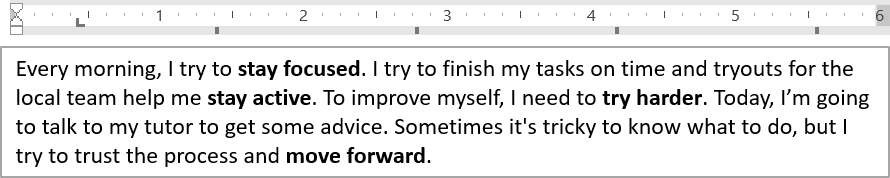
Use IParagraphFormat::set_DefaultTabSize e IParagraphFormat::get_Tabs para configurar tabulações em um parágrafo. O exemplo a seguir define o intervalo padrão de tabulação para 100 pontos e adiciona uma tabulação alinhada à esquerda em 30 pontos. Essas configurações afetam texto que contém caracteres de tabulação.
#include <DOM/IAutoShape.h>
#include <DOM/IParagraph.h>
#include <DOM/IParagraphFormat.h>
#include <DOM/ISlide.h>
#include <DOM/ITabCollection.h>
#include <DOM/ITextFrame.h>
#include <DOM/Presentation.h>
#include <DOM/TabAlignment.h>
#include <Export/SaveFormat.h>

using namespace Aspose::Slides;
using namespace Aspose::Slides::Export;

auto presentation = System::MakeObject<Presentation>(u"sample.pptx");
auto firstShape = presentation->get_Slide(0)->get_Shape(0);

auto autoShape = System::ExplicitCast<IAutoShape>(firstShape);

auto paragraph = autoShape->get_TextFrame()->get_Paragraph(0);
paragraph->get_ParagraphFormat()->set_DefaultTabSize(100.0f);
paragraph->get_ParagraphFormat()->get_Tabs()->Add(30.0f, TabAlignment::Left);

presentation->Save(u"paragraph_tabs.pptx", SaveFormat::Pptx);
presentation->Dispose();
O resultado:
Definir Idioma de Revisão
Aspose.Slides fornece IBasePortionFormat::set_LanguageId, que permite definir o idioma de revisão para uma porção de texto. O idioma de revisão determina o idioma usado para verificação ortográfica e gramatical no PowerPoint.
O exemplo a seguir requer “presentation.pptx” com uma caixa de texto como a primeira forma no primeiro slide e ao menos um parágrafo. Ele substitui o conteúdo do primeiro parágrafo por “1。”, define SimSun como sua fonte e atribui o idioma de revisão Chinês Simplificado (zh-CN). Salva o resultado em “proofing_language.pptx”:
#include <DOM/Fonts/FontData.h>
#include <DOM/IAutoShape.h>
#include <DOM/IParagraph.h>
#include <DOM/IPortionCollection.h>
#include <DOM/IPortionFormat.h>
#include <DOM/ISlide.h>
#include <DOM/ITextFrame.h>
#include <DOM/Portion.h>
#include <DOM/Presentation.h>
#include <Export/SaveFormat.h>

using namespace Aspose::Slides;
using namespace Aspose::Slides::Export;

auto presentation = System::MakeObject<Presentation>(u"presentation.pptx");
auto firstShape = presentation->get_Slide(0)->get_Shape(0);

auto autoShape = System::ExplicitCast<IAutoShape>(firstShape);

auto paragraph = autoShape->get_TextFrame()->get_Paragraph(0);
paragraph->get_Portions()->Clear();

auto font = System::MakeObject<FontData>(u"SimSun");

auto textPortion = System::MakeObject<Portion>();
auto portionFormat = textPortion->get_PortionFormat();
portionFormat->set_ComplexScriptFont(font);
portionFormat->set_EastAsianFont(font);
portionFormat->set_LatinFont(font);

// Definir o idioma de revisão para Chinês Simplificado.
portionFormat->set_LanguageId(u"zh-CN");

textPortion->set_Text(u"1。");
paragraph->get_Portions()->Add(textPortion);

presentation->Save(u"proofing_language.pptx", SaveFormat::Pptx);
presentation->Dispose();
Definir Idioma Padrão
Use LoadOptions::set_DefaultTextLanguage para definir o idioma padrão para texto criado ao carregar ou criar uma apresentação. O exemplo a seguir cria uma apresentação com o inglês dos EUA como idioma de texto padrão, adiciona uma caixa de texto e imprime en-US para sua primeira porção de texto.
#include <DOM/IAutoShape.h>
#include <DOM/IParagraph.h>
#include <DOM/IPortion.h>
#include <DOM/IPortionFormat.h>
#include <DOM/IShapeCollection.h>
#include <DOM/ISlide.h>
#include <DOM/ITextFrame.h>
#include <DOM/LoadOptions.h>
#include <DOM/Presentation.h>
#include <DOM/ShapeType.h>
#include <system/console.h>

using namespace Aspose::Slides;

auto loadOptions = System::MakeObject<LoadOptions>();
loadOptions->set_DefaultTextLanguage(u"en-US");

auto presentation = System::MakeObject<Presentation>(loadOptions);
auto slide = presentation->get_Slide(0);

// Adicionar uma nova forma retangular com texto.
auto shape = slide->get_Shapes()->AddAutoShape(ShapeType::Rectangle, 20.0f, 20.0f, 150.0f, 50.0f);
shape->get_TextFrame()->set_Text(u"Sample text");

// Verificar o idioma da primeira porção.
auto portion = shape->get_TextFrame()->get_Paragraph(0)->get_Portion(0);
auto languageId = portion->get_PortionFormat()->get_LanguageId();
System::Console::WriteLine(languageId);

presentation->Dispose();
Definir Estilo de Texto Padrão
Para aplicar formatação de texto padrão ao nível da apresentação, use IPresentation::get_DefaultTextStyle.
O exemplo a seguir define uma fonte em negrito de 14 pontos como padrão para parágrafos de nível superior em uma nova apresentação e salva em “default_text_style.pptx”. O texto pode herdar esses padrões, a menos que formatações mais específicas os sobrescrevam.
#include <DOM/IParagraphFormat.h>
#include <DOM/IPortionFormat.h>
#include <DOM/ITextStyle.h>
#include <DOM/NullableBool.h>
#include <DOM/Presentation.h>
#include <Export/SaveFormat.h>

using namespace Aspose::Slides;
using namespace Aspose::Slides::Export;

auto presentation = System::MakeObject<Presentation>();

// Obter o formato de parágrafo de nível superior.
auto paragraphFormat = presentation->get_DefaultTextStyle()->GetLevel(0);

if (paragraphFormat != nullptr)
{
    auto defaultPortionFormat = paragraphFormat->get_DefaultPortionFormat();
    defaultPortionFormat->set_FontHeight(14.0f);
    defaultPortionFormat->set_FontBold(NullableBool::True);
}

presentation->Save(u"default_text_style.pptx", SaveFormat::Pptx);
presentation->Dispose();
Extrair Texto com o Efeito Tudo em Maiúsculas
No PowerPoint, aplicar o efeito de fonte All Caps faz o texto aparecer em maiúsculas no slide mesmo quando foi digitado originalmente em minúsculas. Quando você recupera tal porção de texto com Aspose.Slides, a biblioteca devolve o texto exatamente como foi inserido. Para corresponder ao texto exibido, verifique TextCapType e converta a string retornada para maiúsculas quando o valor for TextCapType::All.
Este exemplo requer “sample2.pptx” com uma caixa de texto como a primeira forma no primeiro slide. A primeira porção do primeiro parágrafo contém “Hello, Aspose!” com o efeito All Caps aplicado, como mostrado abaixo.

O exemplo de código abaixo mostra como extrair o texto com o efeito All Caps aplicado:
#include <DOM/IAutoShape.h>
#include <DOM/IParagraph.h>
#include <DOM/IPortion.h>
#include <DOM/IPortionFormat.h>
#include <DOM/IPortionFormatEffectiveData.h>
#include <DOM/ISlide.h>
#include <DOM/ITextFrame.h>
#include <DOM/Presentation.h>
#include <DOM/TextCapType.h>
#include <system/console.h>

using namespace Aspose::Slides;

auto presentation = System::MakeObject<Presentation>(u"sample2.pptx");
auto firstShape = presentation->get_Slide(0)->get_Shape(0);

auto autoShape = System::ExplicitCast<IAutoShape>(firstShape);
auto textPortion = autoShape->get_TextFrame()->get_Paragraph(0)->get_Portion(0);

auto originalText = textPortion->get_Text();
System::Console::WriteLine(u"Original text: " + originalText);

auto textFormat = textPortion->get_PortionFormat()->GetEffective();
if (textFormat->get_TextCapType() == TextCapType::All)
{
    auto uppercaseText = originalText.ToUpper();
    System::Console::WriteLine(u"All-Caps effect: " + uppercaseText);
}

presentation->Dispose();
Saída:
Original text: Hello, Aspose!
All-Caps effect: HELLO, ASPOSE!
FAQ
Como modifico texto em uma tabela em um slide?
Para modificar texto em uma tabela em um slide, use ITable. Iterate through the cells and update each cell through ICell::get_TextFrame and paragraph formatting through IParagraph::get_ParagraphFormat.
Como aplico uma cor gradiente ao texto em um slide do PowerPoint?
Para aplicar uma cor gradiente ao texto, use IBasePortionFormat::get_FillFormat. Set IFillFormat::set_FillType to FillType::Gradient and configure the gradient stops, direction, and transparency.