
在 PHP 中格式化演示文稿文本
概述
本文展示了如何使用 Aspose.Slides for PHP via Java 在 PowerPoint 和 OpenDocument 演示文稿中格式化文本。它涵盖了背景颜色、透明度、字符间距、字体属性、旋转、段落间距、自动适应行为、文本锚点、制表位和语言设置。
除非另有说明,示例使用 sample.pptx。其第一张幻灯片上的第一个形状是一个文本框,其第一段包含下图所示的文本。幻灯片和形状的索引均为零基。选择粗体部分的示例使用有效格式,包括继承的粗体格式:

要查找并突出显示字面文本或正则表达式匹配项,请参阅 搜索和替换文本。
设置文本背景颜色
使用 ParagraphFormat::getDefaultPortionFormat 设置段落的默认突出显示颜色,或使用 BasePortionFormat::getHighlightColor 为单独的文本片段设置突出显示颜色。
以下示例将浅灰色突出显示设置为第一段的默认颜色。对单独片段的显式突出显示颜色优先于此默认值:
use aspose\slides\Presentation;
use aspose\slides\SaveFormat;

$presentation = new Presentation("sample.pptx");
try {
    $slide = $presentation->getSlides()->get_Item(0);

    $autoShape = $slide->getShapes()->get_Item(0);
    $paragraph = $autoShape->getTextFrame()->getParagraphs()->get_Item(0);
    $highlightColor = java("java.awt.Color")->LIGHT_GRAY;

    // 为整个段落设置突出显示颜色。
    $paragraph->getParagraphFormat()->getDefaultPortionFormat()->getHighlightColor()->setColor($highlightColor);

    $presentation->save("gray_paragraph.pptx", SaveFormat::Pptx);
} finally {
    $presentation->dispose();
}
结果:

下面的代码示例演示如何为 带粗体的文本片段 设置背景颜色:
use aspose\slides\Presentation;
use aspose\slides\SaveFormat;

$presentation = new Presentation("sample.pptx");
try {
    $slide = $presentation->getSlides()->get_Item(0);

    $autoShape = $slide->getShapes()->get_Item(0);
    $paragraph = $autoShape->getTextFrame()->getParagraphs()->get_Item(0);
    $highlightColor = java("java.awt.Color")->LIGHT_GRAY;

    $portionCount = java_values($paragraph->getPortions()->getCount());
    for ($portionIndex = 0; $portionIndex < $portionCount; $portionIndex++) {
        $portion = $paragraph->getPortions()->get_Item($portionIndex);
        if (java_values($portion->getPortionFormat()->getEffective()->getFontBold())) {
        // 为文本片段设置突出显示颜色。
            $portion->getPortionFormat()->getHighlightColor()->setColor($highlightColor);
        }
    }

    $presentation->save("gray_text_portions.pptx", SaveFormat::Pptx);
} finally {
    $presentation->dispose();
}
结果:

对齐文本段落
使用 ParagraphFormat::setAlignment 设置文本框内段落的对齐方式。该值可以是居中、左对齐、右对齐、两端对齐等。
以下代码示例展示如何将段落对齐到 居中:
use aspose\slides\Presentation;
use aspose\slides\SaveFormat;
use aspose\slides\TextAlignment;

$presentation = new Presentation("sample.pptx");
try {
    $slide = $presentation->getSlides()->get_Item(0);

    $autoShape = $slide->getShapes()->get_Item(0);
    $paragraph = $autoShape->getTextFrame()->getParagraphs()->get_Item(0);

    // 将段落的对齐方式设置为居中。
    $paragraph->getParagraphFormat()->setAlignment(TextAlignment::Center);

    $presentation->save("aligned_paragraph.pptx", SaveFormat::Pptx);
} finally {
    $presentation->dispose();
}
结果:

在行内对齐字体
使用 ParagraphFormat::setFontAlignment 在一行中垂直对齐不同字体大小的文本片段。此设置适用于整个段落并控制其每行内部的对齐方式。
以下自包含示例在同一张幻灯片上创建四个带标签的文本框。每个段落以 18、36、54 磅的相同文本呈现,字体对齐方式各不相同。示例使用 Arial,禁用自动适应和换行,并保持文本框足够宽以容纳单行。
use aspose\slides\FillType;
use aspose\slides\FontAlignment;
use aspose\slides\FontData;
use aspose\slides\NullableBool;
use aspose\slides\Paragraph;
use aspose\slides\Portion;
use aspose\slides\Presentation;
use aspose\slides\SaveFormat;
use aspose\slides\ShapeType;
use aspose\slides\TextAlignment;
use aspose\slides\TextAnchorType;
use aspose\slides\TextAutofitType;

$presentation = new Presentation();
try {
    $slide = $presentation->getSlides()->get_Item(0);

    $alignments = [FontAlignment::Baseline, FontAlignment::Top, FontAlignment::Center, FontAlignment::Bottom];
    $alignmentNames = ["Baseline", "Top", "Center", "Bottom"];
    $fontSizes = [18, 36, 54];
    $font = new FontData("Arial");
    $gray = java("java.awt.Color")->GRAY;
    $black = java("java.awt.Color")->BLACK;

    for ($i = 0; $i < count($alignments); $i++) {
        $shape = $slide->getShapes()->addAutoShape(ShapeType::Rectangle, 30, 20 + $i * 130, 660, 120);
        $shape->getFillFormat()->setFillType(FillType::NoFill);
        $shape->getLineFormat()->getFillFormat()->setFillType(FillType::NoFill);

        $textFrame = $shape->getTextFrame();
        $textFrame->getTextFrameFormat()->setAnchoringType(TextAnchorType::Top);
        $textFrame->getTextFrameFormat()->setAutofitType(TextAutofitType::None);
        $textFrame->getTextFrameFormat()->setWrapText(NullableBool::False);

        $label = $textFrame->getParagraphs()->get_Item(0);
        $label->setText($alignmentNames[$i]);
        $label->getParagraphFormat()->setAlignment(TextAlignment::Left);
        $label->getParagraphFormat()->getDefaultPortionFormat()->setFontHeight(14);
        $label->getParagraphFormat()->getDefaultPortionFormat()->setLatinFont($font);
        $label->getParagraphFormat()->getDefaultPortionFormat()->getFillFormat()->setFillType(FillType::Solid);
        $label->getParagraphFormat()->getDefaultPortionFormat()->getFillFormat()->getSolidFillColor()->setColor($gray);

        $paragraph = new Paragraph();
        $paragraph->getParagraphFormat()->setFontAlignment($alignments[$i]);
        $paragraph->getParagraphFormat()->setAlignment(TextAlignment::Left);
        $paragraph->getParagraphFormat()->getDefaultPortionFormat()->setLatinFont($font);
        $paragraph->getParagraphFormat()->getDefaultPortionFormat()->getFillFormat()->setFillType(FillType::Solid);
        $paragraph->getParagraphFormat()->getDefaultPortionFormat()->getFillFormat()->getSolidFillColor()->setColor($black);

        foreach ($fontSizes as $fontSize) {
            $portion = new Portion("Ag ");
            $portion->getPortionFormat()->setFontHeight($fontSize);
            $paragraph->getPortions()->add($portion);
        }

        $textFrame->getParagraphs()->add($paragraph);
    }

    $presentation->save("font_alignment.pptx", SaveFormat::Pptx);
} finally {
    $presentation->dispose();
}
结果:
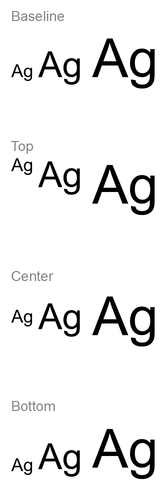
字体对齐使用字体度量,因此单个字母的可见边缘不一定完全对齐。示例包含大写字母和下垂字符,以帮助展示基线与底部对齐的差异。字体可用性与替代、所使用的字符以及字体大小差异都会影响结果。框架尺寸、边距、行间距、换行和自动适应也会影响布局;在比较模式时请使用相同的字体和布局设置。
此设置不同于 ParagraphFormat::setAlignment,后者控制水平段落对齐;也不同于 TextFrameFormat::setAnchoringType,后者在形状内部垂直定位文本块。通过 BasePortionFormat::setEscapement 实现的上标和下标格式会相对于基线移动单个片段,而不是为段落行设置字体对齐。
设置文本透明度
文本透明度通过分配给 BasePortionFormat::getFillFormat 的颜色的 alpha 组件来控制。在下面的示例中,alpha = 50 是 0–255 规模上的 ARGB alpha 通道值,而不是透明度百分比。
下面的代码示例展示如何对 整个段落 应用透明度:
use aspose\slides\FillType;
use aspose\slides\Presentation;
use aspose\slides\SaveFormat;

$alpha = 50;

$presentation = new Presentation("sample.pptx");
try {
    $slide = $presentation->getSlides()->get_Item(0);

    $autoShape = $slide->getShapes()->get_Item(0);
    $paragraph = $autoShape->getTextFrame()->getParagraphs()->get_Item(0);
    $fillFormat = $paragraph->getParagraphFormat()->getDefaultPortionFormat()->getFillFormat();

    // 设置文本的填充颜色为透明颜色。
    $fillFormat->setFillType(FillType::Solid);
    $transparentColor = new Java("java.awt.Color", 0, 0, 0, $alpha);
    $fillFormat->getSolidFillColor()->setColor($transparentColor);

    $presentation->save("transparent_paragraph.pptx", SaveFormat::Pptx);
} finally {
    $presentation->dispose();
}
结果:

以下代码示例展示如何对 带粗体的文本片段 应用透明度:
use aspose\slides\FillType;
use aspose\slides\Presentation;
use aspose\slides\SaveFormat;

$alpha = 50;

$presentation = new Presentation("sample.pptx");
try {
    $slide = $presentation->getSlides()->get_Item(0);

    $autoShape = $slide->getShapes()->get_Item(0);
    $paragraph = $autoShape->getTextFrame()->getParagraphs()->get_Item(0);
    $transparentColor = new Java("java.awt.Color", 0, 0, 0, $alpha);

    $portionCount = java_values($paragraph->getPortions()->getCount());
    for ($portionIndex = 0; $portionIndex < $portionCount; $portionIndex++) {
        $portion = $paragraph->getPortions()->get_Item($portionIndex);
        if (java_values($portion->getPortionFormat()->getEffective()->getFontBold())) {
            // 设置文本片段的透明度。
            $fillFormat = $portion->getPortionFormat()->getFillFormat();
            $fillFormat->setFillType(FillType::Solid);
            $fillFormat->getSolidFillColor()->setColor($transparentColor);
        }
    }

    $presentation->save("transparent_text_portions.pptx", SaveFormat::Pptx);
} finally {
    $presentation->dispose();
}
结果:

设置文本字符间距
使用 BasePortionFormat::setSpacing 可以在文本框内扩展或压缩字符之间的间距。示例中添加了 3 磅的间距;负值会压缩文本。
以下 PHP 代码展示如何在 整个段落 中扩展字符间距:
use aspose\slides\Presentation;
use aspose\slides\SaveFormat;

$presentation = new Presentation("sample.pptx");
try {
    $slide = $presentation->getSlides()->get_Item(0);

    $autoShape = $slide->getShapes()->get_Item(0);
    $paragraph = $autoShape->getTextFrame()->getParagraphs()->get_Item(0);

    // 注意:使用负值来压缩字符间距。
    $paragraph->getParagraphFormat()->getDefaultPortionFormat()->setSpacing(3); // 扩展字符间距。

    $presentation->save("character_spacing_in_paragraph.pptx", SaveFormat::Pptx);
} finally {
    $presentation->dispose();
}
结果:

下面的代码示例展示如何在 带粗体的文本片段 中扩展字符间距:
use aspose\slides\Presentation;
use aspose\slides\SaveFormat;

$presentation = new Presentation("sample.pptx");
try {
    $slide = $presentation->getSlides()->get_Item(0);

    $autoShape = $slide->getShapes()->get_Item(0);
    $paragraph = $autoShape->getTextFrame()->getParagraphs()->get_Item(0);

    $portionCount = java_values($paragraph->getPortions()->getCount());
    for ($portionIndex = 0; $portionIndex < $portionCount; $portionIndex++) {
        $portion = $paragraph->getPortions()->get_Item($portionIndex);
        if (java_values($portion->getPortionFormat()->getEffective()->getFontBold())) {
            // 注意:使用负值来压缩字符间距。
            $portion->getPortionFormat()->setSpacing(3); // 扩展字符间距。
        }
    }

    $presentation->save("character_spacing_in_text_portions.pptx", SaveFormat::Pptx);
} finally {
    $presentation->dispose();
}
结果:

禁用特定字体的字距调整
在某些情况下,Aspose.Slides 渲染的文本可能比 PowerPoint 中显示的略紧。这可能是因为 PowerPoint 在某些字体上会忽略字距调整数据,即使字体包含有效的字距信息且在 PowerPoint 设置中已启用字距调整。
为使渲染输出更接近 PowerPoint,可以为使用受影响字体的文本片段禁用字距调整。将 BasePortionFormat::setKerningMinimalSize 设置为大于实际字体大小的值。本示例需要 “presentation.pptx”,其中第一张幻灯片的第一个形状是文本框。示例检查有效字体名称(包括继承的字体),并对使用 Roboto 的片段设置 100 磅的阈值:低于此阈值的片段将禁用字距调整。
use aspose\slides\Presentation;
use aspose\slides\SaveFormat;

$presentation = new Presentation("presentation.pptx");
try {
    $slide = $presentation->getSlides()->get_Item(0);

    $autoShape = $slide->getShapes()->get_Item(0);
    $targetFont = "Roboto";

    $paragraphCount = java_values($autoShape->getTextFrame()->getParagraphs()->getCount());
    for ($paragraphIndex = 0; $paragraphIndex < $paragraphCount; $paragraphIndex++) {
        $paragraph = $autoShape->getTextFrame()->getParagraphs()->get_Item($paragraphIndex);
        $portionCount = java_values($paragraph->getPortions()->getCount());
        for ($portionIndex = 0; $portionIndex < $portionCount; $portionIndex++) {
            $portion = $paragraph->getPortions()->get_Item($portionIndex);
            $portionFormat = $portion->getPortionFormat()->getEffective();
            $latinFont = $portionFormat->getLatinFont();
            $eastAsianFont = $portionFormat->getEastAsianFont();
            $complexScriptFont = $portionFormat->getComplexScriptFont();

            if ((!java_is_null($latinFont) && $latinFont->getFontName() == $targetFont) ||
                (!java_is_null($eastAsianFont) && $eastAsianFont->getFontName() == $targetFont) ||
                (!java_is_null($complexScriptFont) && $complexScriptFont->getFontName() == $targetFont)) {
                $portion->getPortionFormat()->setKerningMinimalSize(100);
            }
        }
    }

    $presentation->save("output.pptx", SaveFormat::Pptx);
} finally {
    $presentation->dispose();
}
对于低于阈值的匹配文本,此设置可防止字距调整,帮助使 Aspose.Slides 的渲染效果与 PowerPoint 在受该行为影响的字体上的视觉输出保持一致。
管理文本字体属性
可以通过 ParagraphFormat::getDefaultPortionFormat 在段落级别设置字体属性,或通过 PortionFormat 在单独的片段上设置。
以下示例将第一段的默认字体设置为 12 磅 Times New Roman,并采用粗体、斜体和点线下划线格式。对单独片段的显式格式会优先于这些默认设置:
use aspose\slides\FontData;
use aspose\slides\NullableBool;
use aspose\slides\Presentation;
use aspose\slides\SaveFormat;
use aspose\slides\TextUnderlineType;

$presentation = new Presentation("sample.pptx");
try {
    $slide = $presentation->getSlides()->get_Item(0);

    $autoShape = $slide->getShapes()->get_Item(0);
    $paragraph = $autoShape->getTextFrame()->getParagraphs()->get_Item(0);
    $defaultPortionFormat = $paragraph->getParagraphFormat()->getDefaultPortionFormat();
    $font = new FontData("Times New Roman");

    // 设置段落的字体属性。
    $defaultPortionFormat->setFontHeight(12);
    $defaultPortionFormat->setFontBold(NullableBool::True);
    $defaultPortionFormat->setFontItalic(NullableBool::True);
    $defaultPortionFormat->setFontUnderline(TextUnderlineType::Dotted);
    $defaultPortionFormat->setLatinFont($font);

    $presentation->save("font_properties_for_paragraph.pptx", SaveFormat::Pptx);
} finally {
    $presentation->dispose();
}
结果:

以下示例对有效格式为粗体的片段应用 13 磅 Times New Roman、斜体以及点线下划线:
use aspose\slides\FontData;
use aspose\slides\NullableBool;
use aspose\slides\Presentation;
use aspose\slides\SaveFormat;
use aspose\slides\TextUnderlineType;

$presentation = new Presentation("sample.pptx");
try {
    $slide = $presentation->getSlides()->get_Item(0);

    $autoShape = $slide->getShapes()->get_Item(0);
    $paragraph = $autoShape->getTextFrame()->getParagraphs()->get_Item(0);
    $font = new FontData("Times New Roman");

    $portionCount = java_values($paragraph->getPortions()->getCount());
    for ($portionIndex = 0; $portionIndex < $portionCount; $portionIndex++) {
        $portion = $paragraph->getPortions()->get_Item($portionIndex);
        if (java_values($portion->getPortionFormat()->getEffective()->getFontBold())) {
            // 为文本片段设置字体属性。
            $portionFormat = $portion->getPortionFormat();
            $portionFormat->setFontHeight(13);
            $portionFormat->setFontItalic(NullableBool::True);
            $portionFormat->setFontUnderline(TextUnderlineType::Dotted);
            $portionFormat->setLatinFont($font);
        }
    }

    $presentation->save("font_properties_for_text_portions.pptx", SaveFormat::Pptx);
} finally {
    $presentation->dispose();
}
结果:

设置文本旋转
使用 TextFrameFormat::setTextVerticalType 可以在形状内设置预定义的文本方向。
以下代码示例将形状中的文本方向设置为 TextVerticalType::Vertical270,即逆时针旋转 90 度:
use aspose\slides\Presentation;
use aspose\slides\SaveFormat;
use aspose\slides\TextVerticalType;

$presentation = new Presentation("sample.pptx");
try {
    $slide = $presentation->getSlides()->get_Item(0);

    $autoShape = $slide->getShapes()->get_Item(0);
    $autoShape->getTextFrame()->getTextFrameFormat()->setTextVerticalType(TextVerticalType::Vertical270);

    $presentation->save("text_rotation.pptx", SaveFormat::Pptx);
} finally {
    $presentation->dispose();
}
结果:

设置文本框的自定义旋转
使用 TextFrameFormat::setRotationAngle 可以为 TextFrame 设置自定义旋转角度。
下面的代码示例将在形状内将文本框顺时针旋转 3 度:
use aspose\slides\Presentation;
use aspose\slides\SaveFormat;

$presentation = new Presentation("sample.pptx");
try {
    $slide = $presentation->getSlides()->get_Item(0);

    $autoShape = $slide->getShapes()->get_Item(0);
    $autoShape->getTextFrame()->getTextFrameFormat()->setRotationAngle(3);

    $presentation->save("custom_text_rotation.pptx", SaveFormat::Pptx);
} finally {
    $presentation->dispose();
}
结果:

设置段落行距
Aspose.Slides 提供了 ParagraphFormat::setSpaceAfter、ParagraphFormat::setSpaceBefore 和 ParagraphFormat::setSpaceWithin 来控制段落间距。这些属性的使用方式如下:
- 使用正值以段高的百分比指定行距。
- 使用负值以磅为单位指定行距。
以下示例将第一段内部的行距设置为行高的 200%(双倍行距):
use aspose\slides\Presentation;
use aspose\slides\SaveFormat;

$presentation = new Presentation("sample.pptx");
try {
    $slide = $presentation->getSlides()->get_Item(0);

    $autoShape = $slide->getShapes()->get_Item(0);

    $paragraph = $autoShape->getTextFrame()->getParagraphs()->get_Item(0);
    $paragraph->getParagraphFormat()->setSpaceWithin(200);

    $presentation->save("line_spacing.pptx", SaveFormat::Pptx);
} finally {
    $presentation->dispose();
}
结果:

控制换行
段落换行规则在窄文本块以及混合拉丁文和东亚文字的演示文稿中非常有用。以下方法属于 ParagraphFormat,因此它们适用于整个段落:
- setLatinLineBreak 控制拉丁文换行规则。在混合文本中,修改它也会影响相邻的东亚文字和标点的换行位置。
- setEastAsianLineBreak 控制东亚文字换行规则,包括行首和行尾字符的限制。
这些规则不会取代 TextFrameFormat::setWrapText,后者启用文本框内的自动换行。它们影响换行发生时的布局,而不是插入换行字符。显式换行会在段落内部强制换到新行,独立于可用宽度。
以下自包含示例创建一个包含中文和拉丁文的窄文本块。它显式设置了两种换行选项并保存为 “line_breaking.pptx”。要实验任一规则,只需在保持另一个设置不变的情况下更改对应的值。示例使用 24 磅 Arial 和 SimSun,框宽 160 磅,水平文本框边距为零。调用 TextFrameFormat::setAutofitType 并传入 TextAutofitType::None 以保持文本大小和框尺寸固定。
use aspose\slides\FillType;
use aspose\slides\FontData;
use aspose\slides\NullableBool;
use aspose\slides\Presentation;
use aspose\slides\SaveFormat;
use aspose\slides\ShapeType;
use aspose\slides\TextAlignment;
use aspose\slides\TextAutofitType;

$presentation = new Presentation();
try {
    $slide = $presentation->getSlides()->get_Item(0);

    $shape = $slide->getShapes()->addAutoShape(ShapeType::Rectangle, 50, 50, 160, 300);
    $shape->getFillFormat()->setFillType(FillType::NoFill);

    $textFrame = $shape->getTextFrame();
    $textFrame->getTextFrameFormat()->setWrapText(NullableBool::True);
    $textFrame->getTextFrameFormat()->setAutofitType(TextAutofitType::None);
    $textFrame->getTextFrameFormat()->setMarginLeft(0);
    $textFrame->getTextFrameFormat()->setMarginRight(0);

    $paragraph = $textFrame->getParagraphs()->get_Item(0);
    $paragraph->setText("中文排版测试,PowerPoint 中文演示。");

    $format = $paragraph->getParagraphFormat();
    $format->setAlignment(TextAlignment::Left);
    $format->getDefaultPortionFormat()->setFontHeight(24);
    $latinFont = new FontData("Arial");
    $format->getDefaultPortionFormat()->setLatinFont($latinFont);
    $eastAsianFont = new FontData("SimSun");
    $format->getDefaultPortionFormat()->setEastAsianFont($eastAsianFont);
    $format->getDefaultPortionFormat()->getFillFormat()->setFillType(FillType::Solid);
    $blackColor = java("java.awt.Color")->BLACK;
    $format->getDefaultPortionFormat()->getFillFormat()->getSolidFillColor()->setColor($blackColor);
    $format->setLatinLineBreak(NullableBool::False);
    $format->setEastAsianLineBreak(NullableBool::True);

    $presentation->save("line_breaking.pptx", SaveFormat::Pptx);
} finally {
    $presentation->dispose();
}
控制悬挂标点
ParagraphFormat::setHangingPunctuation 允许符合条件的标点超出文本行右边缘,而不是占据下一行。它适用于整个段落,并且不同于悬挂缩进。
以下自包含示例在宽度为 100 磅的文本框中启用悬挂标点并保存为 “hanging_punctuation.pptx”。使用 24 磅 Arial 且水平文本框边距为零时,句号仍位于 “sentence” 之后并延伸至文本右边缘。将属性设置为 NullableBool::False 进行比较:在这些设置下,句号会占据单独一行。启用换行并禁用自动适应以保持可用宽度固定。
use aspose\slides\FillType;
use aspose\slides\FontData;
use aspose\slides\NullableBool;
use aspose\slides\Presentation;
use aspose\slides\SaveFormat;
use aspose\slides\ShapeType;
use aspose\slides\TextAlignment;
use aspose\slides\TextAutofitType;

$presentation = new Presentation();
try {
    $slide = $presentation->getSlides()->get_Item(0);

    $shape = $slide->getShapes()->addAutoShape(ShapeType::Rectangle, 50, 50, 100, 200);
    $shape->getFillFormat()->setFillType(FillType::NoFill);

    $textFrame = $shape->getTextFrame();
    $textFrame->getTextFrameFormat()->setWrapText(NullableBool::True);
    $textFrame->getTextFrameFormat()->setAutofitType(TextAutofitType::None);
    $textFrame->getTextFrameFormat()->setMarginLeft(0);
    $textFrame->getTextFrameFormat()->setMarginRight(0);

    $paragraph = $textFrame->getParagraphs()->get_Item(0);
    $paragraph->setText("Simple text, next sentence.");

    $format = $paragraph->getParagraphFormat();
    $format->setAlignment(TextAlignment::Left);
    $format->getDefaultPortionFormat()->setFontHeight(24);
    $latinFont = new FontData("Arial");
    $format->getDefaultPortionFormat()->setLatinFont($latinFont);
    $format->getDefaultPortionFormat()->getFillFormat()->setFillType(FillType::Solid);
    $blackColor = java("java.awt.Color")->BLACK;
    $format->getDefaultPortionFormat()->getFillFormat()->getSolidFillColor()->setColor($blackColor);
    $format->setHangingPunctuation(NullableBool::True);

    $presentation->save("hanging_punctuation.pptx", SaveFormat::Pptx);
} finally {
    $presentation->dispose();
}
并非所有标点都可以悬挂。上述 字体和布局条件 同样适用于此比较:更改字体、可用宽度、边距或自动适应设置可能会消除可见差异。
设置文本框的自动适应类型
TextFrameFormat::setAutofitType 决定文本超出容器边界时的行为。使用它可以控制文本是缩小、溢出还是自动调整形状大小。以下示例将形状配置为根据文本自动调整大小,并将结果保存为 “autofit_type.pptx”。
use aspose\slides\Presentation;
use aspose\slides\SaveFormat;
use aspose\slides\TextAutofitType;

$presentation = new Presentation("sample.pptx");
try {
    $slide = $presentation->getSlides()->get_Item(0);

    $autoShape = $slide->getShapes()->get_Item(0);
    $autoShape->getTextFrame()->getTextFrameFormat()->setAutofitType(TextAutofitType::Shape);

    $presentation->save("autofit_type.pptx", SaveFormat::Pptx);
} finally {
    $presentation->dispose();
}
要在自动换行后计数行数并查看文本或形状宽度的变化,请参阅 Count Rendered Lines。仅计数行数并不能说明文本是否溢出其容器。
设置文本框的锚点
TextFrameFormat::setAnchoringType 定义文本在形状内部的垂直位置,例如顶部、居中或底部。以下示例将文本锚定在第一个形状的底部,并将结果保存为 “text_anchor.pptx”。
use aspose\slides\Presentation;
use aspose\slides\SaveFormat;
use aspose\slides\TextAnchorType;

$presentation = new Presentation("sample.pptx");
try {
    $slide = $presentation->getSlides()->get_Item(0);

    $autoShape = $slide->getShapes()->get_Item(0);
    $autoShape->getTextFrame()->getTextFrameFormat()->setAnchoringType(TextAnchorType::Bottom);

    $presentation->save("text_anchor.pptx", SaveFormat::Pptx);
} finally {
    $presentation->dispose();
}
设置文本制表
使用 ParagraphFormat::setDefaultTabSize 和 ParagraphFormat::getTabs 配置段落中的制表位。以下示例将默认制表间隔设置为 100 磅,并在 30 磅处添加左对齐制表位。这些设置会影响包含制表符的文本。
use aspose\slides\Presentation;
use aspose\slides\SaveFormat;
use aspose\slides\TabAlignment;

$presentation = new Presentation("sample.pptx");
try {
    $slide = $presentation->getSlides()->get_Item(0);

    $autoShape = $slide->getShapes()->get_Item(0);

    $paragraph = $autoShape->getTextFrame()->getParagraphs()->get_Item(0);
    $paragraph->getParagraphFormat()->setDefaultTabSize(100);
    $paragraph->getParagraphFormat()->getTabs()->add(30, TabAlignment::Left);

    $presentation->save("paragraph_tabs.pptx", SaveFormat::Pptx);
} finally {
    $presentation->dispose();
}
结果:

设置校对语言
Aspose.Slides 提供了 BasePortionFormat::setLanguageId,可为文本片段设置校对语言。校对语言决定 PowerPoint 中拼写和语法检查使用的语言。
以下示例需要 “presentation.pptx”,其中第一张幻灯片的第一个形状是文本框,并且至少包含一个段落。它将第一段的内容替换为 “1。”,将其字体设为 SimSun,并分配简体中文校对语言 (zh-CN)。结果保存为 “proofing_language.pptx”:
use aspose\slides\FontData;
use aspose\slides\Portion;
use aspose\slides\Presentation;
use aspose\slides\SaveFormat;

$presentation = new Presentation("presentation.pptx");
try {
    $slide = $presentation->getSlides()->get_Item(0);

    $autoShape = $slide->getShapes()->get_Item(0);

    $paragraph = $autoShape->getTextFrame()->getParagraphs()->get_Item(0);
    $paragraph->getPortions()->clear();

    $font = new FontData("SimSun");

    $textPortion = new Portion();
    $textPortion->getPortionFormat()->setComplexScriptFont($font);
    $textPortion->getPortionFormat()->setEastAsianFont($font);
    $textPortion->getPortionFormat()->setLatinFont($font);

    // 设置校对语言的 Id。
    $textPortion->getPortionFormat()->setLanguageId("zh-CN");

    $textPortion->setText("1。");
    $paragraph->getPortions()->add($textPortion);

    $presentation->save("proofing_language.pptx", SaveFormat::Pptx);
} finally {
    $presentation->dispose();
}
设置默认语言
使用 LoadOptions::setDefaultTextLanguage 定义在加载或创建演示文稿时创建的文本的默认语言。以下示例创建一个默认文本语言为美式英语的演示文稿,添加一个文本框,并打印其第一个文本片段的语言代码 en-US:
use aspose\slides\LoadOptions;
use aspose\slides\Presentation;
use aspose\slides\ShapeType;

$loadOptions = new LoadOptions();
$loadOptions->setDefaultTextLanguage("en-US");

$presentation = new Presentation($loadOptions);
try {
    $slide = $presentation->getSlides()->get_Item(0);

    // 添加一个带文本的矩形形状。
    $shape = $slide->getShapes()->addAutoShape(ShapeType::Rectangle, 20, 20, 150, 50);
    $shape->getTextFrame()->setText("Sample text");

    // 检查第一个片段的语言。
    $portion = $shape->getTextFrame()->getParagraphs()->get_Item(0)->getPortions()->get_Item(0);
    echo $portion->getPortionFormat()->getLanguageId();
} finally {
    $presentation->dispose();
}
设置默认文本样式
要在演示文稿级别应用默认文本格式,请使用 Presentation::getDefaultTextStyle。
以下示例为新演示文稿中的顶层段落设置 14 磅粗体字作为默认样式,并将其保存为 “default_text_style.pptx”。除非更具体的格式覆盖,否则文本可以继承这些默认设置。
use aspose\slides\NullableBool;
use aspose\slides\Presentation;
use aspose\slides\SaveFormat;

$presentation = new Presentation();
try {
    // 获取顶层段落格式。
    $paragraphFormat = $presentation->getDefaultTextStyle()->getLevel(0);

    if (!java_is_null($paragraphFormat)) {
        $paragraphFormat->getDefaultPortionFormat()->setFontHeight(14);
        $paragraphFormat->getDefaultPortionFormat()->setFontBold(NullableBool::True);
    }

    $presentation->save("default_text_style.pptx", SaveFormat::Pptx);
} finally {
    $presentation->dispose();
}
提取带全大写效果的文本
在 PowerPoint 中,应用 All Caps 字体效果会使文本在幻灯片上显示为大写,即使原始输入为小写。当使用 Aspose.Slides 检索此类文本片段时,库会返回其原始输入的文本。要匹配显示的文本,请检查 TextCapType 并在值为 All 时将返回的字符串转换为大写。
此示例需要 “sample2.pptx”,其中第一张幻灯片的第一个形状是文本框。其第一段的第一个片段包含 “Hello, Aspose!” 并已应用 All Caps 效果,如下图所示。

下面的代码示例展示如何提取已应用 All Caps 效果的文本:
use aspose\slides\Presentation;
use aspose\slides\TextCapType;

$presentation = new Presentation("sample2.pptx");
try {
    $slide = $presentation->getSlides()->get_Item(0);

    $autoShape = $slide->getShapes()->get_Item(0);
    $textPortion = $autoShape->getTextFrame()->getParagraphs()->get_Item(0)->getPortions()->get_Item(0);

    $originalText = $textPortion->getText();
    echo "Original text: ", $originalText, "\n";

    $textFormat = $textPortion->getPortionFormat()->getEffective();
    if (java_values($textFormat->getTextCapType()) === TextCapType::All) {
        $text = strtoupper($originalText);
        echo "All-Caps effect: ", $text, "\n";
    }
} finally {
    $presentation->dispose();
}
输出:
Original text: Hello, Aspose!
All-Caps effect: HELLO, ASPOSE!
常见问题
如何修改幻灯片中表格的文本?
要修改幻灯片中表格的文本,请使用 Table。遍历单元格并通过 Cell::getTextFrame 更新每个单元格的文本框,并通过 Paragraph::getParagraphFormat 更新段落格式。
如何在 PowerPoint 幻灯片上为文本应用渐变颜色?
要为文本应用渐变颜色,请使用 BasePortionFormat::getFillFormat。将 FillFormat::setFillType 设置为 FillType::Gradient,并配置渐变停点、方向和透明度。