
在 Python 中於 PowerPoint 簡報加入數學方程式
概觀
PowerPoint 將方程式儲存為 Office Math Markup Language(OMML)。使用 Aspose.Slides for Python via .NET,您可以以程式方式建立相同類型的數學內容:分數、根號、函式、極限、N 元運算子、矩陣、陣列以及格式化的數學區塊。
在 PowerPoint 中,使用者通常從 Insert > Equation 新增方程式:
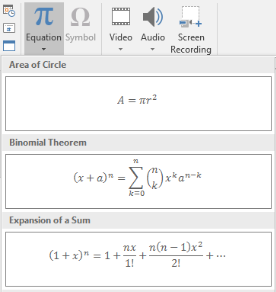
結果是在投影片上顯示可編輯的數學文字:

Aspose.Slides 透過三個主要物件建構該數學文字:
- 數學圖形,由 add_math_shape 建立,用於容納方程式的圖形。
- MathPortion 儲存圖形文字框內的數學內容。
- MathParagraph 包含一個或多個 MathBlock 物件。
以下大多數範例使用 MathematicalText 以及來自 IMathElement 的流式方法,以保持程式碼簡潔易讀。
如需 MathML 匯出情境,請參閱 從簡報中匯出數學方程式(Python via .NET)。
建立方程式
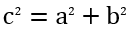
此範例建立一個數學圖形並加入畢氏定理:
import aspose.slides as slides
import aspose.slides.mathtext as math

with slides.Presentation() as presentation:
    slide = presentation.slides[0]

    math_shape = slide.shapes.add_math_shape(20, 20, 700, 120)
    math_paragraph = math_shape.text_frame.paragraphs[0].portions[0].math_paragraph

    equation = (
        math.MathematicalText("c")
        .set_superscript("2")
        .join("=")
        .join(math.MathematicalText("a").set_superscript("2"))
        .join("+")
        .join(math.MathematicalText("b").set_superscript("2"))
    )

    math_paragraph.add(equation)

    presentation.save("pythagorean-theorem.pptx", slides.export.SaveFormat.PPTX)
add_math_shape 會建立已包含數學段落的圖形。存取第一個 MathPortion,取得其 MathParagraph,然後在其中加入數學區塊或數學元素。
新增分數
使用 divide 建立分數。您可以使用 MathFractionTypes 選擇分數樣式。

import aspose.slides as slides
import aspose.slides.mathtext as math

with slides.Presentation() as presentation:
    slide = presentation.slides[0]

    math_shape = slide.shapes.add_math_shape(20, 20, 700, 100)
    math_paragraph = math_shape.text_frame.paragraphs[0].portions[0].math_paragraph

    fraction = math.MathematicalText("1").divide("x", math.MathFractionTypes.SKEWED)

    math_paragraph.add(math.MathBlock(fraction))

    presentation.save("fraction.pptx", slides.export.SaveFormat.PPTX)
若要堆疊式分數,使用 MathFractionTypes.BAR:
stacked_fraction = math.MathematicalText("x + 1").divide("y - 1", math.MathFractionTypes.BAR)
新增根號
使用 radical 建立平方根、立方根或其他根號。當前元素成為底數,參數則為指數。

import aspose.slides as slides
import aspose.slides.mathtext as math

with slides.Presentation() as presentation:
    slide = presentation.slides[0]

    math_shape = slide.shapes.add_math_shape(20, 20, 700, 100)
    math_paragraph = math_shape.text_frame.paragraphs[0].portions[0].math_paragraph

    radical = math.MathematicalText("x").radical("n")

    math_paragraph.add(math.MathBlock(radical))

    presentation.save("radical.pptx", slides.export.SaveFormat.PPTX)
新增函式與極限
使用 as_argument_of_function 或 function 來建立 sin(x)、log(x) 或自訂函式名稱等函式。若要加入極限,請在 MathLimit 中放入 lim,或使用 set_lower_limit。

import aspose.slides as slides
import aspose.slides.mathtext as math

with slides.Presentation() as presentation:
    slide = presentation.slides[0]

    math_shape = slide.shapes.add_math_shape(20, 20, 700, 100)
    math_paragraph = math_shape.text_frame.paragraphs[0].portions[0].math_paragraph

    limit = (
        math.MathematicalText("lim")
        .set_lower_limit("x\u2192\u221E")
        .function("x")
    )

    math_paragraph.add(math.MathBlock(limit))

    presentation.save("functions-and-limits.pptx", slides.export.SaveFormat.PPTX)
若要自訂函式名稱,將函式名稱設為當前元素:
custom_function = math.MathematicalText("f").function("x + 1")
新增 N 元運算子與積分
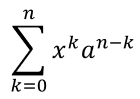
使用 nary 取得求和、聯集、交集等大型運算子。使用 integral 取得積分。兩者皆可設定上下限。
import aspose.slides as slides
import aspose.slides.mathtext as math

with slides.Presentation() as presentation:
    slide = presentation.slides[0]

    math_shape = slide.shapes.add_math_shape(20, 20, 700, 120)
    math_paragraph = math_shape.text_frame.paragraphs[0].portions[0].math_paragraph

    summation_base = (
        math.MathematicalText("x")
        .set_superscript("k")
        .join(math.MathematicalText("a").set_superscript("n-k"))
    )

    summation = summation_base.nary(math.MathNaryOperatorTypes.SUMMATION, "k=0", "n")

    math_paragraph.add(math.MathBlock(summation))

    presentation.save("nary-operators.pptx", slides.export.SaveFormat.PPTX)
N 元運算子用於帶有(可選)上下限的大型運算子。+、-、= 等簡單運算子通常以 MathematicalText 加入並串接於表達式中。
若要加入積分,使用 integral:
integral_base = math.MathematicalText("x").join(math.MathematicalText("dx").to_box())
integral = integral_base.integral(math.MathIntegralTypes.SIMPLE, "0", "1")
新增矩陣
使用 MathMatrix 來建立列與欄。矩陣預設不包含括號,若需要括弧、方括號或大括號,請自行將矩陣包起來。

import aspose.slides as slides
import aspose.slides.mathtext as math

with slides.Presentation() as presentation:
    slide = presentation.slides[0]

    math_shape = slide.shapes.add_math_shape(20, 20, 700, 120)
    math_paragraph = math_shape.text_frame.paragraphs[0].portions[0].math_paragraph

    matrix = math.MathMatrix(2, 3)
    matrix[0, 0] = math.MathematicalText("1")
    matrix[0, 1] = math.MathematicalText("x")
    matrix[1, 0] = math.MathematicalText("x")
    matrix[1, 1] = math.MathematicalText("2")
    matrix[1, 2] = math.MathematicalText("y")

    math_paragraph.add(math.MathBlock(matrix))

    presentation.save("matrix.pptx", slides.export.SaveFormat.PPTX)
新增方程式陣列
當需要對齊的方程式或垂直堆疊的表達式時,使用 to_math_array。

import aspose.slides as slides
import aspose.slides.mathtext as math

with slides.Presentation() as presentation:
    slide = presentation.slides[0]

    math_shape = slide.shapes.add_math_shape(20, 20, 700, 140)
    math_paragraph = math_shape.text_frame.paragraphs[0].portions[0].math_paragraph

    equation_array = (
        math.MathematicalText("x")
        .join("y")
        .to_math_array()
    )

    math_paragraph.add(math.MathBlock(equation_array))

    presentation.save("equation-array.pptx", slides.export.SaveFormat.PPTX)
新增三角函式
當參數為當前元素且函式名稱已知時,使用 as_argument_of_function。

import aspose.slides as slides
import aspose.slides.mathtext as math

with slides.Presentation() as presentation:
    slide = presentation.slides[0]

    math_shape = slide.shapes.add_math_shape(20, 20, 700, 100)
    math_paragraph = math_shape.text_frame.paragraphs[0].portions[0].math_paragraph

    cosine = math.MathematicalText("2x").as_argument_of_function(
        math.MathFunctionsOfOneArgument.COS
    )

    math_paragraph.add(math.MathBlock(cosine))

    presentation.save("trigonometric-function.pptx", slides.export.SaveFormat.PPTX)
新增下標與上標
使用下標與上標輔助方法來處理索引與次方。若必須將索引放於基底左側,請使用 set_sub_superscript_on_the_left。

import aspose.slides as slides
import aspose.slides.mathtext as math

with slides.Presentation() as presentation:
    slide = presentation.slides[0]

    math_shape = slide.shapes.add_math_shape(20, 20, 700, 100)
    math_paragraph = math_shape.text_frame.paragraphs[0].portions[0].math_paragraph

    scripts = math.MathematicalText("Y").set_sub_superscript_on_the_left("1", "n")

    math_paragraph.add(math.MathBlock(scripts))

    presentation.save("subscript-superscript.pptx", slides.export.SaveFormat.PPTX)
新增分隔符號
使用 enclose 可將表達式放入分隔符號內。對於包含多個元素的分隔符號表達式,您亦可設定分隔字元。

import aspose.slides as slides
import aspose.slides.mathtext as math

with slides.Presentation() as presentation:
    slide = presentation.slides[0]

    math_shape = slide.shapes.add_math_shape(20, 20, 700, 100)
    math_paragraph = math_shape.text_frame.paragraphs[0].portions[0].math_paragraph

    delimiter = (
        math.MathematicalText("x")
        .join("y")
        .join("z")
        .enclose("<", ">")
    )
    delimiter.separator_character = "|"

    math_paragraph.add(math.MathBlock(delimiter))

    presentation.save("delimiters.pptx", slides.export.SaveFormat.PPTX)
新增框線方程式
使用 to_border_box,當方程式本身需要被框住時。

import aspose.slides as slides
import aspose.slides.mathtext as math

with slides.Presentation() as presentation:
    slide = presentation.slides[0]

    math_shape = slide.shapes.add_math_shape(20, 20, 700, 100)
    math_paragraph = math_shape.text_frame.paragraphs[0].portions[0].math_paragraph

    boxed_equation = (
        math.MathematicalText("a")
        .set_superscript("2")
        .join("=")
        .join(math.MathematicalText("b").set_superscript("2"))
        .join("+")
        .join(math.MathematicalText("c").set_superscript("2"))
        .to_border_box()
    )

    math_paragraph.add(math.MathBlock(boxed_equation))

    presentation.save("border-box.pptx", slides.export.SaveFormat.PPTX)
群組項目
使用 group 可在表達式上方或下方放置分組符號。加入上下限以為群組項目加上標籤。

import aspose.slides as slides
import aspose.slides.mathtext as math

with slides.Presentation() as presentation:
    slide = presentation.slides[0]

    math_shape = slide.shapes.add_math_shape(20, 20, 700, 120)
    math_paragraph = math_shape.text_frame.paragraphs[0].portions[0].math_paragraph

    grouped = (
        math.MathematicalText("x + y")
        .group(chr(0x23DF), math.MathTopBotPositions.BOTTOM, math.MathTopBotPositions.TOP)
        .set_lower_limit("any text")
    )

    math_paragraph.add(math.MathBlock(grouped))

    presentation.save("grouped-terms.pptx", slides.export.SaveFormat.PPTX)
格式化數學元素
僅在能提升公式可讀性時使用格式化輔助方法。例如,overbar 會在數學元素上方加上橫線。

import aspose.slides as slides
import aspose.slides.mathtext as math

with slides.Presentation() as presentation:
    slide = presentation.slides[0]

    math_shape = slide.shapes.add_math_shape(20, 20, 700, 100)
    math_paragraph = math_shape.text_frame.paragraphs[0].portions[0].math_paragraph

    overbar = math.MathematicalText("ABC").overbar()

    math_paragraph.add(math.MathBlock(overbar))

    presentation.save("overbar.pptx", slides.export.SaveFormat.PPTX)
快速參考
| 任務 | 主要 API |
|---|---|
| 建立數學文字 | MathematicalText |
| 組合元素 | IMathElement.join |
| 建立分數 | IMathElement.divide |
| 新增上標或下標 | set_superscript, set_subscript |
| 新增函式 | function, as_argument_of_function |
| 新增根號 | radical |
| 新增極限 | set_lower_limit, set_upper_limit |
| 新增左側上下標 | set_sub_superscript_on_the_left |
| 新增求和與積分 | nary, integral |
| 新增矩陣 | MathMatrix |
| 新增方程式陣列 | to_math_array |
| 新增分隔符號 | enclose |
| 新增橫線與框線 | overbar, to_border_box |
| 群組項目 | group |
常見問題
我可以編輯現有的 PowerPoint 方程式嗎?
可以。開啟簡報,找到包含 MathPortion 的圖形,取得其 MathParagraph,然後更新該段落中的數學區塊。
方程式會以可編輯的 PowerPoint 數學格式儲存嗎?
會。儲存為 PPTX 時,Aspose.Slides 會將方程式寫入可編輯的 Office 數學內容。
我可以將方程式匯出為 LaTeX 嗎?
可以。從 MathPortion 取得方程式的 MathParagraph,然後呼叫 MathParagraph.to_latex 直接匯出。完整範例請參閱 從簡報中匯出數學方程式(Python via .NET)。