
Gestionar párrafos de texto de PowerPoint en Python mediante Java
Visión general
Aspose.Slides for Python via Java representa el texto como una jerarquía de marcos de texto, párrafos y porciones:
- TextFrame representa el contenedor de texto en una forma y proporciona acceso a su colección de párrafos.
- Paragraph representa un párrafo en un marco de texto y proporciona acceso a sus porciones y al formato a nivel de párrafo.
- Portion representa una ejecución de texto dentro de un párrafo. Cada porción puede tener su propio texto y formato a nivel de carácter.
Por lo tanto, un párrafo puede contener texto con diferentes fuentes, colores, tamaños y otros formatos mediante el uso de múltiples porciones.
Crear y dar formato a los párrafos
Crear párrafos con múltiples porciones
Los siguientes pasos crean un marco de texto con tres párrafos, cada uno con tres porciones:
- Cree una instancia de la clase Presentation.
- Acceda a la diapositiva correspondiente mediante su índice.
- Añada una AutoShape rectangular a la diapositiva.
- Acceda al TextFrame de la forma.
- Utilice el párrafo predeterminado y añada dos objetos Paragraph más al marco de texto.
- Añada suficientes objetos Portion para que cada párrafo contenga tres porciones. El párrafo predeterminado ya contiene una porción vacía.
- Establezca el texto de cada porción.
- Aplique formato a nivel de carácter mediante Portion.getPortionFormat.
- Guarde la presentación modificada.
Este ejemplo de Python implementa los pasos:
import jpype
import asposeslides

if not jpype.isJVMStarted():
    jpype.startJVM()

from asposeslides.api import FillType, NullableBool, Paragraph, Portion, Presentation, SaveFormat, ShapeType
from java.awt import Color

presentation = Presentation()
try:
    slide = presentation.getSlides().get_Item(0)
    shape = slide.getShapes().addAutoShape(ShapeType.Rectangle, 50, 150, 300, 150)
    text_frame = shape.getTextFrame()
    first_paragraph = text_frame.getParagraphs().get_Item(0)
    first_paragraph.getPortions().add(Portion())
    first_paragraph.getPortions().add(Portion())
    second_paragraph = Paragraph()
    second_paragraph.getPortions().add(Portion())
    second_paragraph.getPortions().add(Portion())
    second_paragraph.getPortions().add(Portion())
    text_frame.getParagraphs().add(second_paragraph)
    third_paragraph = Paragraph()
    third_paragraph.getPortions().add(Portion())
    third_paragraph.getPortions().add(Portion())
    third_paragraph.getPortions().add(Portion())
    text_frame.getParagraphs().add(third_paragraph)
    paragraph_count = text_frame.getParagraphs().getCount()
    for paragraph_index in range(paragraph_count):
        paragraph = text_frame.getParagraphs().get_Item(paragraph_index)
        portion_count = paragraph.getPortions().getCount()
        for portion_index in range(portion_count):
            portion = paragraph.getPortions().get_Item(portion_index)
            portion.setText(f"Portion {paragraph_index + 1}.{portion_index + 1}")
            if portion_index == 0:
                portion.getPortionFormat().getFillFormat().setFillType(FillType.Solid)
                portion.getPortionFormat().getFillFormat().getSolidFillColor().setColor(Color.RED)
                portion.getPortionFormat().setFontBold(NullableBool.True_)
                portion.getPortionFormat().setFontHeight(15)
            elif portion_index == 1:
                portion.getPortionFormat().getFillFormat().setFillType(FillType.Solid)
                portion.getPortionFormat().getFillFormat().getSolidFillColor().setColor(Color.BLUE)
                portion.getPortionFormat().setFontItalic(NullableBool.True_)
                portion.getPortionFormat().setFontHeight(18)
    presentation.save("paragraphs_with_portions.pptx", SaveFormat.Pptx)
finally:
    presentation.dispose()
Crear listas con viñetas y numeradas
Crear una lista con viñetas o numerada
Las viñetas y la numeración facilitan la lectura de los elementos relacionados. En Aspose.Slides, la configuración de listas se define mediante BulletFormat.
- Cree una instancia de la clase Presentation.
- Acceda a la diapositiva correspondiente mediante su índice.
- Añada una AutoShape a la diapositiva seleccionada.
- Acceda al TextFrame de la forma.
- Elimine el párrafo predeterminado del marco de texto.
- Cree un Paragraph para una viñeta de símbolo.
- Establezca BulletFormat.setType a BulletType.Symbol y especifique el carácter de la viñeta.
- Establezca el texto del párrafo, la sangría, el color de la viñeta y la altura de la viñeta.
- Añada el párrafo al marco de texto.
- Cree un segundo párrafo y establezca BulletFormat.setType a BulletType.Numbered.
- Configure el estilo de viñeta numerada y añada el párrafo al marco de texto.
- Guarde la presentación.
Este ejemplo de Python crea una viñeta de símbolo y una viñeta numerada:
import jpype
import asposeslides

if not jpype.isJVMStarted():
    jpype.startJVM()

from asposeslides.api import BulletType, ColorType, NullableBool, NumberedBulletStyle, Paragraph, Presentation, SaveFormat, ShapeType
from java.awt import Color

presentation = Presentation()
try:
    slide = presentation.getSlides().get_Item(0)
    shape = slide.getShapes().addAutoShape(ShapeType.Rectangle, 200, 200, 400, 200)
    text_frame = shape.getTextFrame()
    text_frame.getParagraphs().clear()
    symbol_paragraph = Paragraph()
    symbol_paragraph.setText("Welcome to Aspose.Slides")
    symbol_paragraph.getParagraphFormat().getBullet().setType(BulletType.Symbol)
    symbol_paragraph.getParagraphFormat().getBullet().setChar("•")
    symbol_paragraph.getParagraphFormat().setIndent(25)
    symbol_paragraph.getParagraphFormat().getBullet().getColor().setColorType(ColorType.RGB)
    symbol_paragraph.getParagraphFormat().getBullet().getColor().setColor(Color.BLACK)
    symbol_paragraph.getParagraphFormat().getBullet().setBulletHardColor(NullableBool.True_)
    symbol_paragraph.getParagraphFormat().getBullet().setHeight(100)
    text_frame.getParagraphs().add(symbol_paragraph)
    numbered_paragraph = Paragraph()
    numbered_paragraph.setText("This is a numbered item")
    numbered_paragraph.getParagraphFormat().getBullet().setType(BulletType.Numbered)
    numbered_paragraph.getParagraphFormat().getBullet().setNumberedBulletStyle(NumberedBulletStyle.BulletCircleNumWDBlackPlain)
    numbered_paragraph.getParagraphFormat().setIndent(25)
    numbered_paragraph.getParagraphFormat().getBullet().getColor().setColorType(ColorType.RGB)
    numbered_paragraph.getParagraphFormat().getBullet().getColor().setColor(Color.BLACK)
    numbered_paragraph.getParagraphFormat().getBullet().setBulletHardColor(NullableBool.True_)
    numbered_paragraph.getParagraphFormat().getBullet().setHeight(100)
    text_frame.getParagraphs().add(numbered_paragraph)
    presentation.save("bulleted_and_numbered_list.pptx", SaveFormat.Pptx)
finally:
    presentation.dispose()
Utilizar viñetas de imagen
Las viñetas de imagen le permiten usar una imagen personalizada en lugar de un símbolo o número.
- Cree una instancia de la clase Presentation.
- Acceda a la diapositiva correspondiente mediante su índice.
- Añada una AutoShape y acceda a su TextFrame.
- Elimine el párrafo predeterminado del marco de texto.
- Cargue la imagen de la viñeta y añádala a la colección de imágenes de la presentación como un PPImage.
- Cree un Paragraph y establezca su texto.
- Establezca BulletFormat.setType a BulletType.Picture.
- Asigne la imagen mediante BulletFormat.getPicture y establezca la altura de la viñeta.
- Añada el párrafo al marco de texto.
- Guarde la presentación modificada.
Este ejemplo de Python crea una viñeta de imagen:
import jpype
import asposeslides

if not jpype.isJVMStarted():
    jpype.startJVM()

from asposeslides.api import BulletType, Images, Paragraph, Presentation, SaveFormat, ShapeType

presentation = Presentation()
try:
    slide = presentation.getSlides().get_Item(0)
    bullet_image = Images.fromFile("bullets.png")
    try:
        presentation_image = presentation.getImages().addImage(bullet_image)
    finally:
        bullet_image.dispose()
    shape = slide.getShapes().addAutoShape(ShapeType.Rectangle, 200, 200, 400, 200)
    text_frame = shape.getTextFrame()
    text_frame.getParagraphs().clear()
    paragraph = Paragraph()
    paragraph.setText("Welcome to Aspose.Slides")
    paragraph.getParagraphFormat().getBullet().setType(BulletType.Picture)
    paragraph.getParagraphFormat().getBullet().getPicture().setImage(presentation_image)
    paragraph.getParagraphFormat().getBullet().setHeight(100)
    text_frame.getParagraphs().add(paragraph)
    presentation.save("picture_bullet.pptx", SaveFormat.Pptx)
    presentation.save("picture_bullet.ppt", SaveFormat.Ppt)
finally:
    presentation.dispose()
Crear una lista multinivel
Establezca ParagraphFormat.setDepth para colocar los párrafos en diferentes niveles de una lista. El nivel superior tiene una profundidad de 0.
- Cree una Presentation y acceda a una diapositiva.
- Añada una AutoShape y elimine el párrafo predeterminado de su marco de texto.
- Cree cuatro párrafos y configure sus símbolos de viñeta.
- Establezca sus valores de ParagraphFormat.setDepth a
0,1,2y3. - Añada los párrafos al marco de texto y guarde la presentación.
Este ejemplo de Python crea una lista con viñetas de cuatro niveles:
import jpype
import asposeslides

if not jpype.isJVMStarted():
    jpype.startJVM()

from asposeslides.api import BulletType, FillType, Paragraph, Presentation, SaveFormat, ShapeType
from java.awt import Color

presentation = Presentation()
try:
    slide = presentation.getSlides().get_Item(0)
    shape = slide.getShapes().addAutoShape(ShapeType.Rectangle, 200, 200, 400, 200)
    text_frame = shape.getTextFrame()
    text_frame.getParagraphs().clear()
    first_paragraph = Paragraph()
    first_paragraph.setText("Content")
    first_paragraph.getParagraphFormat().getBullet().setType(BulletType.Symbol)
    first_paragraph.getParagraphFormat().getBullet().setChar("•")
    first_paragraph.getParagraphFormat().getDefaultPortionFormat().getFillFormat().setFillType(FillType.Solid)
    first_paragraph.getParagraphFormat().getDefaultPortionFormat().getFillFormat().getSolidFillColor().setColor(Color.BLACK)
    first_paragraph.getParagraphFormat().setDepth(0)
    second_paragraph = Paragraph()
    second_paragraph.setText("Second level")
    second_paragraph.getParagraphFormat().getBullet().setType(BulletType.Symbol)
    second_paragraph.getParagraphFormat().getBullet().setChar('-')
    second_paragraph.getParagraphFormat().getDefaultPortionFormat().getFillFormat().setFillType(FillType.Solid)
    second_paragraph.getParagraphFormat().getDefaultPortionFormat().getFillFormat().getSolidFillColor().setColor(Color.BLACK)
    second_paragraph.getParagraphFormat().setDepth(1)
    third_paragraph = Paragraph()
    third_paragraph.setText("Third level")
    third_paragraph.getParagraphFormat().getBullet().setType(BulletType.Symbol)
    third_paragraph.getParagraphFormat().getBullet().setChar("•")
    third_paragraph.getParagraphFormat().getDefaultPortionFormat().getFillFormat().setFillType(FillType.Solid)
    third_paragraph.getParagraphFormat().getDefaultPortionFormat().getFillFormat().getSolidFillColor().setColor(Color.BLACK)
    third_paragraph.getParagraphFormat().setDepth(2)
    fourth_paragraph = Paragraph()
    fourth_paragraph.setText("Fourth level")
    fourth_paragraph.getParagraphFormat().getBullet().setType(BulletType.Symbol)
    fourth_paragraph.getParagraphFormat().getBullet().setChar('-')
    fourth_paragraph.getParagraphFormat().getDefaultPortionFormat().getFillFormat().setFillType(FillType.Solid)
    fourth_paragraph.getParagraphFormat().getDefaultPortionFormat().getFillFormat().getSolidFillColor().setColor(Color.BLACK)
    fourth_paragraph.getParagraphFormat().setDepth(3)
    text_frame.getParagraphs().add(first_paragraph)
    text_frame.getParagraphs().add(second_paragraph)
    text_frame.getParagraphs().add(third_paragraph)
    text_frame.getParagraphs().add(fourth_paragraph)
    presentation.save("multilevel_list.pptx", SaveFormat.Pptx)
finally:
    presentation.dispose()
Iniciar elementos de lista numerada con valores personalizados
Utilice BulletFormat.setNumberedBulletStartWith para establecer el número inicial que se muestra en un párrafo numerado.
- Cree una Presentation y añada una AutoShape a una diapositiva.
- Elimine el párrafo predeterminado del marco de texto de la forma.
- Cree tres párrafos numerados.
- Establezca BulletFormat.setNumberedBulletStartWith a
2,3y7para los párrafos correspondientes. - Añada los párrafos al marco de texto y guarde la presentación.
Este ejemplo de Python asigna un número de inicio personalizado a cada párrafo:
import jpype
import asposeslides

if not jpype.isJVMStarted():
    jpype.startJVM()

from asposeslides.api import BulletType, Paragraph, Presentation, SaveFormat, ShapeType

presentation = Presentation()
try:
    slide = presentation.getSlides().get_Item(0)
    shape = slide.getShapes().addAutoShape(ShapeType.Rectangle, 200, 200, 400, 200)
    text_frame = shape.getTextFrame()
    text_frame.getParagraphs().clear()
    first_paragraph = Paragraph()
    first_paragraph.setText("Start at 2")
    first_paragraph.getParagraphFormat().getBullet().setType(BulletType.Numbered)
    first_paragraph.getParagraphFormat().getBullet().setNumberedBulletStartWith(2)
    text_frame.getParagraphs().add(first_paragraph)
    second_paragraph = Paragraph()
    second_paragraph.setText("Start at 3")
    second_paragraph.getParagraphFormat().getBullet().setType(BulletType.Numbered)
    second_paragraph.getParagraphFormat().getBullet().setNumberedBulletStartWith(3)
    text_frame.getParagraphs().add(second_paragraph)
    third_paragraph = Paragraph()
    third_paragraph.setText("Start at 7")
    third_paragraph.getParagraphFormat().getBullet().setType(BulletType.Numbered)
    third_paragraph.getParagraphFormat().getBullet().setNumberedBulletStartWith(7)
    text_frame.getParagraphs().add(third_paragraph)
    presentation.save("custom_numbered_list.pptx", SaveFormat.Pptx)
finally:
    presentation.dispose()
Controlar el diseño del párrafo y sus propiedades finales
Establecer una sangría de primera línea
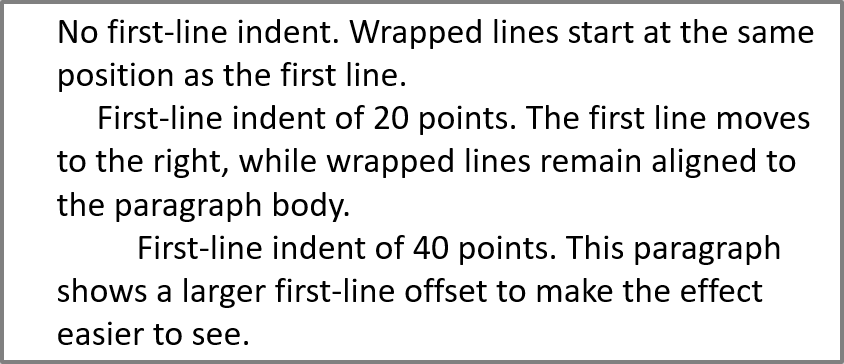
Use ParagraphFormat.setIndent para controlar la sangría de primera línea de un párrafo. Este método mueve solo la primera línea respecto al margen izquierdo del párrafo. Un valor positivo desplaza la primera línea a la derecha, mientras que las líneas restantes permanecen alineadas con el cuerpo del párrafo.
Use ParagraphFormat.setMarginLeft cuando necesite mover todo el párrafo. Use ParagraphFormat.setIndent cuando necesite mover solo la primera línea.
El ejemplo siguiente crea varios párrafos y aplica diferentes valores de ParagraphFormat.setIndent para demostrar cómo la sangría de primera línea afecta el diseño del párrafo.
- Cree una instancia de la clase Presentation.
- Acceda a la diapositiva de destino.
- Añada una AutoShape rectangular a la diapositiva.
- Acceda al TextFrame de la forma y elimine el párrafo predeterminado.
- Cree varios párrafos y establezca diferentes valores de ParagraphFormat.setIndent para ellos.
- Añada los párrafos al marco de texto.
- Guarde la presentación modificada.
Este código le muestra cómo establecer la sangría de un párrafo:
import jpype
import asposeslides

if not jpype.isJVMStarted():
    jpype.startJVM()

from asposeslides.api import FillType, Paragraph, Presentation, SaveFormat, ShapeType, TextAutofitType
from java.awt import Color

presentation = Presentation()
try:
    slide = presentation.getSlides().get_Item(0)
    shape = slide.getShapes().addAutoShape(ShapeType.Rectangle, 50, 50, 420, 220)
    shape.getFillFormat().setFillType(FillType.NoFill)
    shape.getLineFormat().getFillFormat().setFillType(FillType.Solid)
    shape.getLineFormat().getFillFormat().getSolidFillColor().setColor(Color.GRAY)
    text_frame = shape.getTextFrame()
    text_frame.getTextFrameFormat().setAutofitType(TextAutofitType.Shape)
    text_frame.getParagraphs().clear()
    first_paragraph = Paragraph()
    first_paragraph.setText("No first-line indent. Wrapped lines start at the same position as the first line.")
    first_paragraph.getParagraphFormat().getDefaultPortionFormat().getFillFormat().setFillType(FillType.Solid)
    first_paragraph.getParagraphFormat().getDefaultPortionFormat().getFillFormat().getSolidFillColor().setColor(Color.BLACK)
    first_paragraph.getParagraphFormat().setMarginLeft(20.0)
    first_paragraph.getParagraphFormat().setIndent(0.0)
    second_paragraph = Paragraph()
    second_paragraph.setText("First-line indent of 20 points. The first line moves to the right, while wrapped lines remain aligned to the paragraph body.")
    second_paragraph.getParagraphFormat().getDefaultPortionFormat().setFillType(FillType.Solid)
    second_paragraph.getParagraphFormat().getDefaultPortionFormat().getFillFormat().getSolidFillColor().setColor(Color.BLACK)
    second_paragraph.getParagraphFormat().setMarginLeft(20.0)
    second_paragraph.getParagraphFormat().setIndent(20.0)
    third_paragraph = Paragraph()
    third_paragraph.setText("First-line indent of 40 points. This paragraph shows a larger first-line offset to make the effect easier to see.")
    third_paragraph.getParagraphFormat().getDefaultPortionFormat().setFillType(FillType.Solid)
    third_paragraph.getParagraphFormat().getDefaultPortionFormat().getFillFormat().getSolidFillColor().setColor(Color.BLACK)
    third_paragraph.getParagraphFormat().setMarginLeft(20.0)
    third_paragraph.getParagraphFormat().setIndent(40.0)
    text_frame.getParagraphs().add(first_paragraph)
    text_frame.getParagraphs().add(second_paragraph)
    text_frame.getParagraphs().add(third_paragraph)
    presentation.save("paragraph_indent.pptx", SaveFormat.Pptx)
finally:
    presentation.dispose()
El resultado:
Establecer una sangría francesa
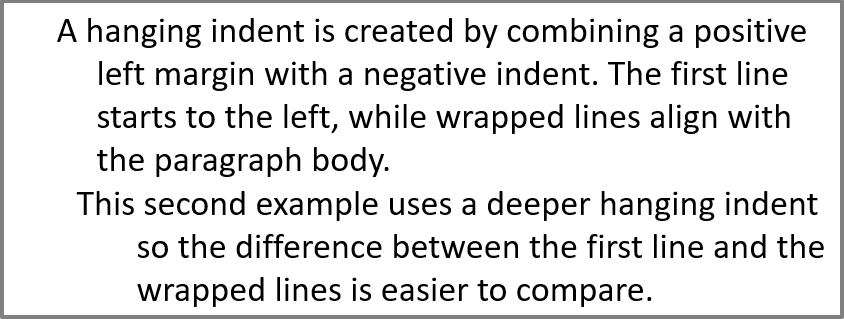
Una sangría francesa es un diseño de párrafo en el que la primera línea comienza a la izquierda de las líneas restantes. En Aspose.Slides, crea este efecto con ParagraphFormat.setIndent. Pase un valor negativo para mover la primera línea a la izquierda respecto al cuerpo del párrafo.
En la práctica, ParagraphFormat.setMarginLeft define la posición izquierda del cuerpo del párrafo, y ParagraphFormat.setIndent define la posición de la primera línea respecto a ese margen. Para crear una sangría francesa, pase un valor positivo a ParagraphFormat.setMarginLeft y un valor negativo a ParagraphFormat.setIndent.
Este formato es útil para bibliografías, referencias, entradas de glosario y otros párrafos donde las líneas envueltas deben alinearse bajo el cuerpo del párrafo en lugar de bajo el primer carácter de la primera línea.
- Cree una instancia de la clase Presentation.
- Acceda a la diapositiva de destino.
- Añada una AutoShape rectangular a la diapositiva.
- Acceda al TextFrame de la forma y elimine el párrafo predeterminado.
- Cree párrafos y pase un valor positivo a ParagraphFormat.setMarginLeft para cada párrafo.
- Pase un valor negativo a ParagraphFormat.setIndent para crear el efecto de sangría francesa.
- Añada los párrafos al marco de texto.
- Guarde la presentación modificada.
Este código le muestra cómo establecer una sangría francesa para un párrafo:
import jpype
import asposeslides

if not jpype.isJVMStarted():
    jpype.startJVM()

from asposeslides.api import FillType, Paragraph, Presentation, SaveFormat, ShapeType, TextAutofitType
from java.awt import Color

presentation = Presentation()
try:
    slide = presentation.getSlides().get_Item(0)
    shape = slide.getShapes().addAutoShape(ShapeType.Rectangle, 50, 50, 420, 220)
    shape.getFillFormat().setFillType(FillType.NoFill)
    shape.getLineFormat().getFillFormat().setFillType(FillType.Solid)
    shape.getLineFormat().getFillFormat().getSolidFillColor().setColor(Color.GRAY)
    text_frame = shape.getTextFrame()
    text_frame.getTextFrameFormat().setAutofitType(TextAutofitType.Shape)
    text_frame.getParagraphs().clear()
    first_paragraph = Paragraph()
    first_paragraph.setText("A hanging indent is created by combining a positive left margin with a negative indent. The first line starts to the left, while wrapped lines align with the paragraph body.")
    first_paragraph.getParagraphFormat().getDefaultPortionFormat().getFillFormat().setFillType(FillType.Solid)
    first_paragraph.getParagraphFormat().getDefaultPortionFormat().getFillFormat().getSolidFillColor().setColor(Color.BLACK)
    first_paragraph.getParagraphFormat().setMarginLeft(40.0)
    first_paragraph.getParagraphFormat().setIndent(-20.0)
    second_paragraph = Paragraph()
    second_paragraph.setText("This second example uses a deeper hanging indent so the difference between the first line and the wrapped lines is easier to compare.")
    second_paragraph.getParagraphFormat().getDefaultPortionFormat().getFillFormat().setFillType(FillType.Solid)
    second_paragraph.getParagraphFormat().getDefaultPortionFormat().getFillFormat().getSolidFillColor().setColor(Color.BLACK)
    second_paragraph.getParagraphFormat().setMarginLeft(60.0)
    second_paragraph.getParagraphFormat().setIndent(-30.0)
    text_frame.getParagraphs().add(first_paragraph)
    text_frame.getParagraphs().add(second_paragraph)
    presentation.save("hanging_indent.pptx", SaveFormat.Pptx)
finally:
    presentation.dispose()
El resultado:
Establecer propiedades de ejecución del párrafo final
Paragraph.setEndParagraphPortionFormat controla el formato de la marca de fin del párrafo. El siguiente ejemplo asigna un tamaño de fuente y una fuente latina a la marca de fin del segundo párrafo:
- Cargue una Presentation y acceda a una diapositiva.
- Añada una AutoShape y elimine su párrafo predeterminado.
- Cree dos párrafos y añada porciones de texto a ellos.
- Cree un PortionFormat para la marca final del segundo párrafo.
- Establezca BasePortionFormat.setFontHeight y BasePortionFormat.setLatinFont.
- Asigne el formato con Paragraph.setEndParagraphPortionFormat y guarde la presentación.
import jpype
import asposeslides

if not jpype.isJVMStarted():
    jpype.startJVM()

from asposeslides.api import FontData, Paragraph, Portion, PortionFormat, Presentation, SaveFormat, ShapeType

presentation = Presentation("Test.pptx")
try:
    slide = presentation.getSlides().get_Item(0)
    shape = slide.getShapes().addAutoShape(ShapeType.Rectangle, 10, 10, 200, 250)
    text_frame = shape.getTextFrame()
    text_frame.getParagraphs().clear()
    first_paragraph = Paragraph()
    first_portion = Portion("Sample text")
    first_paragraph.getPortions().add(first_portion)
    second_paragraph = Paragraph()
    second_portion = Portion("Sample text 2")
    second_paragraph.getPortions().add(second_portion)
    end_paragraph_format = PortionFormat()
    end_paragraph_format.setFontHeight(48)
    latin_font = FontData("Times New Roman")
    end_paragraph_format.setLatinFont(latin_font)
    second_paragraph.setEndParagraphPortionFormat(end_paragraph_format)
    text_frame.getParagraphs().add(first_paragraph)
    text_frame.getParagraphs().add(second_paragraph)
    presentation.save("end_paragraph_format.pptx", SaveFormat.Pptx)
finally:
    presentation.dispose()
Contar líneas renderizadas
Para reglas de párrafo que afectan el ajuste automático y la puntuación al final de línea, vea Control Line Breaking y Control Hanging Punctuation.
Utilice Paragraph.getLinesCount para contar las líneas que ocupa un párrafo después del diseño del texto, incluido el ajuste automático. Esto es útil al comprobar la longitud del texto y el diseño en plantillas de presentaciones.
Un párrafo es un elemento en TextFrame.getParagraphs y puede ocupar varias líneas renderizadas. Un salto de línea explícito dentro de un párrafo fuerza una nueva línea sin crear otro párrafo. El ajuste automático crea líneas basándose en el ancho disponible sin insertar saltos de línea explícitos en el texto. Por lo tanto, contar párrafos o caracteres de salto de línea no da el recuento de líneas renderizadas.
El siguiente ejemplo crea una forma de texto, cuenta sus líneas, estrecha la forma y luego sustituye el texto por una cadena más corta. El ajuste está activado y el autofit está desactivado para que el ancho de la forma controle el ajuste sin reducir automáticamente el texto ni redimensionar la forma. Las dimensiones de la forma están en puntos. Finalmente, el ejemplo añade otro párrafo y suma los recuentos de líneas en todo el marco de texto.
import jpype
import asposeslides

if not jpype.isJVMStarted():
    jpype.startJVM()

from asposeslides.api import NullableBool, Paragraph, Presentation, ShapeType, TextAutofitType

presentation = Presentation()
try:
    slide = presentation.getSlides().get_Item(0)

    shape = slide.getShapes().addAutoShape(ShapeType.Rectangle, 50, 50, 400, 200)
    text_frame = shape.getTextFrame()
    text_frame.getTextFrameFormat().setWrapText(NullableBool.True_)
    text_frame.getTextFrameFormat().setAutofitType(TextAutofitType.None_)

    paragraph = text_frame.getParagraphs().get_Item(0)
    paragraph.getParagraphFormat().getDefaultPortionFormat().setFontHeight(20)
    paragraph.setText("This text demonstrates how automatic wrapping changes the number of rendered lines.")
    print("Original width:", paragraph.getLinesCount())

    shape.setWidth(150)
    print("Narrower shape:", paragraph.getLinesCount())

    paragraph.setText("Short text.")
    print("Shorter text:", paragraph.getLinesCount())

    second_paragraph = Paragraph()
    second_paragraph.setText("Another paragraph.")
    second_paragraph.getParagraphFormat().getDefaultPortionFormat().setFontHeight(20)
    text_frame.getParagraphs().add(second_paragraph)

    total_line_count = 0
    for current_paragraph in text_frame.getParagraphs():
        total_line_count += current_paragraph.getLinesCount()
    print("Total lines in the text frame:", total_line_count)
finally:
    presentation.dispose()
Con este texto y estas dimensiones, estrechar la forma incrementa el recuento de líneas, mientras que sustituir el texto por la cadena corta lo reduce. Los recuentos exactos pueden variar según la disponibilidad y sustitución de fuentes, el tamaño de fuente, los márgenes, la sangría, el ajuste y la configuración de autofit. Utilice las fuentes y configuraciones de diseño previstas para el entorno de destino al comprobar una plantilla.
El recuento de líneas por sí solo no determina si el texto se desborda del contenedor. También importan la altura disponible, la altura de línea, el espaciado entre párrafos y líneas, y el comportamiento de autofit; incluso una sola línea puede superar el ancho disponible cuando el ajuste está desactivado.
Importar y exportar contenido de párrafos
Importar texto HTML en párrafos
Utilice ParagraphCollection.addFromHtml para convertir el marcado HTML en párrafos y porciones en un marco de texto.
- Cree una instancia de la clase Presentation.
- Acceda a una diapositiva y añada una AutoShape.
- Acceda al TextFrame de la forma y elimine el párrafo predeterminado.
- Lea el archivo HTML fuente.
- Pase la cadena HTML a ParagraphCollection.addFromHtml.
- Guarde la presentación modificada.
Este ejemplo de Python importa HTML en un marco de texto:
import jpype
import asposeslides

if not jpype.isJVMStarted():
    jpype.startJVM()

from asposeslides.api import FillType, Presentation, SaveFormat, ShapeType
from pathlib import Path

presentation = Presentation()
try:
    slide = presentation.getSlides().get_Item(0)
    shape_width = presentation.getSlideSize().getSize().getWidth() - 20
    shape_height = presentation.getSlideSize().getSize().getHeight() - 20
    shape = slide.getShapes().addAutoShape(ShapeType.Rectangle, 10, 10, shape_width, shape_height)
    shape.getFillFormat().setFillType(FillType.NoFill)
    shape.getTextFrame().getParagraphs().clear()
    try:
        html = Path("file.html").read_text(encoding="utf-8")
        shape.getTextFrame().getParagraphs().addFromHtml(html)
        presentation.save("html_text.pptx", SaveFormat.Pptx)
    except OSError as exception:
        print("The HTML file could not be read: " + str(exception))
finally:
    presentation.dispose()
Exportar texto del párrafo a HTML
Utilice ParagraphCollection.exportToHtml para exportar un rango seleccionado de párrafos como HTML.
- Cree una instancia de la clase Presentation y cargue la presentación deseada.
- Acceda a la diapositiva y encuentre la AutoShape que contiene el texto.
- Acceda al TextFrame de la forma.
- Llame a ParagraphCollection.exportToHtml con el índice del párrafo inicial y el número de párrafos a exportar.
- Escriba la cadena HTML devuelta a un archivo.
Este ejemplo de Python exporta todos los párrafos del primer marco de texto:
import jpype
import asposeslides

if not jpype.isJVMStarted():
    jpype.startJVM()

from asposeslides.api import AutoShape, Presentation
from pathlib import Path

presentation = Presentation("ExportingHTMLText.pptx")
try:
    shape = presentation.getSlides().get_Item(0).getShapes().get_Item(0)
    if isinstance(shape, AutoShape):
        text_shape = shape
        text_frame = text_shape.getTextFrame()
        if text_frame is not None:
            paragraphs = text_frame.getParagraphs()
            html = paragraphs.exportToHtml(0, paragraphs.getCount(), None)
            try:
                Path("paragraphs.html").write_text(str(html), encoding="utf-8")
            except OSError as exception:
                print("The HTML file could not be written: " + str(exception))
        else:
            print("The first shape does not contain a text frame.")
    else:
        print("The first shape is not a text shape.")
finally:
    presentation.dispose()
Renderizar un párrafo como imagen
Paragraph.getImage renderiza directamente un párrafo individual y devuelve un objeto de imagen. Guarde el resultado en un archivo o flujo con su método save. No es necesario renderizar la forma contenedora ni recortar un mapa de bits manualmente.
Paragraph.getImage puede devolver None si el párrafo no se encuentra en su colección padre, no tiene límites de renderizado válidos o no puede renderizarse. Compruebe el resultado antes de guardarlo y libere la imagen devuelta tras su uso.
Renderizar un párrafo a escala predeterminada
Supongamos que tenemos un archivo de presentación llamado sample.pptx con una diapositiva, donde la primera forma es un cuadro de texto que contiene tres párrafos.
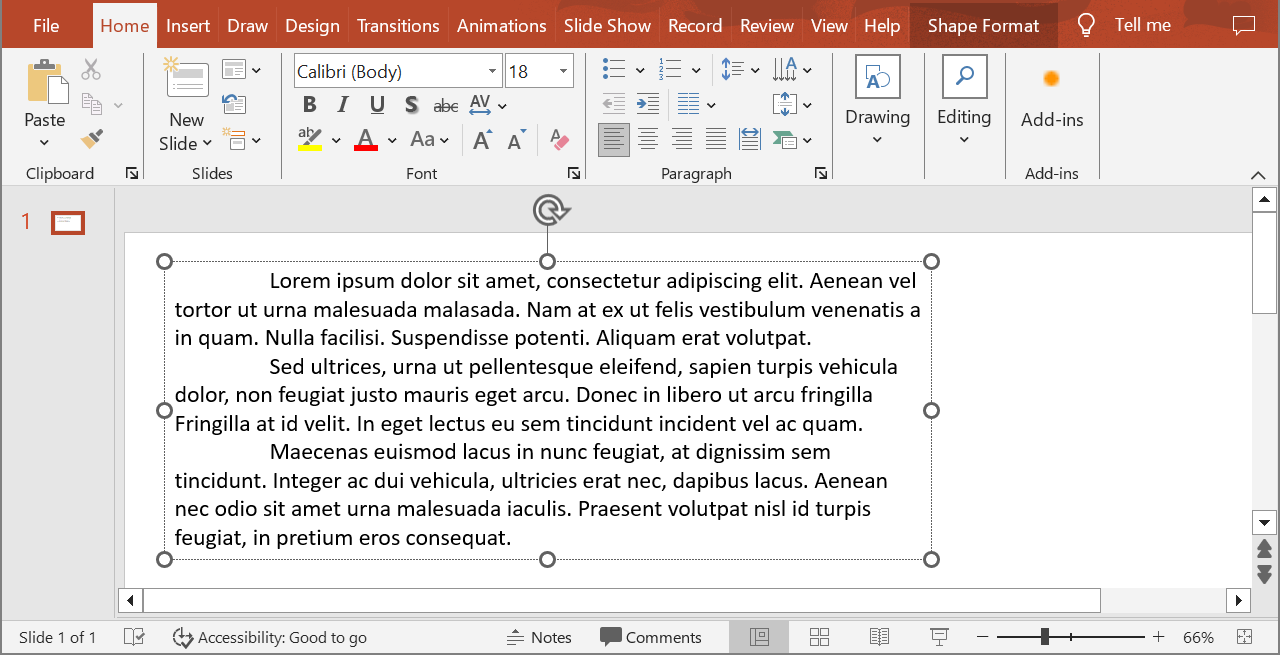
El siguiente ejemplo renderiza el segundo párrafo en una forma de texto normal a la escala predeterminada y guarda la imagen devuelta en formato PNG. El bloque finally asegura que la imagen se libere correctamente.
import jpype
import asposeslides

if not jpype.isJVMStarted():
    jpype.startJVM()

from asposeslides.api import AutoShape, ImageFormat, Presentation

presentation = Presentation("sample.pptx")
try:
    shape = presentation.getSlides().get_Item(0).getShapes().get_Item(0)
    if isinstance(shape, AutoShape):
        text_shape = shape
        text_frame = text_shape.getTextFrame()
        if text_frame is not None and text_frame.getParagraphs().getCount() > 1:
            paragraph = text_frame.getParagraphs().get_Item(1)
            paragraph_image = paragraph.getImage()
            if paragraph_image is not None:
                try:
                    paragraph_image.save("paragraph.png", ImageFormat.Png)
                finally:
                    paragraph_image.dispose()
            else:
                print("The paragraph could not be rendered.")
        else:
            print("The expected paragraph was not found.")
    else:
        print("The first shape is not a text shape.")
finally:
    presentation.dispose()
El resultado:

Renderizar un párrafo en una celda de tabla con escala
Utilice la sobrecarga de Paragraph.getImage que acepta los parámetros scale_x y scale_y para establecer los factores de escala horizontal y vertical. El siguiente ejemplo crea una tabla, renderiza el párrafo en su primera celda a doble ancho y altura respecto a los valores predeterminados, y guarda el resultado como una imagen PNG.
import jpype
import asposeslides

if not jpype.isJVMStarted():
    jpype.startJVM()

from asposeslides.api import ImageFormat, Presentation

scale_x = 2.0
scale_y = 2.0
presentation = Presentation()
try:
    slide = presentation.getSlides().get_Item(0)
    table = slide.getShapes().addTable(50, 50, [300.0], [80.0])
    paragraph = table.get_Item(0, 0).getTextFrame().getParagraphs().get_Item(0)
    paragraph.setText("Text in a table cell")
    paragraph_image = paragraph.getImage(scale_x, scale_y)
    if paragraph_image is not None:
        try:
            paragraph_image.save("table_paragraph.png", ImageFormat.Png)
        finally:
            paragraph_image.dispose()
    else:
        print("The paragraph could not be rendered.")
finally:
    presentation.dispose()
Un factor de escala de 1 mantiene ese eje en su tamaño de píxel predeterminado. Por ejemplo, 2 para ambos factores produce una imagen cuyo ancho y altura son aproximadamente el doble de las dimensiones predeterminadas, lo que resulta en cuatro veces más píxeles. Los factores mayores suelen producir texto más nítido al hacer zoom o generar salida de alta resolución, pero también aumentan el uso de memoria y el tamaño del archivo. Los factores inferiores a 1 generan imágenes más pequeñas con menos detalle. Utilice factores iguales para conservar la relación de aspecto del párrafo; los factores horizontales y verticales diferentes estiran la salida de forma independiente.
Renderizar una forma completa con Shape.getImage sigue siendo útil cuando la salida debe incluir el relleno, el borde u otro contexto visual de la forma. Para una imagen solo del párrafo, utilice Paragraph.getImage.
Preguntas frecuentes
¿Puedo desactivar totalmente el ajuste de línea dentro de un marco de texto?
Sí. Establezca TextFrameFormat.setWrapText para desactivar el ajuste de modo que las líneas no se partan en los bordes del marco de texto.
¿Cómo puedo obtener los límites exactos en la diapositiva de un párrafo específico?
Utilice Paragraph.getRect para recuperar el rectángulo delimitador del párrafo. Portion.getRect proporciona los límites de una porción individual.
¿Dónde se controla la alineación del párrafo (izquierda, derecha, centrado o justificado)?
ParagraphFormat.setAlignment es una configuración a nivel de párrafo y se aplica a todo el párrafo independientemente del formato de porciones individuales.
Para alinear verticalmente porciones con diferentes tamaños de fuente dentro de cada línea, consulte Align Fonts Within a Line.
¿Puedo establecer el idioma de revisión para parte de un párrafo?
Sí. Establezca BasePortionFormat.setLanguageId para porciones individuales, de modo que un párrafo pueda contener texto en varios idiomas.