
Gérer les paragraphes de texte PowerPoint en Python via Java
Vue d’ensemble
Aspose.Slides for Python via Java représente le texte sous forme d’une hiérarchie de zones de texte, de paragraphes et de portions :
- TextFrame représente le conteneur de texte dans une forme et fournit l’accès à sa collection de paragraphes.
- Paragraph représente un paragraphe dans une zone de texte et fournit l’accès à ses portions et à son formatage au niveau du paragraphe.
- Portion représente un segment de texte au sein d’un paragraphe. Chaque portion peut avoir son propre texte et un formatage au niveau des caractères.
Un paragraphe peut donc contenir du texte avec différentes polices, couleurs, tailles et autres formatages en utilisant plusieurs portions.
Créer et formater des paragraphes
Créer des paragraphes avec plusieurs portions
Les étapes suivantes créent une zone de texte contenant trois paragraphes, chacun contenant trois portions :
- Créez une instance de la classe Presentation.
- Accédez à la diapositive concernée par son indice.
- Ajoutez une AutoShape rectangulaire à la diapositive.
- Accédez au TextFrame de la forme.
- Utilisez le paragraphe par défaut et ajoutez deux autres objets Paragraph au cadre de texte.
- Ajoutez suffisamment d’objets Portion pour que chaque paragraphe contienne trois portions. Le paragraphe par défaut contient déjà une portion vide.
- Définissez le texte de chaque portion.
- Appliquez le formatage au niveau des caractères via Portion.getPortionFormat.
- Enregistrez la présentation modifiée.
Cet exemple Python implémente les étapes :
import jpype
import asposeslides

if not jpype.isJVMStarted():
    jpype.startJVM()

from asposeslides.api import FillType, NullableBool, Paragraph, Portion, Presentation, SaveFormat, ShapeType
from java.awt import Color

presentation = Presentation()
try:
    slide = presentation.getSlides().get_Item(0)
    shape = slide.getShapes().addAutoShape(ShapeType.Rectangle, 50, 150, 300, 150)
    text_frame = shape.getTextFrame()
    first_paragraph = text_frame.getParagraphs().get_Item(0)
    first_paragraph.getPortions().add(Portion())
    first_paragraph.getPortions().add(Portion())
    second_paragraph = Paragraph()
    second_paragraph.getPortions().add(Portion())
    second_paragraph.getPortions().add(Portion())
    second_paragraph.getPortions().add(Portion())
    text_frame.getParagraphs().add(second_paragraph)
    third_paragraph = Paragraph()
    third_paragraph.getPortions().add(Portion())
    third_paragraph.getPortions().add(Portion())
    third_paragraph.getPortions().add(Portion())
    text_frame.getParagraphs().add(third_paragraph)
    paragraph_count = text_frame.getParagraphs().getCount()
    for paragraph_index in range(paragraph_count):
        paragraph = text_frame.getParagraphs().get_Item(paragraph_index)
        portion_count = paragraph.getPortions().getCount()
        for portion_index in range(portion_count):
            portion = paragraph.getPortions().get_Item(portion_index)
            portion.setText(f"Portion {paragraph_index + 1}.{portion_index + 1}")
            if portion_index == 0:
                portion.getPortionFormat().getFillFormat().setFillType(FillType.Solid)
                portion.getPortionFormat().getFillFormat().getSolidFillColor().setColor(Color.RED)
                portion.getPortionFormat().setFontBold(NullableBool.True_)
                portion.getPortionFormat().setFontHeight(15)
            elif portion_index == 1:
                portion.getPortionFormat().getFillFormat().setFillType(FillType.Solid)
                portion.getPortionFormat().getFillFormat().getSolidFillColor().setColor(Color.BLUE)
                portion.getPortionFormat().setFontItalic(NullableBool.True_)
                portion.getPortionFormat().setFontHeight(18)
    presentation.save("paragraphs_with_portions.pptx", SaveFormat.Pptx)
finally:
    presentation.dispose()
Créer des listes à puces et numérotées
Créer une liste à puces ou numérotée
Les puces et la numérotation facilitent la lecture d’éléments liés. Dans Aspose.Slides, les paramètres de liste sont définis via BulletFormat.
- Créez une instance de la classe Presentation.
- Accédez à la diapositive concernée par son indice.
- Ajoutez une AutoShape à la diapositive sélectionnée.
- Accédez au TextFrame de la forme.
- Supprimez le paragraphe par défaut du cadre de texte.
- Créez un Paragraph pour une puce symbole.
- Définissez BulletFormat.setType à BulletType.Symbol et spécifiez le caractère de la puce.
- Définissez le texte du paragraphe, le retrait, la couleur de la puce et la hauteur de la puce.
- Ajoutez le paragraphe au cadre de texte.
- Créez un second paragraphe et définissez BulletFormat.setType à BulletType.Numbered.
- Configurez le style de la puce numérotée et ajoutez le paragraphe au cadre de texte.
- Enregistrez la présentation.
Cet exemple Python crée une puce symbole et une puce numérotée :
import jpype
import asposeslides

if not jpype.isJVMStarted():
    jpype.startJVM()

from asposeslides.api import BulletType, ColorType, NullableBool, NumberedBulletStyle, Paragraph, Presentation, SaveFormat, ShapeType
from java.awt import Color

presentation = Presentation()
try:
    slide = presentation.getSlides().get_Item(0)
    shape = slide.getShapes().addAutoShape(ShapeType.Rectangle, 200, 200, 400, 200)
    text_frame = shape.getTextFrame()
    text_frame.getParagraphs().clear()
    symbol_paragraph = Paragraph()
    symbol_paragraph.setText("Welcome to Aspose.Slides")
    symbol_paragraph.getParagraphFormat().getBullet().setType(BulletType.Symbol)
    symbol_paragraph.getParagraphFormat().getBullet().setChar("•")
    symbol_paragraph.getParagraphFormat().setIndent(25)
    symbol_paragraph.getParagraphFormat().getBullet().getColor().setColorType(ColorType.RGB)
    symbol_paragraph.getParagraphFormat().getBullet().getColor().setColor(Color.BLACK)
    symbol_paragraph.getParagraphFormat().getBullet().setBulletHardColor(NullableBool.True_)
    symbol_paragraph.getParagraphFormat().getBullet().setHeight(100)
    text_frame.getParagraphs().add(symbol_paragraph)
    numbered_paragraph = Paragraph()
    numbered_paragraph.setText("This is a numbered item")
    numbered_paragraph.getParagraphFormat().getBullet().setType(BulletType.Numbered)
    numbered_paragraph.getParagraphFormat().getBullet().setNumberedBulletStyle(NumberedBulletStyle.BulletCircleNumWDBlackPlain)
    numbered_paragraph.getParagraphFormat().setIndent(25)
    numbered_paragraph.getParagraphFormat().getBullet().getColor().setColorType(ColorType.RGB)
    numbered_paragraph.getParagraphFormat().getBullet().getColor().setColor(Color.BLACK)
    numbered_paragraph.getParagraphFormat().getBullet().setBulletHardColor(NullableBool.True_)
    numbered_paragraph.getParagraphFormat().getBullet().setHeight(100)
    text_frame.getParagraphs().add(numbered_paragraph)
    presentation.save("bulleted_and_numbered_list.pptx", SaveFormat.Pptx)
finally:
    presentation.dispose()
Utiliser des puces d’image
Les puces d’image vous permettent d’utiliser une image personnalisée à la place d’un symbole ou d’un chiffre.
- Créez une instance de la classe Presentation.
- Accédez à la diapositive concernée par son indice.
- Ajoutez une AutoShape et accédez à son TextFrame.
- Supprimez le paragraphe par défaut du cadre de texte.
- Chargez l’image de la puce et ajoutez‑la à la collection d’images de la présentation en tant que PPImage.
- Créez un Paragraph et définissez son texte.
- Définissez BulletFormat.setType à BulletType.Picture.
- Assignez l’image via BulletFormat.getPicture et définissez la hauteur de la puce.
- Ajoutez le paragraphe au cadre de texte.
- Enregistrez la présentation modifiée.
Cet exemple Python crée une puce d’image :
import jpype
import asposeslides

if not jpype.isJVMStarted():
    jpype.startJVM()

from asposeslides.api import BulletType, Images, Paragraph, Presentation, SaveFormat, ShapeType

presentation = Presentation()
try:
    slide = presentation.getSlides().get_Item(0)
    bullet_image = Images.fromFile("bullets.png")
    try:
        presentation_image = presentation.getImages().addImage(bullet_image)
    finally:
        bullet_image.dispose()
    shape = slide.getShapes().addAutoShape(ShapeType.Rectangle, 200, 200, 400, 200)
    text_frame = shape.getTextFrame()
    text_frame.getParagraphs().clear()
    paragraph = Paragraph()
    paragraph.setText("Welcome to Aspose.Slides")
    paragraph.getParagraphFormat().getBullet().setType(BulletType.Picture)
    paragraph.getParagraphFormat().getBullet().getPicture().setImage(presentation_image)
    paragraph.getParagraphFormat().getBullet().setHeight(100)
    text_frame.getParagraphs().add(paragraph)
    presentation.save("picture_bullet.pptx", SaveFormat.Pptx)
    presentation.save("picture_bullet.ppt", SaveFormat.Ppt)
finally:
    presentation.dispose()
Créer une liste à plusieurs niveaux
Définissez ParagraphFormat.setDepth pour placer les paragraphes à différents niveaux d’une liste. Le niveau supérieur a une profondeur de 0.
- Créez une Presentation et accédez à une diapositive.
- Ajoutez une AutoShape et supprimez le paragraphe par défaut de son cadre de texte.
- Créez quatre paragraphes et configurez leurs symboles de puce.
- Définissez leurs valeurs ParagraphFormat.setDepth à
0,1,2et3. - Ajoutez les paragraphes au cadre de texte et enregistrez la présentation.
Cet exemple Python crée une liste à puces à quatre niveaux :
import jpype
import asposeslides

if not jpype.isJVMStarted():
    jpype.startJVM()

from asposeslides.api import BulletType, FillType, Paragraph, Presentation, SaveFormat, ShapeType
from java.awt import Color

presentation = Presentation()
try:
    slide = presentation.getSlides().get_Item(0)
    shape = slide.getShapes().addAutoShape(ShapeType.Rectangle, 200, 200, 400, 200)
    text_frame = shape.getTextFrame()
    text_frame.getParagraphs().clear()
    first_paragraph = Paragraph()
    first_paragraph.setText("Content")
    first_paragraph.getParagraphFormat().getBullet().setType(BulletType.Symbol)
    first_paragraph.getParagraphFormat().getBullet().setChar("•")
    first_paragraph.getParagraphFormat().getDefaultPortionFormat().getFillFormat().setFillType(FillType.Solid)
    first_paragraph.getParagraphFormat().getDefaultPortionFormat().getFillFormat().getSolidFillColor().setColor(Color.BLACK)
    first_paragraph.getParagraphFormat().setDepth(0)
    second_paragraph = Paragraph()
    second_paragraph.setText("Second level")
    second_paragraph.getParagraphFormat().getBullet().setType(BulletType.Symbol)
    second_paragraph.getParagraphFormat().getBullet().setChar('-')
    second_paragraph.getParagraphFormat().getDefaultPortionFormat().getFillFormat().setFillType(FillType.Solid)
    second_paragraph.getParagraphFormat().getDefaultPortionFormat().getFillFormat().getSolidFillColor().setColor(Color.BLACK)
    second_paragraph.getParagraphFormat().setDepth(1)
    third_paragraph = Paragraph()
    third_paragraph.setText("Third level")
    third_paragraph.getParagraphFormat().getBullet().setType(BulletType.Symbol)
    third_paragraph.getParagraphFormat().getBullet().setChar("•")
    third_paragraph.getParagraphFormat().getDefaultPortionFormat().getFillFormat().setFillType(FillType.Solid)
    third_paragraph.getParagraphFormat().getDefaultPortionFormat().getFillFormat().getSolidFillColor().setColor(Color.BLACK)
    third_paragraph.getParagraphFormat().setDepth(2)
    fourth_paragraph = Paragraph()
    fourth_paragraph.setText("Fourth level")
    fourth_paragraph.getParagraphFormat().getBullet().setType(BulletType.Symbol)
    fourth_paragraph.getParagraphFormat().getBullet().setChar('-')
    fourth_paragraph.getParagraphFormat().getDefaultPortionFormat().getFillFormat().setFillType(FillType.Solid)
    fourth_paragraph.getParagraphFormat().getDefaultPortionFormat().getFillFormat().getSolidFillColor().setColor(Color.BLACK)
    fourth_paragraph.getParagraphFormat().setDepth(3)
    text_frame.getParagraphs().add(first_paragraph)
    text_frame.getParagraphs().add(second_paragraph)
    text_frame.getParagraphs().add(third_paragraph)
    text_frame.getParagraphs().add(fourth_paragraph)
    presentation.save("multilevel_list.pptx", SaveFormat.Pptx)
finally:
    presentation.dispose()
Démarrer les éléments de liste numérotée à des valeurs personnalisées
Utilisez BulletFormat.setNumberedBulletStartWith pour définir le numéro initial affiché pour un paragraphe numéroté.
- Créez une Presentation et ajoutez une AutoShape à une diapositive.
- Supprimez le paragraphe par défaut du cadre de texte de la forme.
- Créez trois paragraphes numérotés.
- Définissez BulletFormat.setNumberedBulletStartWith à
2,3et7pour les paragraphes respectifs. - Ajoutez les paragraphes au cadre de texte et enregistrez la présentation.
Cet exemple Python attribue un numéro de départ personnalisé à chaque paragraphe :
import jpype
import asposeslides

if not jpype.isJVMStarted():
    jpype.startJVM()

from asposeslides.api import BulletType, Paragraph, Presentation, SaveFormat, ShapeType

presentation = Presentation()
try:
    slide = presentation.getSlides().get_Item(0)
    shape = slide.getShapes().addAutoShape(ShapeType.Rectangle, 200, 200, 400, 200)
    text_frame = shape.getTextFrame()
    text_frame.getParagraphs().clear()
    first_paragraph = Paragraph()
    first_paragraph.setText("Start at 2")
    first_paragraph.getParagraphFormat().getBullet().setType(BulletType.Numbered)
    first_paragraph.getParagraphFormat().getBullet().setNumberedBulletStartWith(2)
    text_frame.getParagraphs().add(first_paragraph)
    second_paragraph = Paragraph()
    second_paragraph.setText("Start at 3")
    second_paragraph.getParagraphFormat().getBullet().setType(BulletType.Numbered)
    second_paragraph.getParagraphFormat().getBullet().setNumberedBulletStartWith(3)
    text_frame.getParagraphs().add(second_paragraph)
    third_paragraph = Paragraph()
    third_paragraph.setText("Start at 7")
    third_paragraph.getParagraphFormat().getBullet().setType(BulletType.Numbered)
    third_paragraph.getParagraphFormat().getBullet().setNumberedBulletStartWith(7)
    text_frame.getParagraphs().add(third_paragraph)
    presentation.save("custom_numbered_list.pptx", SaveFormat.Pptx)
finally:
    presentation.dispose()
Contrôler la disposition des paragraphes et les propriétés de fin
Définir un retrait de première ligne
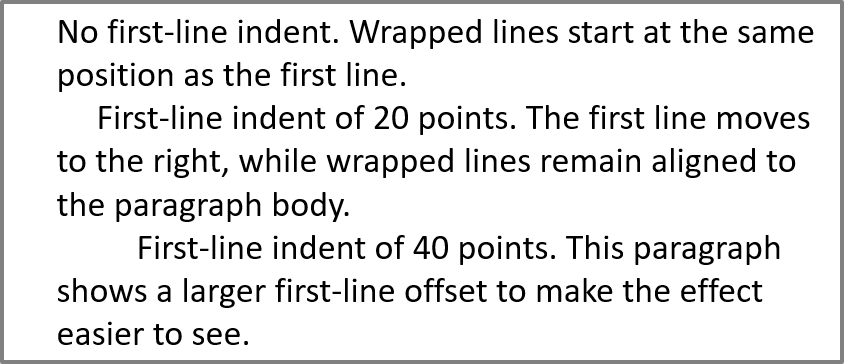
Utilisez ParagraphFormat.setIndent pour contrôler le retrait de première ligne d’un paragraphe. Cette méthode ne déplace que la première ligne par rapport à la marge gauche du paragraphe. Une valeur positive décale la première ligne vers la droite, tandis que les lignes restantes restent alignées sur le corps du paragraphe.
Utilisez ParagraphFormat.setMarginLeft lorsque vous devez déplacer tout le paragraphe. Utilisez ParagraphFormat.setIndent lorsque vous devez déplacer uniquement la première ligne.
L’exemple ci‑dessous crée plusieurs paragraphes et applique différentes valeurs ParagraphFormat.setIndent pour démontrer comment le retrait de première ligne influence la mise en page du paragraphe.
- Créez une instance de la classe Presentation.
- Accédez à la diapositive cible.
- Ajoutez une AutoShape rectangulaire à la diapositive.
- Accédez au TextFrame de la forme et supprimez le paragraphe par défaut.
- Créez plusieurs paragraphes et définissez différentes valeurs ParagraphFormat.setIndent pour chacun.
- Ajoutez les paragraphes au cadre de texte.
- Enregistrez la présentation modifiée.
Ce code montre comment définir un retrait de paragraphe :
import jpype
import asposeslides

if not jpype.isJVMStarted():
    jpype.startJVM()

from asposeslides.api import FillType, Paragraph, Presentation, SaveFormat, ShapeType, TextAutofitType
from java.awt import Color

presentation = Presentation()
try:
    slide = presentation.getSlides().get_Item(0)
    shape = slide.getShapes().addAutoShape(ShapeType.Rectangle, 50, 50, 420, 220)
    shape.getFillFormat().setFillType(FillType.NoFill)
    shape.getLineFormat().getFillFormat().setFillType(FillType.Solid)
    shape.getLineFormat().getFillFormat().getSolidFillColor().setColor(Color.GRAY)
    text_frame = shape.getTextFrame()
    text_frame.getTextFrameFormat().setAutofitType(TextAutofitType.Shape)
    text_frame.getParagraphs().clear()
    first_paragraph = Paragraph()
    first_paragraph.setText("No first-line indent. Wrapped lines start at the same position as the first line.")
    first_paragraph.getParagraphFormat().getDefaultPortionFormat().getFillFormat().setFillType(FillType.Solid)
    first_paragraph.getParagraphFormat().getDefaultPortionFormat().getFillFormat().getSolidFillColor().setColor(Color.BLACK)
    first_paragraph.getParagraphFormat().setMarginLeft(20.0)
    first_paragraph.getParagraphFormat().setIndent(0.0)
    second_paragraph = Paragraph()
    second_paragraph.setText("First-line indent of 20 points. The first line moves to the right, while wrapped lines remain aligned to the paragraph body.")
    second_paragraph.getParagraphFormat().getDefaultPortionFormat().getFillFormat().setFillType(FillType.Solid)
    second_paragraph.getParagraphFormat().getDefaultPortionFormat().getFillFormat().getSolidFillColor().setColor(Color.BLACK)
    second_paragraph.getParagraphFormat().setMarginLeft(20.0)
    second_paragraph.getParagraphFormat().setIndent(20.0)
    third_paragraph = Paragraph()
    third_paragraph.setText("First-line indent of 40 points. This paragraph shows a larger first-line offset to make the effect easier to see.")
    third_paragraph.getParagraphFormat().getDefaultPortionFormat().getFillFormat().setFillType(FillType.Solid)
    third_paragraph.getParagraphFormat().getDefaultPortionFormat().getFillFormat().getSolidFillColor().setColor(Color.BLACK)
    third_paragraph.getParagraphFormat().setMarginLeft(20.0)
    third_paragraph.getParagraphFormat().setIndent(40.0)
    text_frame.getParagraphs().add(first_paragraph)
    text_frame.getParagraphs().add(second_paragraph)
    text_frame.getParagraphs().add(third_paragraph)
    presentation.save("paragraph_indent.pptx", SaveFormat.Pptx)
finally:
    presentation.dispose()
Le résultat :
Définir un retrait suspendu
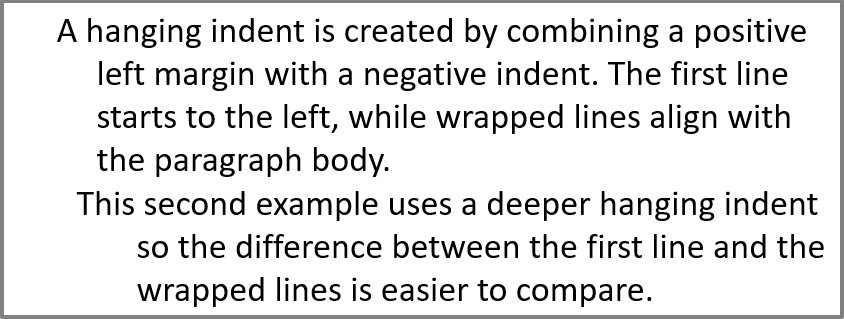
Un retrait suspendu est une mise en page de paragraphe dans laquelle la première ligne commence à gauche des lignes restantes. Dans Aspose.Slides, vous créez cet effet avec ParagraphFormat.setIndent. Passez une valeur négative pour déplacer la première ligne vers la gauche par rapport au corps du paragraphe.
En pratique, ParagraphFormat.setMarginLeft définit la position gauche du corps du paragraphe, et ParagraphFormat.setIndent définit la position de la première ligne par rapport à cette marge. Pour créer un retrait suspendu, passez une valeur positive à ParagraphFormat.setMarginLeft et une valeur négative à ParagraphFormat.setIndent.
Ce formatage est utile pour les bibliographies, références, entrées de glossaire et autres paragraphes où les lignes renvoyées doivent s’aligner sous le corps du paragraphe plutôt que sous le premier caractère de la première ligne.
- Créez une instance de la classe Presentation.
- Accédez à la diapositive cible.
- Ajoutez une AutoShape rectangulaire à la diapositive.
- Accédez au TextFrame de la forme et supprimez le paragraphe par défaut.
- Créez des paragraphes et passez une valeur positive à ParagraphFormat.setMarginLeft pour chaque paragraphe.
- Passez une valeur négative à ParagraphFormat.setIndent pour créer l’effet de retrait suspendu.
- Ajoutez les paragraphes au cadre de texte.
- Enregistrez la présentation modifiée.
Ce code montre comment définir un retrait suspendu pour un paragraphe :
import jpype
import asposeslides

if not jpype.isJVMStarted():
    jpype.startJVM()

from asposeslides.api import FillType, Paragraph, Presentation, SaveFormat, ShapeType, TextAutofitType
from java.awt import Color

presentation = Presentation()
try:
    slide = presentation.getSlides().get_Item(0)
    shape = slide.getShapes().addAutoShape(ShapeType.Rectangle, 50, 50, 420, 220)
    shape.getFillFormat().setFillType(FillType.NoFill)
    shape.getLineFormat().getFillFormat().setFillType(FillType.Solid)
    shape.getLineFormat().getFillFormat().getSolidFillColor().setColor(Color.GRAY)
    text_frame = shape.getTextFrame()
    text_frame.getTextFrameFormat().setAutofitType(TextAutofitType.Shape)
    text_frame.getParagraphs().clear()
    first_paragraph = Paragraph()
    first_paragraph.setText("A hanging indent is created by combining a positive left margin with a negative indent. The first line starts to the left, while wrapped lines align with the paragraph body.")
    first_paragraph.getParagraphFormat().getDefaultPortionFormat().getFillFormat().setFillType(FillType.Solid)
    first_paragraph.getParagraphFormat().getDefaultPortionFormat().getFillFormat().getSolidFillColor().setColor(Color.BLACK)
    first_paragraph.getParagraphFormat().setMarginLeft(40.0)
    first_paragraph.getParagraphFormat().setIndent(-20.0)
    second_paragraph = Paragraph()
    second_paragraph.setText("This second example uses a deeper hanging indent so the difference between the first line and the wrapped lines is easier to compare.")
    second_paragraph.getParagraphFormat().getDefaultPortionFormat().getFillFormat().setFillType(FillType.Solid)
    second_paragraph.getParagraphFormat().getDefaultPortionFormat().getFillFormat().getSolidFillColor().setColor(Color.BLACK)
    second_paragraph.getParagraphFormat().setMarginLeft(60.0)
    second_paragraph.getParagraphFormat().setIndent(-30.0)
    text_frame.getParagraphs().add(first_paragraph)
    text_frame.getParagraphs().add(second_paragraph)
    presentation.save("hanging_indent.pptx", SaveFormat.Pptx)
finally:
    presentation.dispose()
Le résultat :
Définir les propriétés de fin de paragraphe
Paragraph.setEndParagraphPortionFormat contrôle le formatage du signe de fin de paragraphe. L’exemple suivant attribue une taille de police et une police latine au signe de fin du deuxième paragraphe :
- Chargez une Presentation et accédez à une diapositive.
- Ajoutez une AutoShape et supprimez son paragraphe par défaut.
- Créez deux paragraphes et ajoutez‑leur des portions de texte.
- Créez un PortionFormat pour le signe de fin du deuxième paragraphe.
- Définissez BasePortionFormat.setFontHeight et BasePortionFormat.setLatinFont.
- Assignez le format avec Paragraph.setEndParagraphPortionFormat et enregistrez la présentation.
import jpype
import asposeslides

if not jpype.isJVMStarted():
    jpype.startJVM()

from asposeslides.api import FontData, Paragraph, Portion, PortionFormat, Presentation, SaveFormat, ShapeType

presentation = Presentation("Test.pptx")
try:
    slide = presentation.getSlides().get_Item(0)
    shape = slide.getShapes().addAutoShape(ShapeType.Rectangle, 10, 10, 200, 250)
    text_frame = shape.getTextFrame()
    text_frame.getParagraphs().clear()
    first_paragraph = Paragraph()
    first_portion = Portion("Sample text")
    first_paragraph.getPortions().add(first_portion)
    second_paragraph = Paragraph()
    second_portion = Portion("Sample text 2")
    second_paragraph.getPortions().add(second_portion)
    end_paragraph_format = PortionFormat()
    end_paragraph_format.setFontHeight(48)
    latin_font = FontData("Times New Roman")
    end_paragraph_format.setLatinFont(latin_font)
    second_paragraph.setEndParagraphPortionFormat(end_paragraph_format)
    text_frame.getParagraphs().add(first_paragraph)
    text_frame.getParagraphs().add(second_paragraph)
    presentation.save("end_paragraph_format.pptx", SaveFormat.Pptx)
finally:
    presentation.dispose()
Compter les lignes rendues
Pour les règles de paragraphe qui affectent le retour à la ligne automatique et la ponctuation en fin de ligne, voir Control Line Breaking et Control Hanging Punctuation.
Utilisez Paragraph.getLinesCount pour compter les lignes occupées par un paragraphe après la mise en page du texte, y compris le retour à la ligne automatique. Ceci est utile lors de la vérification de la longueur du texte et de la mise en page dans des modèles de présentation.
Un paragraphe est un élément de TextFrame.getParagraphs et peut occuper plusieurs lignes rendues. Un saut de ligne explicite à l’intérieur d’un paragraphe force une nouvelle ligne sans créer un autre paragraphe. Le retour à la ligne automatique crée des lignes en fonction de la largeur disponible sans insérer de sauts de ligne explicites dans le texte. Ainsi, compter les paragraphes ou les caractères de saut de ligne ne donne pas le nombre de lignes réellement rendues.
L’exemple suivant crée une forme de texte, compte ses lignes, réduit la largeur de la forme, puis remplace le texte par une chaîne plus courte. Le retour à la ligne est activé et l’ajustement automatique est désactivé afin que la largeur de la forme contrôle le retour à la ligne sans réduire automatiquement le texte ni redimensionner la forme. Les dimensions de la forme sont exprimées en points. Enfin, l’exemple ajoute un autre paragraphe et additionne les comptes de lignes de l’ensemble du cadre de texte.
import jpype
import asposeslides

if not jpype.isJVMStarted():
    jpype.startJVM()

from asposeslides.api import NullableBool, Paragraph, Presentation, ShapeType, TextAutofitType

presentation = Presentation()
try:
    slide = presentation.getSlides().get_Item(0)

    shape = slide.getShapes().addAutoShape(ShapeType.Rectangle, 50, 50, 400, 200)
    text_frame = shape.getTextFrame()
    text_frame.getTextFrameFormat().setWrapText(NullableBool.True_)
    text_frame.getTextFrameFormat().setAutofitType(TextAutofitType.None_)

    paragraph = text_frame.getParagraphs().get_Item(0)
    paragraph.getParagraphFormat().getDefaultPortionFormat().setFontHeight(20)
    paragraph.setText("This text demonstrates how automatic wrapping changes the number of rendered lines.")
    print("Original width:", paragraph.getLinesCount())

    shape.setWidth(150)
    print("Narrower shape:", paragraph.getLinesCount())

    paragraph.setText("Short text.")
    print("Shorter text:", paragraph.getLinesCount())

    second_paragraph = Paragraph()
    second_paragraph.setText("Another paragraph.")
    second_paragraph.getParagraphFormat().getDefaultPortionFormat().setFontHeight(20)
    text_frame.getParagraphs().add(second_paragraph)

    total_line_count = 0
    for current_paragraph in text_frame.getParagraphs():
        total_line_count += current_paragraph.getLinesCount()
    print("Total lines in the text frame:", total_line_count)
finally:
    presentation.dispose()
Avec ce texte et ces dimensions, réduire la forme augmente le nombre de lignes, tandis que remplacer le texte par la courte chaîne le diminue. Les comptes exacts peuvent varier selon la disponibilité et la substitution des polices, la taille de la police, les marges, les retraits, le retour à la ligne et les paramètres d’ajustement automatique. Utilisez les polices et les paramètres de mise en page prévus pour l’environnement cible lors de la vérification d’un modèle.
Le simple nombre de lignes ne détermine pas si le texte dépasse son conteneur. La hauteur disponible, la hauteur des lignes, les espacements entre paragraphes et lignes, ainsi que le comportement d’ajustement automatique sont également importants ; même une seule ligne peut dépasser la largeur disponible lorsqu’un retour à la ligne est désactivé.
Importer et exporter le contenu des paragraphes
Importer du texte HTML dans des paragraphes
Utilisez ParagraphCollection.addFromHtml pour convertir le balisage HTML en paragraphes et portions dans une zone de texte.
- Créez une instance de la classe Presentation.
- Accédez à une diapositive et ajoutez une AutoShape.
- Accédez au TextFrame de la forme et supprimez le paragraphe par défaut.
- Lisez le fichier HTML source.
- Transmettez la chaîne HTML à ParagraphCollection.addFromHtml.
- Enregistrez la présentation modifiée.
Cet exemple Python importe du HTML dans un cadre de texte :
import jpype
import asposeslides

if not jpype.isJVMStarted():
    jpype.startJVM()

from asposeslides.api import FillType, Presentation, SaveFormat, ShapeType
from pathlib import Path

presentation = Presentation()
try:
    slide = presentation.getSlides().get_Item(0)
    shape_width = presentation.getSlideSize().getSize().getWidth() - 20
    shape_height = presentation.getSlideSize().getSize().getHeight() - 20
    shape = slide.getShapes().addAutoShape(ShapeType.Rectangle, 10, 10, shape_width, shape_height)
    shape.getFillFormat().setFillType(FillType.NoFill)
    shape.getTextFrame().getParagraphs().clear()
    try:
        html = Path("file.html").read_text(encoding="utf-8")
        shape.getTextFrame().getParagraphs().addFromHtml(html)
        presentation.save("html_text.pptx", SaveFormat.Pptx)
    except OSError as exception:
        print("The HTML file could not be read: " + str(exception))
finally:
    presentation.dispose()
Exporter le texte du paragraphe en HTML
Utilisez ParagraphCollection.exportToHtml pour exporter une plage sélectionnée de paragraphes au format HTML.
- Créez une instance de la classe Presentation et chargez la présentation souhaitée.
- Accédez à la diapositive et localisez l’AutoShape contenant le texte.
- Accédez au TextFrame de la forme.
- Appelez ParagraphCollection.exportToHtml avec l’indice du paragraphe de départ et le nombre de paragraphes à exporter.
- Écrivez la chaîne HTML retournée dans un fichier.
Cet exemple Python exporte tous les paragraphes du premier cadre de texte :
import jpype
import asposeslides

if not jpype.isJVMStarted():
    jpype.startJVM()

from asposeslides.api import AutoShape, Presentation
from pathlib import Path

presentation = Presentation("ExportingHTMLText.pptx")
try:
    shape = presentation.getSlides().get_Item(0).getShapes().get_Item(0)
    if isinstance(shape, AutoShape):
        text_shape = shape
        text_frame = text_shape.getTextFrame()
        if text_frame is not None:
            paragraphs = text_frame.getParagraphs()
            html = paragraphs.exportToHtml(0, paragraphs.getCount(), None)
            try:
                Path("paragraphs.html").write_text(str(html), encoding="utf-8")
            except OSError as exception:
                print("The HTML file could not be written: " + str(exception))
        else:
            print("The first shape does not contain a text frame.")
    else:
        print("The first shape is not a text shape.")
finally:
    presentation.dispose()
Rendre un paragraphe sous forme d’image
Paragraph.getImage rend directement un paragraphe individuel et renvoie un objet image. Enregistrez le résultat dans un fichier ou un flux avec sa méthode save. Vous n’avez pas besoin de rendre la forme contenant le texte ni de recadrer manuellement un bitmap.
Paragraph.getImage peut renvoyer None si le paragraphe est introuvable dans sa collection parente, s’il n’a pas de limites de rendu valides ou s’il ne peut pas être rendu. Vérifiez le résultat avant de l’enregistrer et libérez l’image retournée après utilisation.
Rendre un paragraphe à l’échelle par défaut
Supposons que nous disposions d’un fichier de présentation nommé sample.pptx contenant une diapositive, où la première forme est une zone de texte contenant trois paragraphes.
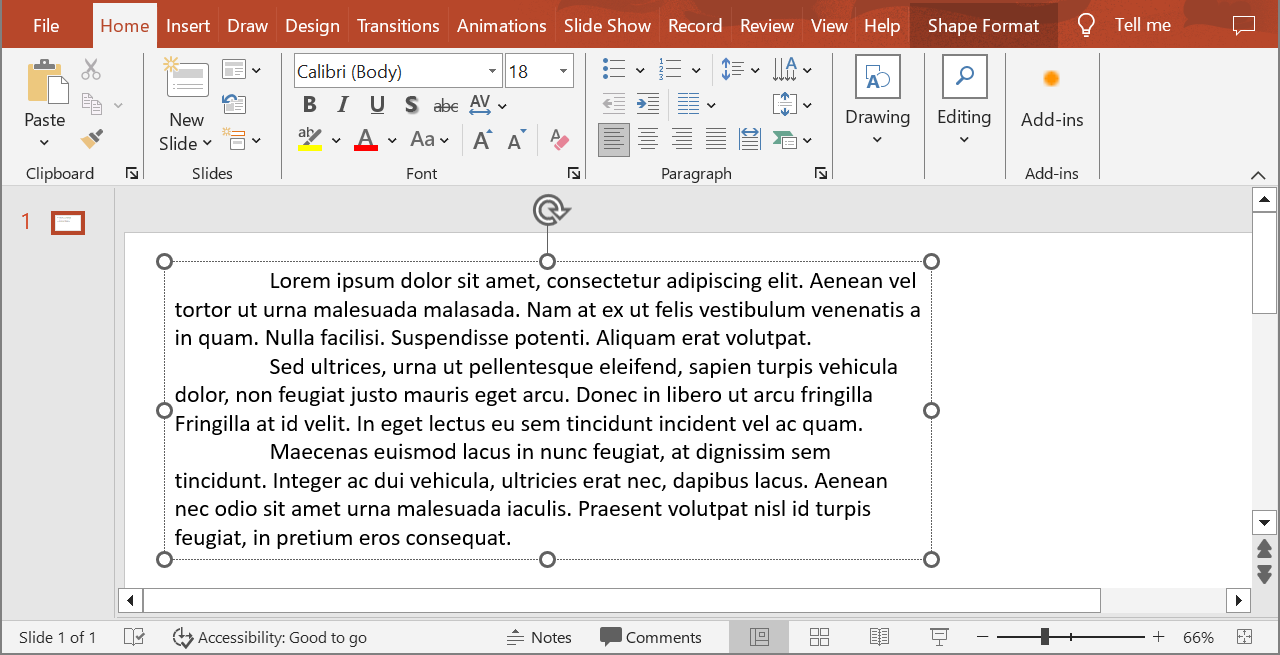
L’exemple suivant rend le second paragraphe dans une forme de texte ordinaire à l’échelle par défaut et enregistre l’image retournée au format PNG. Le bloc finally garantit que l’image est correctement libérée.
import jpype
import asposeslides

if not jpype.isJVMStarted():
    jpype.startJVM()

from asposeslides.api import AutoShape, ImageFormat, Presentation

presentation = Presentation("sample.pptx")
try:
    shape = presentation.getSlides().get_Item(0).getShapes().get_Item(0)
    if isinstance(shape, AutoShape):
        text_shape = shape
        text_frame = text_shape.getTextFrame()
        if text_frame is not None and text_frame.getParagraphs().getCount() > 1:
            paragraph = text_frame.getParagraphs().get_Item(1)
            paragraph_image = paragraph.getImage()
            if paragraph_image is not None:
                try:
                    paragraph_image.save("paragraph.png", ImageFormat.Png)
                finally:
                    paragraph_image.dispose()
            else:
                print("The paragraph could not be rendered.")
        else:
            print("The expected paragraph was not found.")
    else:
        print("The first shape is not a text shape.")
finally:
    presentation.dispose()
Le résultat :

Rendre un paragraphe dans une cellule de tableau avec mise à l’échelle
Utilisez la surcharge de Paragraph.getImage qui accepte les paramètres scale_x et scale_y pour définir les facteurs d’échelle horizontaux et verticaux. L’exemple suivant crée un tableau, rend le paragraphe dans sa première cellule à deux fois sa largeur et hauteur par défaut, puis enregistre le résultat au format PNG.
import jpype
import asposeslides

if not jpype.isJVMStarted():
    jpype.startJVM()

from asposeslides.api import ImageFormat, Presentation

scale_x = 2.0
scale_y = 2.0
presentation = Presentation()
try:
    slide = presentation.getSlides().get_Item(0)
    table = slide.getShapes().addTable(50, 50, [300.0], [80.0])
    paragraph = table.get_Item(0, 0).getTextFrame().getParagraphs().get_Item(0)
    paragraph.setText("Text in a table cell")
    paragraph_image = paragraph.getImage(scale_x, scale_y)
    if paragraph_image is not None:
        try:
            paragraph_image.save("table_paragraph.png", ImageFormat.Png)
        finally:
            paragraph_image.dispose()
    else:
        print("The paragraph could not be rendered.")
finally:
    presentation.dispose()
Un facteur d’échelle de 1 conserve cette dimension à sa taille de pixel par défaut. Par exemple, 2 pour les deux facteurs produit une image dont la largeur et la hauteur sont approximativement le double des dimensions par défaut, ce qui donne quatre fois plus de pixels. Des facteurs plus élevés produisent généralement un texte plus net pour le zoom ou la sortie haute résolution, mais augmentent également l’utilisation de mémoire et la taille du fichier. Des facteurs inférieurs à 1 produisent des images plus petites avec moins de détails. Utilisez des facteurs égaux pour préserver le ratio d’aspect du paragraphe ; des facteurs horizontaux et verticaux différents étirent la sortie indépendamment.
Rendre une forme entière avec Shape.getImage reste utile lorsque la sortie doit inclure le remplissage, la bordure ou tout autre contexte visuel de la forme. Pour une image contenant uniquement le paragraphe, utilisez Paragraph.getImage.
FAQ
Puis‑je désactiver complètement le retour à la ligne dans une zone de texte ?
Oui. Réglez TextFrameFormat.setWrapText pour désactiver le retour à la ligne afin que les lignes ne se coupent pas aux bords de la zone de texte.
Comment obtenir les limites exactes d’un paragraphe spécifique sur la diapositive ?
Utilisez Paragraph.getRect pour récupérer le rectangle englobant du paragraphe. Portion.getRect fournit les limites d’une portion individuelle.
Où l’alignement du paragraphe (gauche, droite, centre ou justifié) est‑il contrôlé ?
ParagraphFormat.setAlignment est un paramètre au niveau du paragraphe et s’applique à tout le paragraphe, quel que soit le formatage des portions individuelles.
Pour aligner verticalement des portions de tailles de police différentes au sein de chaque ligne, voir Aligner les polices dans une ligne.
Puis‑je définir la langue de correction pour une partie d’un paragraphe ?
Oui. Réglez BasePortionFormat.setLanguageId pour les portions individuelles, de sorte qu’un paragraphe puisse contenir du texte dans plusieurs langues.